1912 United States presidential election in North Dakota
 | |||||||||||||||||||||||||||||||||||||||||||||||||||||||
November 5, 1912
| |||||||||||||||||||||||||||||||||||||||||||||||||||||||
| |||||||||||||||||||||||||||||||||||||||||||||||||||||||
 County results
| |||||||||||||||||||||||||||||||||||||||||||||||||||||||
| |||||||||||||||||||||||||||||||||||||||||||||||||||||||
.jpg)
| Elections in North Dakota |
|---|
 |
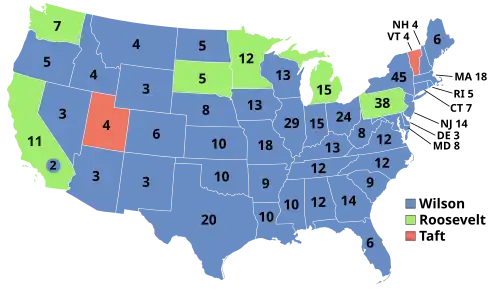
The 1912 United States presidential election in North Dakota took place on November 5, 1912, as part of the 1912 United States presidential election. Voters chose five representatives, or electors, to the Electoral College, who voted for president and vice president.
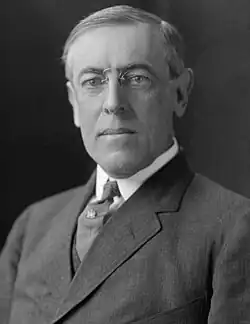
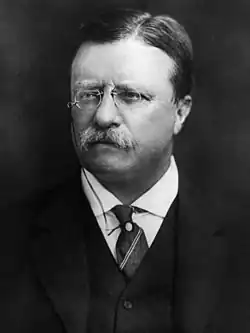
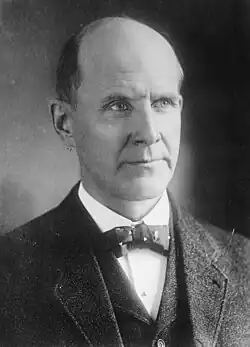
North Dakota was won by Princeton University President Woodrow Wilson (D–Virginia), running with governor of Indiana Thomas R. Marshall, with 34.14% of the popular vote, against the 26th president of the United States Theodore Roosevelt (P–New York), running with governor of California Hiram Johnson, with 29.71% of the popular vote, the 27th president of the United States William Howard Taft (R–Ohio), running with Columbia University President Nicholas Murray Butler, with 26.67% of the popular vote and the five-time candidate of the Socialist Party of America for President of the United States Eugene V. Debs (S–Indiana), running with the first Socialist mayor of a major city in the United States, Emil Seidel, with 8.05 percent of the popular vote.[1]
As a result of his win in the state, Wilson became the first Democratic presidential candidate to outright carry North Dakota, although Grover Cleveland did receive an electoral vote under a fusion ticket run in the state's first presidential election two decades earlier. He would later win the state again four years later. This election marks the last time four different candidates won at least one county within one individual state. This feat would be shared by Kansas in the same election; however, the only other occurrences in presidential election history have been in Missouri in 1860, and in Illinois and Virginia in 1824.
Primary elections
The first state-wide presidential preference primaries were held in North Dakota on March 19, 1912. Under North Dakota law, a candidate could be placed on a party's primary ballot by petition. A candidate needed the signatures of 5% of registered party members in each congressional district. Three days were allowed to object to signatures.[2] Only John Burke appeared on the Democratic Party ballot. The Republican Party ballot included William Howard Taft, Theodore Roosevelt, and Robert M. La Follette.[3]
Democratic Party
| |||||||||||||||||||
March 19, 1912
| |||||||||||||||||||
| |||||||||||||||||||
 County Results
Burke: 100% | |||||||||||||||||||

A primary for the Democratic presidential candidate was held in North Dakota on March 19, 1912. Only John Burke appeared on the ballot for the Democratic primary, allowing him to receive all 9,357 votes.[3]
| Party | Candidate | Votes | % | |
|---|---|---|---|---|
| Democratic | John Burke | 9,357 | 100% | |
| Total votes | 9,357 | 100% | ||
Republican Party
| |||||||||||||||||||
March 19, 1912
| |||||||||||||||||||
| |||||||||||||||||||
 Election results by county
| |||||||||||||||||||

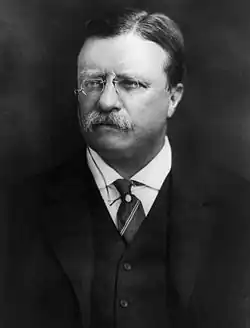
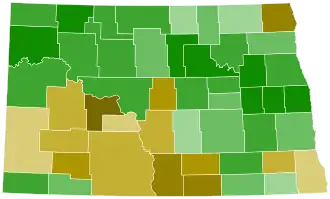
A primary for the Republican presidential candidate was held in North Dakota on March 19, 1912.[3] The state's progressive organization, led by Senator Asle Gronna, had committed to La Follette in 1911, while the conservative faction of the party under L. B. Hanna supported Roosevelt.[4] La Follette committees had been active for months in nearly every precinct, whereas Roosevelt organizers were slow to establish a presence in the state. John F. Bass, brother of New Hampshire governor Robert P. Bass, was sent to manage Roosevelt's campaign in the state, which displeased some of his supporters who viewed Bass as an outsider.[5]
La Follette won the primary with 34,123 votes to Roosevelt's 23,669 and Taft's 1,876,[3] bounding all 10 delegates to vote for him in the convention.[6] Following Roosevelt's defeat, Bass claimed that "our reports indicate that practically all the Democrats have voted for La Fol-lette. If the Democrats had stayed out of the Republican primary there is no question that Roosevelt would have won."[5]
According to an analysis of some of the early returns by The New York Times, La Follette received approximately 80 percent of the Norwegian vote in the six big valley counties and drew strong support in the communities where he had spoken during the week before the primary.[5]
| Party | Candidate | Votes | % | |
|---|---|---|---|---|
| Republican | Robert M. La Follette | 34,123 | 57.19% | |
| Republican | Theodore Roosevelt | 23,669 | 39.67% | |
| Republican | William Howard Taft | 1,876 | 3.14% | |
| Total votes | 59,668 | 100% | ||
Results
| Party | Candidate | Votes | % | |
|---|---|---|---|---|
| Democratic | Woodrow Wilson | 29,555 | 34.14% | |
| Progressive | Theodore Roosevelt | 25,726 | 29.71% | |
| Republican | William Howard Taft (incumbent) | 23,090 | 26.67% | |
| Socialist | Eugene V. Debs | 6,966 | 8.05% | |
| Prohibition | Eugene W. Chafin | 1,243 | 1.44% | |
| Total votes | 86,580 | 100% | ||
Results by county
| County | Woodrow Wilson[7] Democratic |
William Howard Taft[7] Republican |
Theodore Roosevelt[7] Progressive "Bull Moose" |
Eugene V. Debs[8] Socialist |
Eugene W. Chafin[8] Prohibition |
Total votes cast | |||||
|---|---|---|---|---|---|---|---|---|---|---|---|
| # | % | # | % | # | % | # | % | # | % | ||
| Adams | 249 | 29.33% | 205 | 24.15% | 305 | 35.92% | 63 | 7.42% | 27 | 3.18% | 849 |
| Barnes | 940 | 40.76% | 570 | 24.72% | 655 | 28.40% | 93 | 4.03% | 48 | 2.08% | 2,306 |
| Benson | 594 | 30.14% | 515 | 26.13% | 716 | 36.33% | 98 | 4.97% | 48 | 2.44% | 1,971 |
| Billings | 547 | 28.80% | 671 | 35.33% | 495 | 26.07% | 161 | 8.48% | 25 | 1.32% | 1,899 |
| Bottineau | 825 | 31.76% | 700 | 26.94% | 625 | 24.06% | 401 | 15.43% | 47 | 1.81% | 2,598 |
| Bowman | 361 | 34.88% | 302 | 29.18% | 258 | 24.93% | 99 | 9.57% | 15 | 1.45% | 1,035 |
| Burke | 308 | 27.50% | 264 | 23.57% | 207 | 18.48% | 320 | 28.57% | 21 | 1.88% | 1,120 |
| Burleigh | 609 | 30.62% | 720 | 36.20% | 552 | 27.75% | 92 | 4.63% | 16 | 0.80% | 1,989 |
| Cass | 1,814 | 36.14% | 1,316 | 26.22% | 1,669 | 33.25% | 164 | 3.27% | 56 | 1.12% | 5,019 |
| Cavalier | 932 | 39.98% | 561 | 24.07% | 746 | 32.00% | 69 | 2.96% | 23 | 0.99% | 2,331 |
| Dickey | 723 | 43.77% | 494 | 29.90% | 354 | 21.43% | 69 | 4.18% | 12 | 0.73% | 1,652 |
| Divide | 375 | 26.54% | 404 | 28.59% | 459 | 32.48% | 160 | 11.32% | 15 | 1.06% | 1,413 |
| Dunn | 246 | 27.95% | 285 | 32.39% | 297 | 33.75% | 47 | 5.34% | 5 | 0.57% | 880 |
| Eddy | 376 | 41.32% | 199 | 21.87% | 290 | 31.87% | 34 | 3.74% | 11 | 1.21% | 910 |
| Emmons | 524 | 38.90% | 410 | 30.44% | 374 | 27.77% | 24 | 1.78% | 15 | 1.11% | 1,347 |
| Foster | 403 | 42.38% | 285 | 29.97% | 232 | 24.40% | 20 | 2.10% | 11 | 1.16% | 951 |
| Grand Forks | 1,492 | 37.31% | 955 | 23.88% | 1,327 | 33.18% | 180 | 4.50% | 45 | 1.13% | 3,999 |
| Griggs | 434 | 43.62% | 144 | 14.47% | 314 | 31.56% | 65 | 6.53% | 38 | 3.82% | 995 |
| Hettinger | 381 | 32.51% | 442 | 37.71% | 288 | 24.57% | 47 | 4.01% | 14 | 1.19% | 1,172 |
| Kidder | 218 | 26.14% | 322 | 38.61% | 210 | 25.18% | 65 | 7.79% | 19 | 2.28% | 834 |
| LaMoure | 588 | 38.61% | 436 | 28.63% | 419 | 27.51% | 65 | 4.27% | 15 | 0.98% | 1,523 |
| Logan | 146 | 21.66% | 269 | 39.91% | 225 | 33.38% | 30 | 4.45% | 4 | 0.59% | 674 |
| McHenry | 959 | 38.44% | 589 | 23.61% | 672 | 26.93% | 246 | 9.86% | 29 | 1.16% | 2,495 |
| McIntosh | 125 | 12.98% | 202 | 20.98% | 607 | 63.03% | 25 | 2.60% | 4 | 0.42% | 963 |
| McKenzie | 293 | 28.31% | 285 | 27.54% | 228 | 22.03% | 219 | 21.16% | 10 | 0.97% | 1,035 |
| McLean | 583 | 29.59% | 505 | 25.63% | 526 | 26.70% | 325 | 16.50% | 31 | 1.57% | 1,970 |
| Mercer | 142 | 19.27% | 147 | 19.95% | 389 | 52.78% | 53 | 7.19% | 6 | 0.81% | 737 |
| Morton | 1,017 | 28.11% | 1,011 | 27.94% | 1,262 | 34.88% | 284 | 7.85% | 44 | 1.22% | 3,618 |
| Mountrail | 307 | 21.16% | 407 | 28.05% | 347 | 23.91% | 372 | 25.64% | 18 | 1.24% | 1,451 |
| Nelson | 526 | 30.92% | 448 | 26.34% | 511 | 30.04% | 178 | 10.46% | 38 | 2.23% | 1,701 |
| Oliver | 139 | 24.05% | 131 | 22.66% | 178 | 30.80% | 116 | 20.07% | 14 | 2.42% | 578 |
| Pembina | 975 | 39.24% | 615 | 24.75% | 807 | 32.47% | 35 | 1.41% | 53 | 2.13% | 2,485 |
| Pierce | 453 | 38.42% | 264 | 22.39% | 276 | 23.41% | 159 | 13.49% | 27 | 2.29% | 1,179 |
| Ramsey | 917 | 39.94% | 739 | 32.19% | 472 | 20.56% | 150 | 6.53% | 18 | 0.78% | 2,296 |
| Ransom | 490 | 30.90% | 495 | 31.21% | 540 | 34.05% | 30 | 1.89% | 31 | 1.95% | 1,586 |
| Renville | 420 | 32.97% | 224 | 17.58% | 341 | 26.77% | 272 | 21.35% | 17 | 1.33% | 1,274 |
| Richland | 1,380 | 42.65% | 1,034 | 31.95% | 742 | 22.93% | 34 | 1.05% | 46 | 1.42% | 3,236 |
| Rolette | 396 | 31.23% | 339 | 26.74% | 322 | 25.39% | 184 | 14.51% | 27 | 2.13% | 1,268 |
| Sargent | 641 | 39.20% | 605 | 37.00% | 277 | 16.94% | 93 | 5.69% | 19 | 1.16% | 1,635 |
| Sheridan | 170 | 17.78% | 306 | 32.01% | 447 | 46.76% | 26 | 2.72% | 7 | 0.73% | 956 |
| Stark | 678 | 39.24% | 387 | 22.40% | 597 | 34.55% | 58 | 3.36% | 8 | 0.46% | 1,728 |
| Steele | 253 | 25.17% | 237 | 23.58% | 444 | 44.18% | 55 | 5.47% | 16 | 1.59% | 1,005 |
| Stutsman | 1,100 | 41.12% | 757 | 28.30% | 706 | 26.39% | 84 | 3.14% | 28 | 1.05% | 2,675 |
| Towner | 532 | 39.88% | 352 | 26.39% | 317 | 23.76% | 112 | 8.40% | 21 | 1.57% | 1,334 |
| Traill | 507 | 29.24% | 365 | 21.05% | 755 | 43.54% | 68 | 3.92% | 39 | 2.25% | 1,734 |
| Walsh | 1,206 | 41.85% | 586 | 20.33% | 868 | 30.12% | 185 | 6.42% | 37 | 1.28% | 2,882 |
| Ward | 1,071 | 30.58% | 686 | 19.59% | 1,065 | 30.41% | 613 | 17.50% | 67 | 1.91% | 3,502 |
| Wells | 494 | 32.72% | 356 | 23.58% | 611 | 40.46% | 36 | 2.38% | 13 | 0.86% | 1,510 |
| Williams | 696 | 30.53% | 549 | 24.08% | 402 | 17.63% | 588 | 25.79% | 45 | 1.97% | 2,280 |
| Totals | 29,555 | 34.14% | 23,090 | 26.67% | 25,726 | 29.71% | 6,966 | 8.05% | 1,243 | 1.44% | 86,580 |
See also
References
- ^ a b "1912 Presidential Election Results — North Dakota".
- ^ "ATTACKS ROOSEVELT". The New York Times. ISSN 0362-4331. Retrieved November 22, 2025.
- ^ a b c d e f "Election Results". Secretary of State | North Dakota. Retrieved November 22, 2025.
- ^ Mowry, George E. (1946). "Chapter Eight: Old Friends are Friends No Longer". Theodore Roosevelt and the Progressive Movement. New York: Hill and Wang. p. 231.
- ^ a b c "BEAT ROOSEVELT IN NORTH DAKOTA". The New York Times. ISSN 0362-4331. Retrieved November 22, 2025.
- ^ "LA FOLLETTE'S VOTE HEAVY". The New York Times. ISSN 0362-4331. Retrieved November 22, 2025.
- ^ a b c "1912 Presidential Election Popular Vote". Géoelections. (.xlsx file for €15)
- ^ a b "1912 Presidential Election Popular Vote for Eugene Debs". Géoelections. (.xlsx file for €15)