2001–02 FIS Ski Jumping World Cup – Zakopane
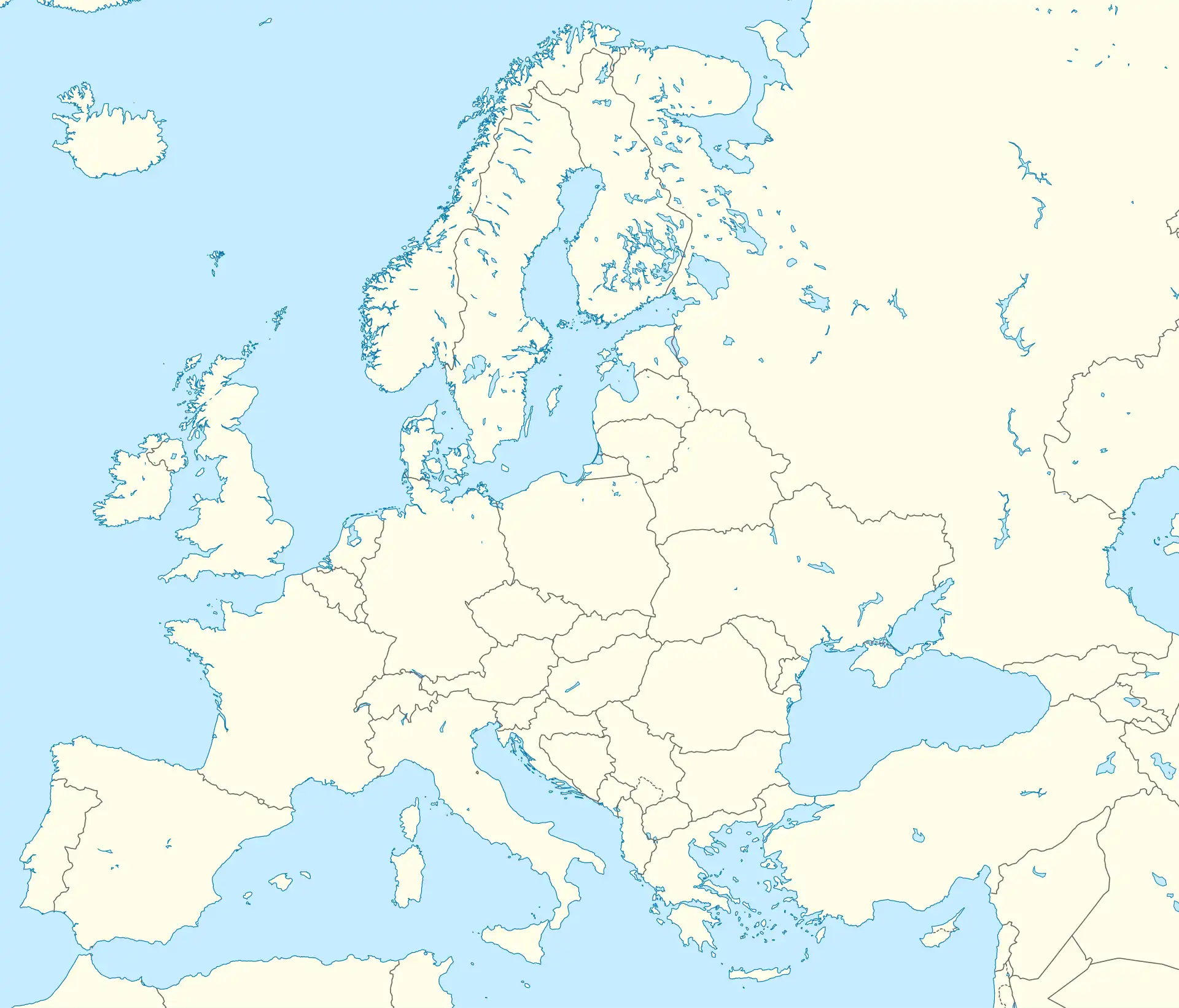
2001–02 FIS Ski Jumping World Cup – Zakopane was a series of ski jumping competitions held as part of the 2001–02 FIS Ski Jumping World Cup from 18 to 20 January 2002 at the Wielka Krokiew in Zakopane, Poland.
Two individual competitions were contested on the large hill, marking the seventh time Zakopane hosted World Cup ski jumping events. These were the 15th and 16th competitions of the 2001–02 World Cup season.
The first competition was won by Matti Hautamäki of Finland, while the second was won by Adam Małysz of Poland. Sven Hannawald of Germany finished second in both events. Third place went to Andreas Widhölzl of Austria in the first competition and Matti Hautamäki in the second.
This was the fifth time Zakopane hosted two individual large hill competitions as part of the Ski Jumping World Cup. In 1980, one competition was held on the normal hill and one on the large hill, while in 1990, a single large hill competition took place.
A total of 73 athletes from 16 nations participated,[1][2] with the oldest competitor being the Czech Republic's Jaroslav Sakala (32 years, 188 days) and the youngest being Belarus' Alexandr Svietlov (17 years, 285 days).
Pre-competition

Prior to the Zakopane events, 16 competitions had been held in the 2001–02 World Cup season, including 14 individual and two team events.[3] The overall World Cup leader was Adam Małysz of Poland with 1074 points, 175 points ahead of Sven Hannawald of Germany. Matti Hautamäki of Finland held third place with 611 points. In the Nations Cup, Germany led, followed by Austria and Finland.[4]
Previous World Cup events in the season saw victories by Adam Małysz and Sven Hannawald (six times each), Risto Jussilainen, and Stephan Hocke (once each).[3]
From 30 December 2001 to 6 January 2002, the 2001–02 Four Hills Tournament was held, with Sven Hannawald becoming the first skier to win all four competitions in a single edition.[5] Matti Hautamäki finished second, and Martin Höllwarth took third, while Adam Małysz, a pre-tournament favorite, placed fourth.[5][6]
The most recent competitions before Zakopane, held in Willingen, Germany, on 12–13 January, were won by Sven Hannawald (individual) and the Austrian team (team event). In the individual competition, Hannawald outperformed Matti Hautamäki and Veli-Matti Lindström of Finland.[7] In the team event, Austria defeated Finland and Germany.[8]
World Cup standings before Zakopane
| Rank | Athlete | Country | Points | Deficit to leader |
|---|---|---|---|---|
| 1 | Adam Małysz | Poland | 1074 | – |
| 2 | Sven Hannawald | Germany | 899 | 175 |
| 3 | Matti Hautamäki | Finland | 611 | 463 |
| 4 | Martin Höllwarth | Austria | 575 | 499 |
| 5 | Andreas Widhölzl | Austria | 505 | 569 |
| 6 | Stephan Hocke | Germany | 457 | 617 |
| 7 | Martin Schmitt | Germany | 444 | 630 |
| 8 | Simon Ammann | Switzerland | 402 | 672 |
| 9 | Andreas Goldberger | Austria | 360 | 714 |
| 10 | Risto Jussilainen | Finland | 342 | 732 |
| 11 | Kazuyoshi Funaki | Japan | 328 | 746 |
| 12 | Martin Koch | Austria | 259 | 815 |
| 12 | Roberto Cecon | Italy | 259 | 815 |
| 14 | Stefan Horngacher | Austria | 239 | 835 |
| 15 | Alan Alborn | United States | 203 | 871 |
| 16 | Veli-Matti Lindström | Finland | 200 | 874 |
| 17 | Peter Žonta | Slovenia | 185 | 889 |
| 18 | Hideharu Miyahira | Japan | 177 | 897 |
| 19 | Valery Kobelev | Russia | 176 | 898 |
| 20 | Jakub Janda | Czech Republic | 141 | 933 |
| 21 | Christof Duffner | Germany | 134 | 940 |
| 22 | Janne Ahonen | Finland | 133 | 941 |
| 22 | Jussi Hautamäki | Finland | 133 | 941 |
| 24 | Andreas Küttel | Switzerland | 126 | 948 |
| 25 | Toni Nieminen | Finland | 124 | 950 |
| 26 | Robert Kranjec | Slovenia | 121 | 953 |
| 27 | Noriaki Kasai | Japan | 109 | 965 |
| 28 | Georg Späth | Germany | 108 | 966 |
| 29 | Hiroki Yamada | Japan | 106 | 968 |
| 30 | Damjan Fras | Slovenia | 104 | 970 |
| 31 | Tami Kiuru | Finland | 87 | 987 |
| 32 | Michael Uhrmann | Germany | 84 | 990 |
| 33 | Primož Peterka | Slovenia | 83 | 991 |
| 34 | Roar Ljøkelsøy | Norway | 82 | 992 |
| 35 | Masahiko Harada | Japan | 73 | 1001 |
| 36 | Alexander Herr | Germany | 72 | 1002 |
| 37 | Ildar Fatkullin | Russia | 67 | 1007 |
| 38 | Tommy Ingebrigtsen | Norway | 66 | 1008 |
| 39 | Nicolas Dessum | France | 61 | 1013 |
| 40 | Clint Jones | United States | 51 | 1023 |
| 41 | Anders Bardal | Norway | 44 | 1030 |
| 42 | Kazuya Yoshioka | Japan | 43 | 1031 |
| 43 | Janne Happonen | Finland | 25 | 1049 |
| 44 | Wolfgang Loitzl | Austria | 24 | 1050 |
| 45 | Dirk Else | Germany | 23 | 1051 |
| 46 | Janne Ylijärvi | Finland | 21 | 1053 |
| 47 | Michal Doležal | Czech Republic | 20 | 1054 |
| 48 | Manuel Fettner | Austria | 19 | 1055 |
| 49 | Lassi Huuskonen | Finland | 15 | 1059 |
| 50 | Ville Kantee | Finland | 13 | 1061 |
| 51 | Robert Mateja | Poland | 9 | 1065 |
| 51 | Igor Medved | Slovenia | 9 | 1065 |
| 51 | Kristoffer Jåfs | Sweden | 9 | 1065 |
| 54 | Frank Löffler | Germany | 8 | 1066 |
| 54 | Tomasz Pochwała | Poland | 8 | 1066 |
| 56 | Tomisław Tajner | Poland | 7 | 1067 |
| 57 | Sylvain Freiholz | Switzerland | 6 | 1068 |
| 57 | Stanislav Filimonov | Kazakhstan | 6 | 1068 |
| 57 | Emmanuel Chedal | France | 6 | 1068 |
| 60 | Rok Benkovič | Slovenia | 5 | 1069 |
| 60 | Pekka Salminen | Finland | 5 | 1069 |
| 62 | Wojciech Skupień | Poland | 4 | 1070 |
| 63 | Jörg Ritzerfeld | Germany | 3 | 1071 |
| 64 | Rémi Santiago | France | 2 | 1072 |
| 65 | Hansjörg Jäkle | Germany | 1 | 1073 |
| 65 | Choi Heung-chul | South Korea | 1 | 1073 |
Event organization
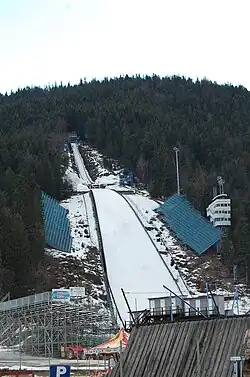
For the first time, the World Cup competitions were to be held on the modernized Wielka Krokiew. The ski jump was rebuilt ahead of the 2001 Winter Universiade. As part of the modernization, the construction point was moved from 116 to 120 meters, and the jury point from 128 to 134 meters.[9]
For each of the two competitions, the organizers prepared 40.000 tickets, half of which were available in presale. The ticket price for both competitions was 20 PLN, and for one competition – 15 PLN. The reduced-price ticket cost 5 PLN.[10]
Event schedule
The first official ski jumping training was scheduled for 18 January 2002, and the last event was the second World Cup competition held two days later. In total, two individual competitions were planned, as well as two qualification rounds, two official trainings, and one trial round.[10]
| Date | Time | Event[10] |
|---|---|---|
| 18 January 2002 | 11:00 AM | Official training on the K-120 hill (2 rounds) |
| 1:00 PM | Qualification round before the individual competition on the K-120 hill | |
| 19 January 2002 | 12:00 PM | Trial round before the individual competition on the K-120 hill |
| 1:45 PM | Start of the first round of the individual competition on the K-120 hill, followed by the second competition round | |
| 20 January 2002 | 12:00 PM | Qualification round before the individual competition on the K-120 hill |
| 1:45 PM | Start of the first round of the individual competition on the K-120 hill, followed by the second competition round |
Ski jumping hill
The 2002 World Cup ski jumping competitions in Zakopane were held at Wielka Krokiew, a ski jumping hill named after the skier Stanisław Marusarz, located on the northern slope of Krokiew mountain in the Western Tatras. Two individual competitions were conducted at the venue.[10] Wielka Krokiew has hosted World Cup competitions six times before – in 1980, 1990, 1996, 1998, and in January and December 1999.[11]
Jury
On behalf of the International Ski Federation, the competition director was Walter Hofer, with Miran Tepeš as his assistant. Additionally, the head of the competitions representing the World Cup organizers in Zakopane was the Pole Władysław Gąsienica Roj. The technical delegate during all the competitions was the Norwayn Torgeir Nordby, assisted by the Austrian Max Sandbichler.[1][2][12][13]
| Judge | Country | Judging tower position | ||||
|---|---|---|---|---|---|---|
| Qualification for first
individual competition (18 January 2002)[1] |
First individual
competition (19 January 2002)[12] |
Qualification for second
individual competition (20 January 2002)[2] |
Second
individual competition (20 January 2002)[13] | |||
| Bruno Bosin | Italy | E | E | A | A | |
| Kazimierz Długopolski | Poland | B | B | C | C | |
| Gerhard Krab | Austria | D | D | B | B | |
| Geir S. Løng | Norway | A | A | D | D | |
| Peter Schlank | Slovakia | C | C | E | E | |
Competition
Training rounds and qualifications for the first individual competition (18 January 2002)

The first of three training rounds began on Friday, 18 January at 11:00 AM.[10] Its winner was Adam Małysz, who achieved a distance of 125 meters in his attempt. Sven Hannawald landed one meter shorter. The third-best result was by Michael Uhrmann with 118 meters.[14]
In the second training, the longest jump was made by Sven Hannawald. The German representative landed at 132 meters. Adam Małysz jumped 3.5 meters shorter. Andreas Widhölzl was third with 125 meters.[14]
The qualification round for the first individual event started at 1:00 PM.[1] It ended with a win by Robert Kranjec. The Slovenian jumper reached 129.5 meters and was the best competitor among those fighting for a place in the first competition round. Andreas Widhölzl landed four meters shorter and took second place. Third was Norwayn Anders Bardal, who jumped 126 meters. Competitors already qualified for the competition started from the 14th and 13th start gates, while those fighting for a place in the competition jumped from the 14th gate.[1]
Despite being listed on the start list, Jussi Hautamäki, Ville Kantee, and Sven Hannawald – who had a guaranteed place in the competition due to holding second place in the World Cup standings – did not participate in the qualifications.[1]
69 out of 72 registered athletes from 16 countries took part in the qualifications.[1]
Trial round before the first individual competition (19 January 2002)
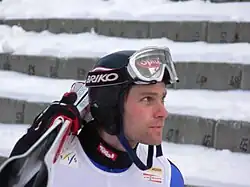
The trial round before the first individual competition began on 19 January at 12:00 PM. It ended with a victory by Martin Schmitt, who jumped 136 meters. This jump was half a meter longer than the Wielka Krokiew record, which was held by Stefan Kaiser and set in March 2001 during the Continental Cup competition.[15]
First individual competition (19 January 2002)
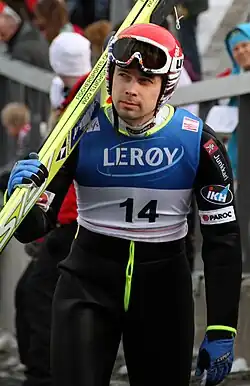
The first individual competition started on 19 January at 1:45 PM.[12] The event took place under variable wind conditions.[16]
The first to jump was Marcin Bachleda, who reached 99.5 meters. The Pole led until the jump of the third competitor, Łukasz Kruczek, who landed 10.5 meters further than his compatriot and became the new leader. The fifth jumper on the hill was Blaž Vrhovnik, who, thanks to a distance of 112 meters, was classified in first place. The Slovenian led the competition until Lars Bystøl's jump. The Norwayn, starting with number 15, reached 116 meters. The same result was achieved by Tomasz Pochwała, who, due to higher style points, overtook Bystøl by 0.5 points. Pochwała led until the jump of his compatriot, Robert Mateja (118.5 m). Dirk Else jumped 6.5 meters further than Mateja. The German became the new leader of the competition, with a 10.2 point lead over Mateja. Dirk Else could not be overtaken by Wolfgang Loitzl (121.5 m), Primož Peterka (117.5 m), Michael Uhrmann (117.5 m), Peter Žonta (121.5 m), and Stefan Horngacher (106.5 m).[17]
The first of the last 10 competitors in the first round was Martin Koch, who jumped 125 meters and became the leader of the competition with a 2-point advantage over Else. The next to jump was Risto Jussilainen, who landed at 114 meters. Andreas Goldberger jumped 88.5 meters and was classified in the last place. Another German competitor, Martin Schmitt, reached 122 meters and took third place in the competition. His compatriot, Stephan Hocke, landed at 112.5 meters and was ranked 25th after his attempt. Andreas Widhölzl flew 11.5 meters further and became the new leader of the competition. The Austrian was ahead of his compatriot Koch by 0.7 points. Martin Höllwarth jumped 120.5 meters. Three meters further landed Matti Hautamäki, who took third place in the competition. Sven Hannawald jumped 124 meters after him. The German overtook the Finn by 0.4 points and took third place. The World Cup leader Adam Małysz jumped 120.5 meters and was ranked seventh, 6.3 points behind the leader Andreas Widhölzl. Behind the Austrian, the next positions were held by Martin Koch and Sven Hannawald.[17]
The second round started with Christof Duffner, who jumped 119.5 meters. The lead changed after the next jumper, Stephan Hocke, who landed 4 meters further. The German led the competition until the attempt of Veli-Matti Lindström, who was 22nd after the first round (112 m). Hocke improved by 9 meters in the final round and took the lead by 6.1 points over Lindström. The lead changed again after Risto Jussilainen's jump. The Finn landed 2 meters further than Lindström and overtook him by 6.2 points. Jussilainen led the competition until the jump of Robert Mateja, 12th after the first round. The Pole landed at 120 meters. Mateja could not beat Toni Nieminen, who, after a 117-meter jump, lost to the Pole by 7.4 points. The leader from Zakopane was replaced by Robert Kranjec, 11th after the first round. The Slovenian jumped 121.5 meters. Martin Höllwarth, who opened the last 10 competitors, jumped 124.5 meters and took the lead. Next was Wolfgang Loitzl, who, with a jump of 116.5 meters, took fourth place. Peter Žonta, eighth after the first round, also landed at 116.5 meters and was fourth in the competition, tied with Loitzl. Adam Małysz landed 4.5 meters further than Žonta and was ranked second, 4.8 points behind Höllwarth. Martin Schmitt, who jumped next, reached 128.5 meters and took the lead. Dirk Else, who was fifth after the first jump, jumped 115 meters and dropped to eighth place at Wielka Krokiew. 16 meters further than Else was Matti Hautamäki, who became the new leader with an 11.7 point lead over Schmitt. Sven Hannawald, third after the first round, jumped 130 meters, placing second with a 0.4 point deficit to the leading Finn. Martin Koch jumped 10 meters less and took fifth place. The winner of the first round, Andreas Widhölzl, jumped 124.5 meters and took third place. Thus, the winner of the first World Cup competition in Zakopane was Matti Hautamäki. It was his second World Cup victory in his career and the first of the season. The next places on the podium went to Sven Hannawald and Andreas Widhölzl.[18]
51 competitors from 13 countries participated in the competition.[12]
Qualifications for the second individual competition (20 January 2002)
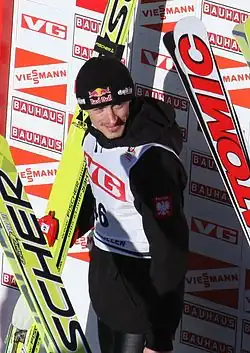
The qualification round for the second individual competition in Zakopane began on 20 January at 12:00 PM.[2] The winner was Christof Duffner. The German jumper reached a distance of 131.5 meters and was the best among those competing for a place in the main event. Robert Kranjec was ranked second, landing at 128 meters. The third-place qualifier, Martin Schmitt, reached a distance half a meter shorter. Competitors who were already guaranteed a spot in the competition started their attempts from the 9th start gate, while those fighting for qualification jumped from the 10th gate.[2]
69 athletes from 16 countries took part in the qualifications.[2]
Second individual competition (20 January 2002)
The second individual competition at Wielka Krokiew began on 20 January at 1:48 PM.[13] The event opened with Andrzej Galica, who jumped 106 meters. The Pole led until Grzegorz Śliwka jumped the same distance but received higher style points, taking the lead. Marcin Bachleda then improved the result with a jump of 114.5 meters. Igor Medved surpassed him by 1.5 meters and became the new leader. The Slovenian stayed in front until Tomasz Pochwała landed at 119.5 meters. Wolfgang Loitzl achieved the same distance but with higher style marks, overtaking Pochwała. The Austrian lost the lead to Anders Bardal, who exceeded the hill's construction point by half a meter. Tami Kiuru jumped one meter farther and took the lead by 0.8 points over Bardal. Stefan Horngacher landed at 124 meters but had lower style points and led Kiuru by only one point. His compatriot Martin Koch jumped 117 meters, finishing behind Horngacher by 2.5 meters but with better style, taking the lead. Andreas Goldberger jumped 2.5 meters closer but with better style, taking the lead. Risto Jussilainen jumped 117.5 meters and was eighth, while Stephan Hocke jumped 117 meters, placing 13th. Martin Schmitt overtook Goldberger with a 123-meter jump, beating the Austrian by 2.2 points. Andreas Widhölzl then jumped 125.5 meters, followed by Martin Höllwarth, who jumped three meters shorter. Matti Hautamäki, winner of Saturday's competition, jumped 128.5 meters and led by 4.4 points over Widhölzl. Sven Hannawald jumped 1.5 meters farther and took the lead. The last jumper in the first round, World Cup leader Adam Małysz, achieved the longest jump of the round at 131.5 meters and took the lead with a 1.3-point advantage over Hannawald. Matti Hautamäki was third.[19]
The second round started with 30th place after the first round, Christof Duffner, who jumped 108 meters but did not hold the lead for long as Peter Žonta followed with 114.5 meters. Žonta led until Blaž Vrhovnik jumped 115 meters. Robert Mateja, who was 25th after the first round, jumped 115.5 meters and surpassed Vrhovnik by 1.8 points. Martin Koch, 19th after the first round, jumped 129.5 meters in the second attempt, overtaking Mateja by 31.3 points. Anders Bardal jumped 106.5 meters and fell to 14th place, 36.1 points behind Koch. Tami Kiuru landed at 111.5 meters, falling to ninth place. Stefan Horngacher jumped 121 meters but lost to Koch by 6.7 points. Andreas Goldberger, seventh after the first round, jumped 114.5 meters and stayed in seventh place. Martin Schmitt jumped 9.5 meters farther and took the lead with a 3.4-point advantage over Koch. Martin Höllwarth, fifth at the halfway point, jumped 122.5 meters and took second place behind Schmitt and ahead of Koch. Andreas Widhölzl landed at 121.5 meters and took the lead. Matti Hautamäki then jumped half a meter farther, taking the lead with a 6.8-point margin over Widhölzl. Sven Hannawald, second after the first round, jumped 125 meters and overtook Hautamäki by 9.6 points. The last jumper, Adam Małysz, jumped 123.5 meters and, with higher style points, won the competition by 0.6 points over Hannawald. This was Małysz's 21st World Cup victory, seventh of the season, and first in his home country. Just behind him were Sven Hannawald and Matti Hautamäki.[20]
50 competitors from 11 countries participated in the contest.[13]
Controversies
During the competitions, a significant number of fans holding genuine tickets were not allowed into the stands. Meanwhile, people with fake tickets appeared under the hill. The organizers were unable to control the crowd of spectators interested in the event. As a result, each day of the competition saw around 80.000 fans at Wielka Krokiew, instead of the planned 40.000.[15] The organizers apologized to the affected fans and offered them free tickets to the Polish Championships and Continental Cup competitions.[21]
Another controversy arose from the behavior of some spectators gathered under the hill. The audience clearly showed their dislike for Sven Hannawald by whistling and booing during every one of his competition attempts and even when the German athlete stood on the podium. The behavior of the fans was criticized by both Polish and German media.[22] The athlete himself described the competitions held in Zakopane as "hell".[23]
World Cup standings after the competitions in Zakopane
In the World Cup standings after the competitions in Zakopane, several changes occurred among the top athletes. Martin Schmitt moved up from 7th to 6th place, overtaking Stephan Hocke. Andreas Goldberger dropped from 9th to 10th, being overtaken by Risto Jussilainen. Martin Koch advanced to 11th place. Kazuyoshi Funaki, who had been ranked 11th before the competitions in Poland, dropped to 12th. Positions also swapped between the 13th and 14th place holders before the Zakopane events – Roberto Cecon and Stefan Horngacher. In the top 15 of the overall World Cup standings, there was only one change in personnel: 15th-ranked Alan Alborn before the Wielka Krokiew competitions was replaced in that spot by Veli-Matti Lindström.[24]
In the Nations Cup standings, there were no changes at the top. The first three positions remained with Germany, Austria, and Finland.[24]
| World Cup standings after the competitions in Zakopane[24] | ||||
|---|---|---|---|---|
| Rank | Athlete | Country | Points | Deficit to leader |
| 1. | Adam Małysz | Poland | 1210 | – |
| 2. | Sven Hannawald | Germany | 1059 | 151 |
| 3. | Matti Hautamäki | Finland | 771 | 439 |
| 4. | Martin Höllwarth | Austria | 660 | 550 |
| 5. | Andreas Widhölzl | Austria | 615 | 595 |
| 6. | Martin Schmitt | Germany | 539 | 671 |
| 7. | Stephan Hocke | Germany | 482 | 728 |
| 8. | Simon Ammann | Switzerland | 402 | 808 |
| 9. | Risto Jussilainen | Finland | 386 | 824 |
| 10. | Andreas Goldberger | Japan | 380 | 830 |
| 11. | Martin Koch | Austria | 335 | 875 |
| 12. | Kazuyoshi Funaki | Japan | 328 | 882 |
| 13. | Stefan Horngacher | Austria | 268 | 942 |
| 14. | Roberto Cecon | Italy | 263 | 947 |
| 15. | Veli-Matti Lindström | Finland | 220 | 990 |
| 16. | Peter Žonta | Slovenia | 217 | 993 |
| 17. | Alan Alborn | United States | 203 | 1007 |
| 18. | Robert Kranjec | Slovenia | 179 | 1031 |
| 19. | Hideharu Miyahira | Japan | 177 | 1033 |
| 20. | Valery Kobelev | Russia | 176 | 1034 |
| 21. | Janne Ahonen | Finland | 151 | 1059 |
| 22. | Christof Duffner | Germany | 142 | 1068 |
| 22. | Toni Nieminen | Finland | 142 | 1068 |
| 24. | Jakub Janda | Czech Republic | 141 | 1069 |
| 25. | Jussi Hautamäki | Finland | 133 | 1077 |
| 26. | Andreas Küttel | Switzerland | 126 | 1084 |
| 27. | Damjan Fras | Slovenia | 125 | 1085 |
| 28. | Primož Peterka | Slovenia | 121 | 1089 |
| 29. | Georg Späth | Germany | 118 | 1092 |
| 30. | Noriaki Kasai | Japan | 109 | 1101 |
| 31. | Hiroki Yamada | Japan | 106 | 1104 |
| 32. | Tami Kiuru | Finland | 101 | 1109 |
| 33. | Michael Uhrmann | Germany | 100 | 1110 |
| 34. | Roar Ljøkelsøy | Norway | 91 | 1119 |
| 35. | Alexander Herr | Germany | 90 | 1120 |
| 36. | Wolfgang Loitzl | Austria | 82 | 1128 |
| 37. | Masahiko Harada | Japan | 73 | 1137 |
| 38. | Ildar Fatkullin | Russia | 67 | 1143 |
| 39. | Tommy Ingebrigtsen | Norway | 66 | 1144 |
| 40. | Anders Bardal | Norway | 63 | 1147 |
| 41. | Nicolas Dessum | France | 61 | 1149 |
| 42. | Clint Jones | United States | 51 | 1159 |
| 43. | Robert Mateja | Poland | 50 | 1160 |
| 44. | Dirk Else | Germany | 46 | 1164 |
| 45. | Kazuya Yoshioka | Japan | 43 | 1167 |
| 46. | Tomasz Pochwała | Poland | 38 | 1172 |
| 47. | Janne Happonen | Finland | 25 | 1185 |
| 48. | Janne Ylijärvi | Finland | 21 | 1189 |
| 49. | Michal Doležal | Czech Republic | 20 | 1190 |
| 50. | Manuel Fettner | Austria | 19 | 1191 |
| 51. | Blaž Vrhovnik | Slovenia | 18 | 1192 |
| 52. | Lassi Huuskonen | Finland | 15 | 1195 |
| 52. | Igor Medved | Slovenia | 15 | 1195 |
| 54. | Ville Kantee | Finland | 13 | 1197 |
| 55. | Lars Bystøl | Norway | 11 | 1199 |
| 56. | Kristoffer Jåfs | Sweden | 9 | 1201 |
| 57. | Frank Löffler | Germany | 8 | 1202 |
| 58. | Tomisław Tajner | Poland | 7 | 1203 |
| 59. | Emmanuel Chedal | France | 6 | 1204 |
| 59. | Sylvain Freiholz | Switzerland | 6 | 1204 |
| 59. | Stanislav Filimonov | Kazakhstan | 6 | 1204 |
| 62. | Łukasz Kruczek | Poland | 5 | 1205 |
| 62. | Pekka Salminen | Finland | 5 | 1205 |
| 62. | Rok Benkovič | Slovenia | 5 | 1205 |
| 65. | Wojciech Skupień | Poland | 4 | 1206 |
| 66. | Marcin Bachleda | Poland | 3 | 1207 |
| 66. | Jörg Ritzerfeld | Germany | 3 | 1207 |
| 68. | Rémi Santiago | France | 2 | 1208 |
| 68. | Stefan Kaiser | Austria | 2 | 1208 |
| 70. | Choi Heung-chul | South Korea | 1 | 1209 |
| 70. | Hansjörg Jäkle | Germany | 1 | 1209 |
Medalists
First individual competition (19 January 2002)
| Medal[12] | Name | Jump 1 | Jump 2 | Style points A • B • C • D • E |
Total score | Deficit |
|---|---|---|---|---|---|---|

|
 Matti Hautamäki Matti Hautamäki
|
123.5 m 122.8 points |
131.0 m 136.8 points |
18.5 • 19.0 • 18.0 • 19.0 • 19.0 19.0 • 19.0 • 19.0 • 19.0 • 19.5 |
259.6 points | – |

|
 Sven Hannawald Sven Hannawald
|
124.0 m 123.2 points |
130.0 m 136.0 points |
18.5 • 18.5 • 18.5 • 19.0 • 19.0 19.5 • 19.0 • 19.5 • 19.5 • 19.0 |
259.2 points | 0.4 points |

|
 Andreas Widhölzl Andreas Widhölzl
|
124.0 m 124.2 points |
124.5 m 125.6 points |
19.0 • 19.0 • 19.0 • 19.0 • 19.0 19.0 • 19.0 • 19.0 • 19.5 • 19.5 |
249.8 points | 9.8 points |
Second individual competition (20 January 2002)
| Medal[13] | Name | Jump 1 | Jump 2 | Style points A • B • C • D • E |
Total score | Deficit |
|---|---|---|---|---|---|---|
|
|
 Adam Małysz Adam Małysz
|
131.0 m 137.3 points |
123.5 m 124.8 points |
19.0 • 19.0 • 19.5 • 19.5 • 19.0 19.5 • 19.5 • 19.5 • 19.5 • 19.5 |
262.1 points | – |
|
|
Sven Hannawald
|
130.0 m 136.0 points |
125.0 m 125.5 points |
19.5 • 19.0 • 19.0 • 19.5 • 19.5 19.5 • 19.0 • 18.5 • 19.0 • 18.5 |
261.5 points | 0.6 points |
|
|
Matti Hautamäki
|
128.5 m 131.3 points |
122.0 m 120.6 points |
19.0 • 19.0 • 18.5 • 18.5 • 18.5 19.0 • 19.0 • 19.0 • 19.0 • 19.0 |
251.9 points | 10.2 points |
Results
Qualifications for the first individual competition (18 January 2002)
| Rank[1] | Athlete | Country | Jump | Gate | Points | Qualification |
|---|---|---|---|---|---|---|
| 1. | Robert Kranjec | Slovenia | 129.5 | 14 | 128.1 | Q |
| 2. | Andreas Widhölzl | Austria | 125.5 | 13 | 126.9 | pq |
| 3. | Anders Bardal | Norway | 126.0 | 14 | 125.8 | Q |
| 4. | Lars Bystøl | Norway | 126.0 | 14 | 125.3 | Q |
| 5. | Stefan Kaiser | Austria | 126.0 | 14 | 124.3 | Q |
| 6. | Michael Uhrmann | Germany | 124.5 | 14 | 122.1 | Q |
| 7. | Adam Małysz | Poland | 126.0 | 13 | 121.8 | pq |
| 7. | Martin Höllwarth | Austria | 123.5 | 13 | 121.8 | pq |
| 9. | Wolfgang Loitzl | Austria | 123.5 | 14 | 120.8 | Q |
| 10. | Igor Medved | Slovenia | 124.0 | 14 | 120.7 | Q |
| 11. | Martin Koch | Austria | 123.5 | 14 | 120.3 | pq |
| 11. | Tami Kiuru | Finland | 123.5 | 14 | 120.3 | Q |
| 13. | Georg Späth | Germany | 124.5 | 14 | 119.6 | Q |
| 14. | Veli-Matti Lindström | Finland | 123.0 | 14 | 119.4 | Q |
| 15. | Martin Schmitt | Germany | 122.5 | 14 | 119.0 | pq |
| 16. | Robert Mateja | Poland | 122.0 | 14 | 118.6 | Q |
| 17. | Christof Duffner | Germany | 123.5 | 14 | 118.3 | Q |
| 18. | Tomasz Pochwała | Poland | 122.5 | 14 | 118.0 | Q |
| 19. | Primož Peterka | Slovenia | 123.0 | 14 | 117.9 | Q |
| 20. | Risto Jussilainen | Finland | 122.5 | 14 | 117.0 | pq |
| 21. | Damjan Fras | Slovenia | 121.5 | 14 | 116.7 | Q |
| 22. | Toni Nieminen | Finland | 122.5 | 14 | 116.5 | Q |
| 23. | Andreas Goldberger | Austria | 121.0 | 14 | 116.3 | pq |
| 24. | Roar Ljøkelsøy | Norway | 120.5 | 14 | 115.9 | Q |
| 25. | Jakub Janda | Czech Republic | 119.5 | 14 | 115.1 | Q |
| 26. | Roberto Cecon | Italy | 123.0 | 14 | 114.9 | pq |
| 27. | Janne Ahonen | Finland | 121.0 | 14 | 114.8 | Q |
| 28. | Peter Žonta | Slovenia | 122.0 | 14 | 114.6 | Q |
| 29. | Stefan Horngacher | Austria | 121.0 | 14 | 114.3 | pq |
| 30. | Dirk Else | Germany | 122.0 | 14 | 113.6 | Q |
| 31. | Blaž Vrhovnik | Slovenia | 119.5 | 14 | 113.1 | Q |
| 32. | Andrey Lyskovets | Belarus | 119.0 | 14 | 112,2 | Q |
| 33. | Alexander Herr | Germany | 119.5 | 14 | 112.1 | Q |
| 34. | Matti Hautamäki | Finland | 120.0 | 13 | 110.0 | pq |
| 35. | Tomisław Tajner | Poland | 117.5 | 14 | 109.5 | Q |
| 35. | Morten Solem | Norway | 117.5 | 14 | 109.5 | Q |
| 37. | Jaroslav Sakala | Czech Republic | 117.5 | 14 | 108.5 | Q |
| 38. | Marcin Bachleda | Poland | 117.0 | 14 | 108.1 | Q |
| 39. | Stephan Hocke | Germany | 116.5 | 13 | 105.7 | pq |
| 40. | Martin Mesík | Slovakia | 117.5 | 14 | 105.0 | Q |
| 41. | Olav Magne Dønnem | Norway | 115.0 | 14 | 104.5 | Q |
| 42. | Grzegorz Śliwka | Poland | 115.5 | 14 | 103.9 | Q |
| 43. | Wojciech Skupień | Poland | 115.0 | 14 | 103.0 | Q |
| 44. | Łukasz Kruczek | Poland | 114.5 | 14 | 102.6 | Q |
| 45. | Marco Steinauer | Switzerland | 114.0 | 14 | 101.7 | Q |
| 46. | Kristoffer Jåfs | Sweden | 113.5 | 14 | 98.3 | Q |
| 47. | Jan Matura | Czech Republic | 112.0 | 14 | 98.1 | Q |
| 48. | Sylvain Freiholz | Switzerland | 111.5 | 14 | 96.2 | Q |
| 48. | Jaan Jüris | Estonia | 111.5 | 14 | 96.2 | Q |
| 48. | Dmitry Zhuchikhin | Russia | 111.5 | 14 | 96.2 | Q |
| 51. | Tommy Ingebrigtsen | Norway | 112.5 | 14 | 95.5 | nq |
| 52. | Paweł Kruczek | Poland | 111.5 | 14 | 95.2 | nq |
| 53. | Michal Doležal | Czech Republic | 108.0 | 14 | 88.9 | nq |
| 54. | Volodymyr Boshchuk | Ukraine | 107.0 | 14 | 85.1 | nq |
| 55. | Ján Zelenčík | Slovakia | 107.5 | 14 | 85.0 | nq |
| 56. | Krystian Długopolski | Poland | 105.5 | 14 | 84.9 | nq |
| 56. | Wojciech Tajner | Poland | 105.5 | 14 | 84.9 | nq |
| 58. | Andrzej Galica | Poland | 106.0 | 14 | 84.8 | nq |
| 59. | Dušan Oršula | Slovakia | 105.0 | 14 | 83.0 | nq |
| 60. | Georgi Zharkov | Bulgaria | 104.5 | 14 | 81.6 | nq |
| 61. | Ivan Kozlov | Ukraine | 103.5 | 14 | 81.3 | nq |
| 62. | Siergey Kozhevnikov | Russia | 104.5 | 14 | 80.6 | nq |
| 63. | Maciej Maciusiak | Poland | 103.0 | 14 | 80.4 | nq |
| 64. | Jure Radelj | Slovenia | 100.0 | 14 | 72.5 | nq |
| 65. | Alexander Svetlov | Belarus | 97.5 | 14 | 66.5 | nq |
| 66. | Matej Uram | Slovakia | 97.0 | 14 | 64.6 | nq |
| 67. | Grzegorz Sobczyk | Poland | 96.0 | 14 | 63.8 | nq |
| 68. | Daniel Bachleda | Poland | 95.5 | 14 | 63.4 | nq |
| 69. | Jouko Hein | Estonia | 88.0 | 14 | 44.9 | nq |
| – | Sven Hannawald | Germany | 0.0 | – | DNS | pq |
| – | Jussi Hautamäki | Finland | 0.0 | – | DNS | nq |
| – | Ville Kantee | Finland | 0.0 | – | DNS | nq |
Legend:
- pq – competitor has a guaranteed qualification due to being in the top 15 of the World Cup standings
- Q – competitor qualified for the main competition
- nq – competitor was eliminated in the qualification round
- DNS – competitor did not start
First individual competition (19 January 2002)
| Rank[12] | Athlete | Country | Jump 1 | Jump 2 | Points |
|---|---|---|---|---|---|
| 1. | Matti Hautamäki | Finland | 123.5 | 131.0 | 259.6 |
| 2. | Sven Hannawald | Germany | 124.0 | 130.0 | 259.2 |
| 3. | Andreas Widhölzl | Austria | 124.0 | 124.5 | 249.8 |
| 4. | Martin Schmitt | Germany | 122.0 | 128.5 | 247.9 |
| 5. | Martin Höllwarth | Austria | 120.5 | 124.5 | 241.5 |
| 6. | Martin Koch | Austria | 125.0 | 120.0 | 237.0 |
| 7. | Adam Małysz | Poland | 120.5 | 121.0 | 236.7 |
| 8. | Robert Kranjec | Slovenia | 119.5 | 121.5 | 229.8 |
| 9. | Robert Mateja | Poland | 118.5 | 120.0 | 226.8 |
| 10. | Peter Žonta | Slovenia | 121.5 | 116.5 | 225.4 |
| 10. | Wolfgang Loitzl | Austria | 121.5 | 116.5 | 225.4 |
| 12. | Dirk Else | Germany | 125.0 | 115.0 | 225.0 |
| 13. | Risto Jussilainen | Finland | 114.0 | 123.0 | 221,1 |
| 14. | Toni Nieminen | Finland | 118.5 | 117.0 | 219.4 |
| 15. | Michael Uhrmann | Germany | 117.5 | 118.0 | 218.4 |
| 15. | Primož Peterka | Slovenia | 117.5 | 118.0 | 218.4 |
| 17. | Tomasz Pochwała | Poland | 116.0 | 118.0 | 217.2 |
| 18. | Veli-Matti Lindström | Finland | 112.0 | 121.0 | 214.9 |
| 19. | Stephan Hocke | Germany | 112.5 | 123.5 | 208.8 |
| 20. | Anders Bardal | Norway | 120.5 | 112.5 | 207.9 |
| 21. | Georg Späth | Germany | 113.5 | 116.0 | 206.6 |
| 21. | Damjan Fras | Slovenia | 110.5 | 119.0 | 206.6 |
| 23. | Blaž Vrhovnik | Slovenia | 112.0 | 116.5 | 204.3 |
| 24. | Lars Bystøl | Norway | 116.0 | 111.5 | 204.3 |
| 25. | Christof Duffner | Germany | 112.0 | 119.5 | 203.2 |
| 26. | Łukasz Kruczek | Poland | 110.0 | 116.5 | 202,2 |
| 27. | Roberto Cecon | Italy | 110.5 | 114.5 | 199.5 |
| 28. | Alexander Herr | Germany | 113.0 | 111.0 | 197.2 |
| 29. | Stefan Kaiser | Austria | 110.5 | 106.0 | 178.7 |
| 30. | Igor Medved | Slovenia | 110.0 | 105.5 | 176.4 |
| 31. | Morten Solem | Norway | 108.0 | - | 89.4 |
| 32. | Kristoffer Jåfs | Sweden | 108.0 | - | 88.4 |
| 33. | Jaroslav Sakala | Czech Republic | 106.0 | - | 87.3 |
| 34. | Janne Ahonen | Finland | 108.0 | - | 86.4 |
| 35. | Stefan Horngacher | Austria | 106.5 | - | 86.2 |
| 36. | Martin Mesík | Slovakia | 105.0 | - | 83.5 |
| 37. | Tami Kiuru | Finland | 105.5 | - | 83.4 |
| 38. | Roar Ljøkelsøy | Norway | 105.5 | - | 82.9 |
| 39. | Jan Matura | Czech Republic | 103.5 | - | 80.8 |
| 40. | Wojciech Skupień | Poland | 103.5 | - | 80.3 |
| 41. | Tomisław Tajner | Poland | 102.0 | - | 78.1 |
| 42. | Sylvain Freiholz | Switzerland | 101.5 | - | 77.2 |
| 43. | Olav Magne Dønnem | Norway | 100.5 | - | 74.4 |
| 44. | Jaan Jüris | Estonia | 100.0 | - | 73.0 |
| 45. | Dmitry Zhuchikhin | Russia | 99.5 | - | 72.6 |
| 46. | Marcin Bachleda | Poland | 99.5 | - | 72.1 |
| 47. | Andrey Lyskovets | Belarus | 98.0 | - | 68.9 |
| 48. | Grzegorz Śliwka | Poland | 97.5 | - | 68.0 |
| 49. | Jakub Janda | Czech Republic | 93.0 | - | 60.4 |
| 50. | Marco Steinauer | Switzerland | 89.5 | - | 53.1 |
| 51. | Andreas Goldberger | Austria | 88.5 | - | 47.3 |
Qualifications for the second individual competition (20 January 2002)
| Rank[2] | Athlete | Country | Jump | Gate | Points | Qualification |
|---|---|---|---|---|---|---|
| 1. | Christof Duffner | Germany | 131.5 | 10 | 130.7 | Q |
| 2. | Robert Kranjec | Slovenia | 128.0 | 10 | 129.4 | Q |
| 3. | Martin Schmitt | Germany | 127.5 | 9 | 128.5 | pq |
| 4. | Janne Ahonen | Finland | 126.5 | 10 | 126.2 | Q |
| 5. | Martin Höllwarth | Austria | 128.0 | 9 | 125.4 | pq |
| 6. | Michael Uhrmann | Germany | 125.0 | 10 | 120.5 | Q |
| 7. | Peter Žonta | Slovenia | 125.5 | 10 | 118.9 | Q |
| 8. | Tomasz Pochwała | Poland | 122.5 | 10 | 118.5 | Q |
| 9. | Roar Ljøkelsøy | Norway | 121.0 | 10 | 117.3 | Q |
| 10. | Andreas Widhölzl | Austria | 121.5 | 9 | 116.7 | pq |
| 11. | Toni Nieminen | Finland | 123.0 | 10 | 115.4 | Q |
| 12. | Jakub Janda | Czech Republic | 119.5 | 10 | 115.1 | Q |
| 13. | Robert Mateja | Poland | 119.0 | 10 | 112,2 | Q |
| 14. | Anders Bardal | Norway | 117.5 | 10 | 110.5 | Q |
| 15. | Martin Koch | Austria | 119.0 | 9 | 109.7 | pq |
| 16. | Stefan Kaiser | Austria | 118.0 | 10 | 109.4 | Q |
| 17. | Matti Hautamäki | Finland | 119.5 | 9 | 108.6 | pq |
| 18. | Damjan Fras | Slovenia | 117.0 | 10 | 106.6 | Q |
| 19. | Alexander Herr | Germany | 116.0 | 10 | 105.8 | Q |
| 20. | Tami Kiuru | Finland | 116.5 | 10 | 105.7 | Q |
| 21. | Tommy Ingebrigtsen | Norway | 117.0 | 10 | 105.6 | Q |
| 22. | Sven Hannawald | Germany | 117.5 | 9 | 105.0 | pq |
| 23. | Veli-Matti Lindström | Finland | 116.5 | 9 | 102.7 | pq |
| 24. | Sylvain Freiholz | Switzerland | 113.5 | 10 | 102.3 | Q |
| 25. | Blaž Vrhovnik | Slovenia | 114.0 | 10 | 102,2 | Q |
| 26. | Wolfgang Loitzl | Austria | 113.0 | 10 | 101.9 | Q |
| 27. | Marcin Bachleda | Poland | 113.0 | 10 | 100.4 | Q |
| 28. | Risto Jussilainen | Finland | 113.0 | 9 | 99.9 | pq |
| 28. | Paweł Kruczek | Poland | 113.0 | 10 | 99.9 | Q |
| 30. | Adam Małysz | Poland | 114.0 | 9 | 99.2 | pq |
| 31. | Kristoffer Jåfs | Sweden | 114.0 | 10 | 97.7 | Q |
| 32. | Łukasz Kruczek | Poland | 112.0 | 10 | 97.1 | Q |
| 33. | Grzegorz Śliwka | Poland | 111.0 | 10 | 96.8 | Q |
| 34. | Primož Peterka | Slovenia | 111.5 | 10 | 96.2 | Q |
| 35. | Stefan Horngacher | Austria | 112.5 | 9 | 95.0 | pq |
| 36. | Igor Medved | Slovenia | 111.0 | 10 | 94.8 | Q |
| 37. | Lars Bystøl | Norway | 110.0 | 10 | 94.5 | Q |
| 38. | Krystian Długopolski | Poland | 109.0 | 10 | 93.2 | Q |
| 39. | Michal Doležal | Czech Republic | 108.0 | 10 | 90.4 | Q |
| 40. | Andreas Goldberger | Austria | 109.5 | 9 | 90.1 | pq |
| 41. | Andrzej Galica | Poland | 110.0 | 10 | 89.5 | Q |
| 42. | Dmitry Zhuchikhin | Russia | 107.0 | 10 | 87.6 | Q |
| 43. | Jaroslav Sakala | Czech Republic | 106.0 | 10 | 87.3 | Q |
| 44. | Stephan Hocke | Germany | 109.0 | 9 | 86.7 | pq |
| 44. | Georg Späth | Germany | 106.5 | 10 | 86.7 | Q |
| 46. | Tomisław Tajner | Poland | 105.5 | 10 | 85.4 | Q |
| 47. | Dirk Else | Germany | 105.5 | 10 | 84.9 | Q |
| 47. | Håvard Lie | Norway | 105.5 | 10 | 84.9 | Q |
| 49. | Wojciech Skupień | Poland | 109.0 | 10 | 84.7 | Q |
| 50. | Siergey Kozhevnikov | Russia | 104.5 | 10 | 81,1 | nq |
| 51. | Matej Uram | Slovakia | 100.0 | 10 | 75.0 | nq |
| 52. | Jan Matura | Czech Republic | 99.5 | 10 | 72.6 | nq |
| 53. | Volodymyr Boshchuk | Ukraine | 100.5 | 10 | 72.4 | nq |
| 54. | Marco Steinauer | Switzerland | 98.5 | 10 | 72.3 | nq |
| 55. | Dušan Oršula | Slovakia | 99.0 | 10 | 70.7 | nq |
| 56. | Roberto Cecon | Italy | 100.0 | 9 | 70.0 | pq |
| 57. | Andrey Lyskovets | Belarus | 97.0 | 10 | 68.1 | nq |
| 58. | Martin Mesík | Slovakia | 96.5 | 10 | 66.7 | nq |
| 59. | Jaan Jüris | Estonia | 97.0 | 10 | 65.1 | nq |
| 60. | Wojciech Tajner | Poland | 96.5 | 10 | 62.7 | nq |
| 61. | Jure Radelj | Slovenia | 94.0 | 10 | 58.7 | nq |
| 62. | Morten Solem | Norway | 92.0 | 10 | 58.6 | nq |
| 63. | Maciej Maciusiak | Poland | 93.0 | 10 | 58.4 | nq |
| 64. | Daniel Bachleda | Poland | 90.5 | 10 | 54.4 | nq |
| 65. | Ján Zelenčík | Slovakia | 91.5 | 10 | 52,2 | nq |
| 66. | Grzegorz Sobczyk | Poland | 89.0 | 10 | 51.7 | nq |
| 67. | Ivan Kozlov | Ukraine | 88.0 | 10 | 50.4 | nq |
| 68. | Georgi Zharkov | Bulgaria | 86.5 | 10 | 46.2 | nq |
| 69. | Jouko Hein | Estonia | 58.0 | 10 | 0.0 | nq |
Legend:
- pq – athlete has automatic qualification thanks to a position in the top 15 of the World Cup standings
- Q – athlete qualified for the main competition
- nq – athlete was eliminated in the qualifications
Second individual competition (20 January 2002)
| Rank[13] | Athlete | Country | Jump 1 | Jump 2 | Points |
|---|---|---|---|---|---|
| 1. | Adam Małysz | Poland | 131.0 | 123.5 | 262.1 |
| 2. | Sven Hannawald | Germany | 130.0 | 125.0 | 261.5 |
| 3. | Matti Hautamäki | Finland | 128.5 | 122.0 | 251.9 |
| 4. | Andreas Widhölzl | Austria | 125.5 | 121.5 | 245.1 |
| 5. | Martin Schmitt | Germany | 123.0 | 124.0 | 243.6 |
| 6. | Martin Höllwarth | Austria | 122.5 | 122.5 | 241.5 |
| 7. | Martin Koch | Austria | 117.0 | 129.5 | 240.2 |
| 8. | Wolfgang Loitzl | Austria | 119.5 | 122.5 | 235.1 |
| 9. | Stefan Horngacher | Austria | 124.0 | 121.0 | 233.5 |
| 10. | Robert Kranjec | Slovenia | 117.5 | 125.0 | 232.5 |
| 11. | Risto Jussilainen | Finland | 117.5 | 123.5 | 229.8 |
| 12. | Primož Peterka | Slovenia | 118.0 | 121.0 | 225.2 |
| 13. | Andreas Goldberger | Austria | 121.5 | 114.5 | 222.8 |
| 14. | Janne Ahonen | Finland | 118.5 | 118.0 | 222.7 |
| 15. | Tomasz Pochwała | Poland | 119.5 | 117.0 | 222,2 |
| 16. | Alexander Herr | Germany | 120.5 | 115.0 | 218.4 |
| 17. | Tami Kiuru | Finland | 121.5 | 111.5 | 213.9 |
| 18. | Stephan Hocke | Germany | 117.0 | 115.5 | 212.5 |
| 19. | Robert Mateja | Poland | 115.0 | 115.5 | 208.9 |
| 20. | Damjan Fras | Slovenia | 117.0 | 113.5 | 206.9 |
| 21. | Blaž Vrhovnik | Slovenia | 114.5 | 115.0 | 206.1 |
| 22. | Roar Ljøkelsøy | Norway | 116.0 | 112.0 | 204.9 |
| 23. | Anders Bardal | Norway | 120.5 | 106.5 | 204.1 |
| 24. | Veli-Matti Lindström | Finland | 115.0 | 112.5 | 204.0 |
| 25. | Peter Žonta | Slovenia | 113.5 | 114.5 | 203.9 |
| 26. | Igor Medved | Slovenia | 116.0 | 111.0 | 201.6 |
| 27. | Lars Bystøl | Norway | 113.0 | 112.0 | 201.0 |
| 28. | Marcin Bachleda | Poland | 114.5 | 111.0 | 196.4 |
| 29. | Christof Duffner | Germany | 113.5 | 108.0 | 189.7 |
| 30. | Dirk Else | Germany | 115.5 | 91.0 | 155.2 |
| 31. | Roberto Cecon | Italy | 113.0 | – | 99.9 |
| 32. | Sylvain Freiholz | Switzerland | 112.5 | – | 99.0 |
| 33. | Wojciech Skupień | Poland | 109.5 | – | 93.6 |
| 34. | Kristoffer Jåfs | Sweden | 110.0 | – | 93.5 |
| 35. | Tomisław Tajner | Poland | 109.0 | – | 92,2 |
| 36. | Håvard Lie | Norway | 109.5 | – | 92.1 |
| 37. | Dmitry Zhuchikhin | Russia | 107.5 | – | 90.0 |
| 38. | Georg Späth | Germany | 108.0 | – | 89.4 |
| 39. | Michael Uhrmann | Germany | 107.5 | – | 89.0 |
| 40. | Jakub Janda | Czech Republic | 106.0 | – | 88.8 |
| 41. | Grzegorz Śliwka | Poland | 106.0 | – | 86.8 |
| 42. | Andrzej Galica | Poland | 106.0 | – | 85.8 |
| 43. | Toni Nieminen | Finland | 105.5 | – | 84.9 |
| 44. | Jaroslav Sakala | Czech Republic | 104.5 | – | 84.6 |
| 45. | Michal Doležal | Czech Republic | 102.5 | – | 79.0 |
| 46. | Stefan Kaiser | Austria | 99.5 | – | 73.6 |
| 47. | Krystian Długopolski | Poland | 97.0 | – | 68.6 |
| 48. | Tommy Ingebrigtsen | Norway | 94.0 | – | 61.2 |
| 49. | Łukasz Kruczek | Poland | 94.5 | – | 59.1 |
| 50. | Paweł Kruczek | Poland | 91.5 | – | 50.7 |
Team line-ups
From the top 15 in the overall World Cup standings, Alan Alborn, Simon Ammann, and Kazuyoshi Funaki were absent from the start; before the competitions in Poland, they held the 15th, 8th, and 11th positions respectively.[4]
Since Poland was the host of the event, it had the right to enter an additional 10 athletes in the qualifications from the so-called "national quota", granted for two competitions organized on home soil. Thus, 15 Polish representatives took part in the qualifications for each of the two competitions on Wielka Krokiew.[1][2]
| Athlete | Birth date | World Cup rank[4] | Qualifying round | Main competition | ||
|---|---|---|---|---|---|---|
| 19 January[25][26] | 20 January[27][28] | 19 January | 20 January | |||
| Austria (7)
| ||||||
| Stefan Kaiser | 15 February 1983 | – | – | 29 | 46 | |
| Andreas Goldberger | 29 November 1972 | 9 | 6 | 7 | 51 | 40 |
| Stefan Horngacher | 20 September 1969 | 14 | 14 | 17 | 35 | 9 |
| Martin Höllwarth | 13 April 1974 | 4 | q | 33 | 5 | 6 |
| Martin Koch | 22 January 1982 | 12 | q | 19 | 6 | 7 |
| Andreas Widhölzl | 14 October 1976 | 5 | 4 | 3 | 3 | 4 |
| Wolfgang Loitzl | 13 January 1980 | 44 | 21 | 13 | 10 | 8 |
 Belarus (2) Belarus (2)
| ||||||
| Alexander Svetlov | 8 April 1984 | – | – | q | – | |
| Andrey Lyskovets | 7 October 1974 | – | – | 47 | q | |
 Bulgaria (1) Bulgaria (1)
| ||||||
| Georgi Zharkov | 10 May 1976 | – | – | q | q | |
 Czech Republic (4) Czech Republic (4)
| ||||||
| Michal Doležal | 11 March 1978 | 47 | 7 | 34 | q | 45 |
| Jakub Janda | 27 April 1978 | 20 | 30 | 31 | 49 | 40 |
| Jan Matura | 29 January 1980 | – | – | 39 | q | |
| Jaroslav Sakala | 14 July 1969 | – | 34 | 40 | 33 | 44 |
 Estonia (2) Estonia (2)
| ||||||
| Jouko Hein | 23 February 1980 | – | – | q | q | |
| Jaan Jüris | 23 June 1977 | – | – | 44 | q | |
| Finland (8)
| ||||||
| Janne Ahonen | 11 May 1977 | 22 | 2 | 2 | 34 | 14 |
| Risto Jussilainen | 10 June 1975 | 10 | 5 | 8 | 13 | 11 |
| Matti Hautamäki | 14 July 1981 | 3 | DNSq | – | 1 | 3 |
| Jussi Hautamäki | 20 April 1979 | 22 | 17 | 10 | DNSq | – |
| Ville Kantee | 8 December 1978 | 50 | 9 | 6 | DNSq | – |
| Tami Kiuru | 13 September 1976 | 31 | – | 37 | 17 | |
| Veli-Matti Lindström | 15 November 1983 | 16 | – | 18 | 24 | |
| Toni Nieminen | 31 May 1975 | 25 | – | 14 | 43 | |
| Germany (8)
| ||||||
| Christof Duffner | 16 December 1971 | 21 | – | 25 | 29 | |
| Dirk Else | 27 August 1977 | 45 | – | 12 | 30 | |
| Sven Hannawald | 9 November 1974 | 2 | – | 2 | 2 | |
| Alexander Herr | 4 October 1978 | 36 | 27 | 23 | 28 | 16 |
| Stephan Hocke | 20 October 1983 | 6 | – | 19 | 18 | |
| Martin Schmitt | 29 January 1978 | 7 | 1 | 1 | 4 | 5 |
| Georg Späth | 24 February 1981 | 28 | – | 21 | 38 | |
| Michael Uhrmann | 16 September 1978 | 32 | 37 | 46 | 15 | 39 |
 Norway (7) Norway (7)
| ||||||
| Anders Bardal | 24 August 1982 | 41 | – | 20 | 23 | |
| Tommy Ingebrigtsen | 8 August 1977 | 38 | 10 | 21 | q | 48 |
| Roar Ljøkelsøy | 31 May 1976 | 34 | 28 | 36 | 38 | 22 |
| Lars Bystøl | 4 December 1978 | – | – | 24 | 27 | |
| Olav Magne Dønnem | 21 November 1980 | – | 42 | q | 43 | – |
| Håvard Lie | 21 May 1975 | – | – | – | 36 | |
| Morten Solem | 5 August 1980 | – | – | 31 | q | |
| Poland (15)
| ||||||
| Adam Małysz | 3 December 1977 | 1 | 13 | 38 | 7 | 1 |
| Robert Mateja | 5 October 1974 | 51 | 40 | 49 | 9 | 19 |
| Tomasz Pochwała | 7 May 1983 | 54 | q | q | 17 | 15 |
| Wojciech Skupień | 9 March 1976 | 62 | 46 | q | 40 | 33 |
| Tomisław Tajner | 14 May 1983 | 56 | q | q | 41 | 35 |
| Daniel Bachleda | 1 January 1981 | – | – | q | q | |
| Marcin Bachleda | 4 September 1982 | – | q | q | 46 | 28 |
| Krystian Długopolski | 3 August 1980 | – | q | q | q | 47 |
| Andrzej Galica | 6 June 1980 | – | – | q | 42 | |
| Łukasz Kruczek | 1 November 1975 | – | q | 44 | 26 | 49 |
| Paweł Kruczek | 1 January 1983 | – | q | q | q | 50 |
| Maciej Maciusiak | 28 March 1982 | – | q | q | q | q |
| Grzegorz Sobczyk | 10 February 1981 | – | q | – | q | q |
| Grzegorz Śliwka | 19 April 1982 | – | q | q | 48 | 41 |
| Wojciech Tajner | 24 June 1980 | – | – | q | q | q |
 Russia (2) Russia (2)
| ||||||
| Siergey Kozhevnikov | 1 February 1982 | – | – | q | q | |
| Dmitry Zhuchikhin | 28 November 1980 | – | – | 45 | 37 | |
 Slovakia (4) Slovakia (4)
| ||||||
| Martin Mesík | 17 October 1979 | – | q | q | 36 | q |
| Dušan Oršula | 23 August 1979 | – | – | q | q | q |
| Matej Uram | 30 May 1983 | – | – | q | q | |
| Ján Zelenčík | 17 October 1979 | – | q | q | q | q |
 Slovenia (7) Slovenia (7)
| ||||||
| Damjan Fras | 21 February 1973 | 30 | 49 | 26 | 21 | 20 |
| Robert Kranjec | 16 July 1981 | 26 | – | 8 | 10 | |
| Igor Medved | 9 March 1981 | 51 | – | 30 | 26 | |
| Primož Peterka | 28 February 1979 | 33 | DNSq | DNSq | 15 | 12 |
| Jure Radelj | 26 November 1977 | – | – | q | q | |
| Blaž Vrhovnik | 8 May 1981 | – | 24 | 17 | 23 | 21 |
| Peter Žonta | 9 January 1979 | 17 | 18 | 16 | 10 | 25 |
.svg.png) Switzerland (2) Switzerland (2)
| ||||||
| Sylvain Freiholz | 23 November 1974 | 57 | 26 | 35 | 42 | 32 |
| Marco Steinauer | 13 April 1976 | – | 48 | 50 | 50 | q |
 Sweden (1) Sweden (1)
| ||||||
| Kristoffer Jåfs | 30 July 1980 | 51 | – | 32 | 34 | |
 Ukraine (2) Ukraine (2)
| ||||||
| Volodymyr Boshchuk | 3 August 1982 | – | q | q | q | q |
| Ivan Kozlov | 6 May 1978 | – | q | q | q | q |
 Italy (1) Italy (1)
| ||||||
| Roberto Cecon | 28 December 1971 | 12 | 36 | 28 | 27 | 31 |
- Legend:
- q – Athlete did not qualify for the main competition
- – – Athlete was not entered in the qualifying round
- DNSq – Athlete was entered but did not start in the qualifying round
References
- ^ a b c d e f g h i "FIS World Cup Ski-Jumping - 15th World Cup Competition - Ski-Jumping Individual K120 - Results Qualification" (PDF). medias1.fis-ski.com. Retrieved 9 August 2025.
- ^ a b c d e f g h "FIS World Cup Ski-Jumping - 16th World Cup Competition - Ski-Jumping Individual K120 - Results Qualification" (PDF). medias2.fis-ski.com. Retrieved 9 August 2025.
- ^ a b "Skoki Narciarskie – Puchar Świata 2001/2002" [Ski Jumping – World Cup 2001/2002]. skokinarciarskie.pl (in Polish). Retrieved 9 August 2025.
- ^ a b c d "Skoki Narciarskie – Puchar Świata 2001/2002: Klasyfikacja po konkursie: 13.01.2001, Willingen K-120" [Ski Jumping – World Cup 2001/2002: Standings after the competition: 13 January 2001, Willingen K-120]. skokinarciarskie.pl (in Polish). Retrieved 9 August 2025.
- ^ a b "Skoki Narciarskie – Turniej Czterech Skoczni 2001/2002" [Ski Jumping – Four Hills Tournament 2001/2002]. skokinarciarskie.pl (in Polish). Retrieved 9 August 2025.
- ^ Mieczyński, Tadeusz (27 December 2001). "Przed Turniejem Czterech Skoczni" [Before the Four Hills Tournament]. skijumping.pl (in Polish). Archived from the original on 4 March 2016.
- ^ "Skoki Narciarskie – Willingen, Puchar Świata 2001/2002: 12.01.2002 - Willingen (Niemcy) K-120" [Ski Jumping – Willingen, World Cup 2001/2002: 12 January 2002 - Willingen (Germany) K-120]. skokinarciarskie.pl (in Polish). Retrieved 9 August 2025.
- ^ "Skoki Narciarskie – Zakopane, Puchar Świata 2001/2002: 13.01.2002 - Willingen (Niemcy) K-120" [Ski Jumping – Zakopane, World Cup 2001/2002: 13 January 2002 - Willingen (Germany) K-120]. skokinarciarskie.pl (in Polish). Retrieved 9 August 2025.
- ^ "Wielka Krokiew, Zakopane". www.skisprungschanzen.com (in Polish). Retrieved 10 August 2025.
- ^ a b c d e Stawowczyk, Paweł. "Bilety na PŚ w Zakopanem" [Tickets for the World Cup in Zakopane]. www.skokinarciarskie.pl (in Polish). Retrieved 10 August 2025.
- ^ Dworakowski, Adrian (19 January 2007). "Historia Pucharu Świata w Zakopanem" [History of the World Cup in Zakopane]. www.skijumping.pl (in Polish). Retrieved 9 August 2025.
- ^ a b c d e f "FIS World Cup Ski-Jumping - 15th World Cup Competition - Ski-Jumping Individual K120 - Official results" (PDF). medias1.fis-ski.com. Retrieved 9 August 2025.
- ^ a b c d e f "FIS World Cup Ski-Jumping - 16th World Cup Competition - Ski-Jumping Individual K120 - Official Results" (PDF). medias2.fis-ski.com. Retrieved 9 August 2025.
- ^ a b Serafin, Marek (19 January 2002). "Pojedynek Adama ze Svenem" [Duel between Adam and Sven]. Przegląd Sportowy (in Polish). 16.
- ^ a b Serafin, Marek (21 January 2002). "Przerwana passa" [Broken Streak]. Przegląd Sportowy (in Polish). 17.
- ^ Serafin, Marek (21 January 2002). "Adam redivivus!". Przegląd Sportowy (in Polish). 17.
- ^ a b "Skoki Narciarskie – Zakopane, Puchar Świata 2001/2002: 19.01.2002 - Zakopane (Polska) K-116: wyniki po I serii" [Ski Jumping – Zakopane, World Cup 2001/2002: 19 January 2002 – Zakopane (Poland) K-116: Results After the First Round]. skokinarciarskie.pl (in Polish). Retrieved 9 August 2025.
- ^ "Skoki Narciarskie – Zakopane, Puchar Świata 2001/2002: 19.01.2002 - Zakopane (Polska) K-116" [Ski Jumping – Zakopane, World Cup 2001/2002: 19 January 2002 – Zakopane (Poland) K-116]. skokinarciarskie.pl (in Polish). Retrieved 9 August 2025.
- ^ "Skoki Narciarskie – Zakopane, Puchar Świata 2001/2002: 20.01.2002 - Zakopane (Polska) K-116: wyniki po I serii" [Ski Jumping – Zakopane, World Cup 2001/2002: 20 January 2002 – Zakopane (Poland) K-116: Results After the First Round]. skokinarciarskie.pl (in Polish). Retrieved 9 August 2025.
- ^ "Skoki Narciarskie – Zakopane, Puchar Świata 2001/2002: 20.01.2002 - Zakopane (Polska) K-116" [Ski Jumping – Zakopane, World Cup 2001/2002: 20 January 2002 – Zakopane (Poland) K-116]. skokinarciarskie.pl (in Polish). Retrieved 9 August 2025.
- ^ Mieczyński, Tadeusz (21 January 2002). "Skoki Narciarskie: Organizatorzy przepraszają" [Ski Jumping: Organizers Apologize]. www.skijumping.pl (in Polish). Archived from the original on 24 September 2015. Retrieved 13 August 2025.
- ^ "Skoki Narciarskie: Po zawodach w Zakopanem..." [Ski Jumping: After the Competition in Zakopane...]. www.skijumping.pl (in Polish). 21 January 2002. Archived from the original on 24 September 2015. Retrieved 13 August 2025.
- ^ "Skoki Narciarskie: Publiczność kontra Hannawald?" [Ski Jumping: The Audience Versus Hannawald?]. www.skijumping.pl (in Polish). 20 January 2002. Archived from the original on 24 September 2015. Retrieved 13 August 2025.
- ^ a b c "Skoki Narciarskie – Puchar Świata 2001/2002: Klasyfikacja po konkursie: 20.01.2002, Zakopane K-116" [Ski Jumping – World Cup 2001/2002: Standings After the Competition: 20 January 2002, Zakopane K-116]. skokinarciarskie.pl (in Polish). Retrieved 9 August 2025.
- ^ "Zakopane POL 1999.12.18 PS Q World Cup". www.wyniki-skoki.hostingasp.pl (in Polish). Retrieved 12 August 2025.
- ^ "FIS-Ski: World Cup - Men's Large Hill 18.12.1999". www.fis-ski.com. Retrieved 12 August 2025.
- ^ "Zakopane POL 1999.12.19 PS Q World Cup". www.wyniki-skoki.hostingasp.pl (in Polish). Retrieved 12 August 2025.
- ^ "FIS-Ski: World Cup – Men's Large Hill 19.12.1999". www.fis-ski.com. Retrieved 12 August 2025.