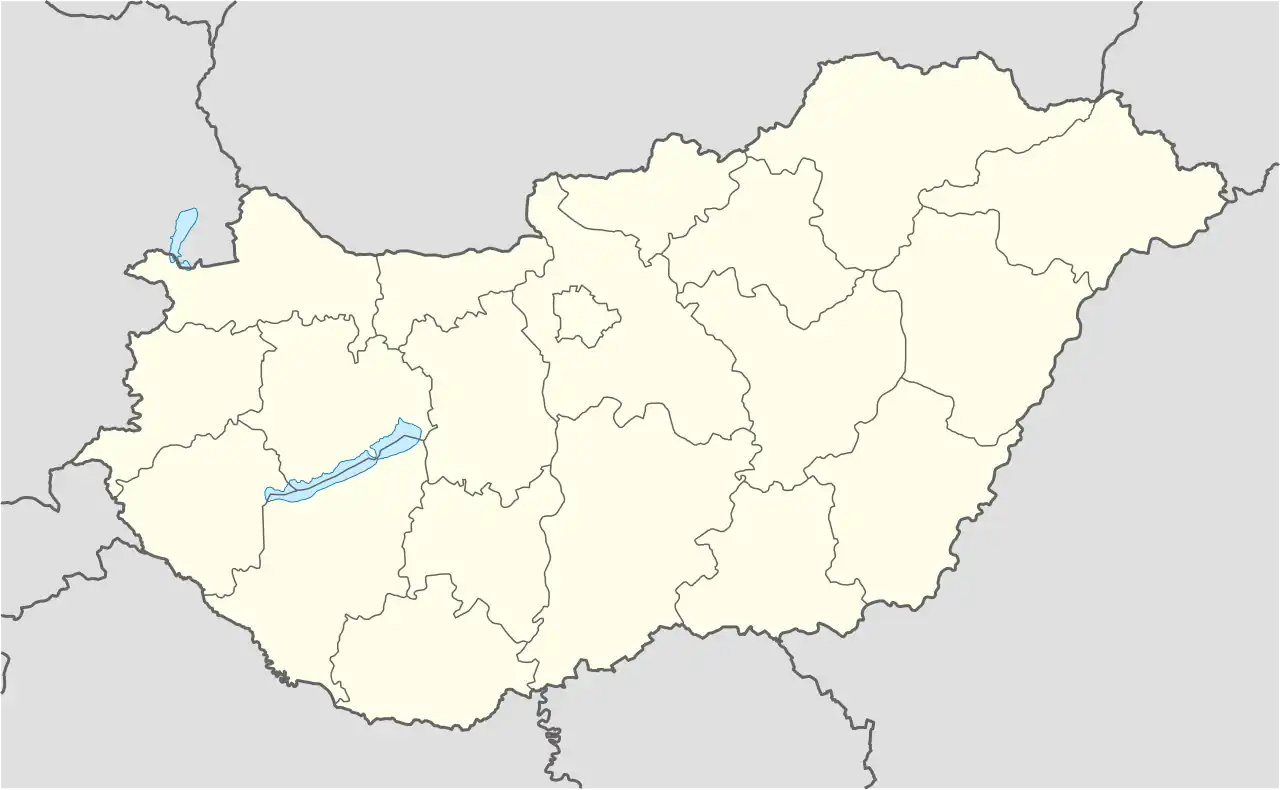
The 2025 Sitting Volleyball European Championships – Men's event was the 22nd edition of the biannual continental championship, contested by the senior men's national sitting volleyball teams in Europe, sanctioned by ParaVolley Europe. It was held in Győr, Hungary from 28 July to 2 August 2025, marking the fourth time the event is held in the country.[1][2]
Twelve teams took part for the twelfth time, the same as the previous edition.
On 4 September 2024, Budapest, Hungary was given the hosting rights.[3] This marks the fourth time the country hosts the event, after 2001, 2007 and 2019.
Quotes
“In the last five years, we have witnessed a huge development in ParaVolley Europe, and the #EuroSittingVolley will be back to Budapest. We are in a new era of paravolley, and expect an even better event compared to the one held in the Hungarian capital six years ago, and that was already an excellent one.”
— Branko Mihorko, ParaVolley Europe president.
“Our country can not only be a good organiser again, but can also hope for a successful performance. The previous year was also good for our Sitting Volleyball players, the women's national team finished fifth in the European Championship, but the men also perform better and better every year. We are confident that the 2025 event will also promote their professional development. Furthermore, the Hungarian Volleyball Federation seized the chance to organise the event because believes in social responsibility, and considers it important that Sitting Volleyball and sport belong to everyone, and with this event also wants to draw attention to this matter,”
— Gabriella Vatai, Hungarian Volleyball Federation president.
Change of venue
On 19 February 2025, following a request by the original venue, the Ludovika University of Public Service in Budapest, to fulfil their purpose-specific obligations, the host city was changed from Budapest to Győr.[4]
Preparations
On 21 December 2024, the hosting contract was signed.[5]
On 12 June 2025, the competition website went live.[6]
Teams
Twelve teams took part for the twelfth time, the same as the previous edition. France and Netherlands are present after being absent in 2023. Lithuania and Slovenia didn't participate after taking part in 2023.
The Olympic Sports Park in Győr was the venue.[7][8] The complex hosted Athletics, Gymnastics, Judo and Tennis at the 2017 European Youth Summer Olympic Festival. This is the first time the city will hold the championship. Three separate courts were used at the arena.
The draw was held at 14:00 CET on 19 May 2025 at the Virtu restaurant, on the 28th floor of the MOL Campus in Budapest, Hungary.[9][10] The draw started with, in order, pots 1, 2 and 3 being drawn, with each team selected then allocated into the first available group alphabetically. Hosts Hungary were pre-allocated into A1.
Seeding
The seeding was based on the ParaVolley Europe rankings.
12 teams are split into two groups of six. The top four in each group plays in the Quarterfinals, while the bottom 2 in each group plays in the classification rounds.
Opening ceremony
The opening ceremony took place on 27 July, a day before the tournament began.[11] The opening ceremony contained a parade of nations and a performance from JP Dance Company.
Group stage
All times are local.
The top four teams in each pool qualify for the knockout stage.
Match won 3–0 or 3–1: 3 match points for the winner, 0 match points for the loser
Match won 3–2: 2 match points for the winner, 1 match point for the loser
Tiebreakers
Number of matches won
Match points
Sets ratio
Points ratio
If the tie continues as per the point ratio between two teams, the priority is given to the team which won the match between them. When the tie in points ratio is between three or more teams, a new classification of these teams in the terms of points 1, 2, 3 and 4 is made taking into consideration only the matches in which they were opposed to each other.
The four losers that failed to make the quarter finals all play each other in a four team group to decide the places 9–12. Games against the teams that have already played each other are carried over.
The top three teams, Bosnia and Herzegovina, Germany and Ukraine qualified for the world championship. Serbia, Turkey and France achieved their best results, placing fourth, seventh and eleventh respectively.

 Hungary
 Bosnia and Herzegovina (12th title)
 Germany
 Ukraine
 Serbia
 Croatia
 France
 Italy
Italy
 Latvia
 Netherlands
 Poland
 Turkey



 Draw Live Stream


