Ahlswede–Khachatrian theorem
In extremal set theory, the Ahlswede–Khachatrian theorem generalizes the Erdős–Ko–Rado theorem to t-intersecting families. Given parameters n, k and t, it describes the maximum size of a t-intersecting family of subsets of of size k, as well as the families achieving the maximum size.

Statement
Let be integer parameters. A t-intersecting family is a collection of subsets of of size k such that if then . Frankl[1] constructed the t-intersecting families




The Ahlswede–Khachatrian theorem states that if is t-intersecting then

Furthermore, equality is possible only if is equivalent to a Frankl family, meaning that it coincides with one after permuting the coordinates.
More explicitly, if

(where the upper bound is ignored when ) then , with equality if an only if is equivalent to ; and if

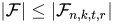


then , with equality if an only if is equivalent to or to .


History
Erdős, Ko and Rado[2] showed that if then the maximum size of a t-intersecting family is . Frankl[1] proved that when , the same bound holds for all , which is tight due to the example . This was extended to all t (using completely different techniques) by Wilson.[3]
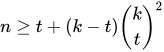
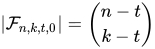



As for smaller n, Erdős, Ko and Rado made the conjecture, which states that when , the maximum size of a t-intersecting family is[4][5]



which coincides with the size of the Frankl family . This conjecture is a special case of the Ahlswede–Khachatrian theorem.

Ahlswede and Khachatrian proved their theorem in two different ways: using generating sets[6] and using its dual.[7] Using similar techniques, they later proved the corresponding Hilton–Milner theorem, which determines the maximum size of a t-intersecting family with the additional condition that no element is contained in all sets of the family.[8]
Related results
Weighted version
Katona's intersection theorem[9] determines the maximum size of an intersecting family of subsets of . When is odd, the unique optimal family consists of all sets of size at least (corresponding to the Majority function), and when is odd, the unique optimal families consist of all sets whose intersection with a fixed set of size is at least (Majority on coordinates).


Friedgut[10] considered a measure-theoretic generalization of Katona's theorem, in which instead of maximizing the size of the intersecting family, we maximize its -measure, where is given by the formula


The measure corresponds to the process which chooses a random subset of by adding each element with probability p independently.
Katona's intersection theorem is the case . Friedgut considered the case . The weighted analog of the Erdős–Ko–Rado theorem[11] states that if is intersecting then for all , with equality if and only if consists of all sets containing a fixed point. Friedgut proved the analog of Wilson's result[3] in this setting: if is t-intersecting then for all , with equality if and only if consists of all sets containing t fixed points. Friedgut's techniques are similar to Wilson's.


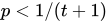
Dinur and Safra[12] and Ahlswede and Khachatrian[13] observed that the Ahlswede–Khachatrian theorem implies its own weighted version, for all . To state the weighted version, we first define the analogs of the Frankl families:

The weighted Ahlswede–Khachatrian theorem states that if is t-intersecting then for all ,


with equality only if is equivalent to a Frankl family. Explicitly, is optimal in the range


The argument of Dinur and Safra proves this result for all , without the characterization of the optimal cases. The main idea is that if we take a random subset of of size , then the distribution of its intersection with tends to as .


Filmus[14] proved weighted Ahlswede–Khachatrian theorem for all using the original arguments of Ahlswede and Khachatrian[6][7] for , and using a different argument of Ahlswede and Khachatrian, originally used to provide an alternative proof of Katona's theorem, for .[15] He also showed that the Frankl families are the unique optimal families for all .


Version for strings
Ahlswede and Khachatrian proved a version of the Ahlswede–Khachatrian theorem for strings over a finite alphabet.[13] Given a finite alphabet , a collection of strings of length n is t-intersecting if any two strings in the collection agree in at least t places. The analogs of the Frankl family in this setting are


where is an arbitrary word, and is the number of positions in which w and agree.


The Ahlswede–Khachatrian theorem for strings states that if is t-intersecting then
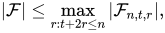
with equality if and only if is equivalent to a Frankl family.
The theorem is proved by a reduction to the weighted Ahlswede–Khachatrian theorem, with .

References
Notes
- ^ a b Frankl (1978)
- ^ Erdős, Ko & Rado (1961)
- ^ a b Wilson (1984)
- ^ Erdős (1987, p. 56)
- ^ Deza & Frankl (1983)
- ^ a b Ahlswede & Khachatrian (1997)
- ^ a b Ahlswede & Khachatrian (1999)
- ^ Ahlswede & Khachatrian (1996)
- ^ Katona (1964)
- ^ Friedgut (2008)
- ^ Fishburn et al. (1986)
- ^ Dinur & Safra (2005)
- ^ a b Ahlswede & Khachatrian (1998)
- ^ Filmus (2017)
- ^ Ahlswede & Khachatrian (2004)
Works cited
- Ahlswede, Rudolf; Khachatrian, Levon H. (1996). "The complete nontrivial-intersection theorem for systems of finite sets". Journal of Combinatorial Theory, Series A. 76 (1): 121–138. doi:10.1006/jcta.1996.0092.
- Ahlswede, Rudolf; Khachatrian, Levon H. (1997). "The complete intersection theorem for systems of finite sets". European Journal of Combinatorics. 18 (2): 125–136. doi:10.1006/eujc.1995.0092.
- Ahlswede, Rudolf; Khachatrian, Levon H. (1999). "A Pushing-Pulling Method: New Proofs of Intersection Theorems". Combinatorica. 19: 1–15. CiteSeerX 10.1.1.380.5794. doi:10.1007/s004930050042. S2CID 13331544.
- Ahlswede, Rudolf; Khachatrian, Levon H. (1998). "The Diametric Theorem in Hamming Spaces—Optimal Anticodes". Advances in Applied Mathematics. 20 (4): 429–449. doi:10.1006/aama.1998.0588.
- Ahlswede, Rudolf; Khachatrian, Levon H. (2004). "Katona's Intersection Theorem: Four Proofs". Combinatorica. 25: 105–110. doi:10.1007/s00493-005-0008-4. S2CID 13340174.
- Deza, Michel; Frankl, Peter (1983). "Erdős–Ko–Rado theorem—22 years later". SIAM Journal on Algebraic and Discrete Methods. 4 (4): 419–431. doi:10.1137/0604042.
- Dinur, Irit; Safra, Shmuel (2005). "On the hardness of approximating minimum vertex cover". Annals of Mathematics. 162 (1): 439–485. doi:10.4007/annals.2005.162.439. MR 2178966. Zbl 1084.68051.
- Erdős, Paul (1987). "My joint work with Richard Rado". Surveys in Combinatorics. London Mathematical Society Lecture Notes. Vol. 123. pp. 53–80.
- Erdős, Paul; Ko, Chao; Rado, Richard (1961). "Intersection theorems for systems of finite sets" (PDF). Quarterly Journal of Mathematics. Second Series. 12: 313–320. doi:10.1093/qmath/12.1.313.
- Filmus, Yuval (2017). "The weighted complete intersection theorem". Journal of Combinatorial Theory, Series A. 151: 84–101. doi:10.1016/j.jcta.2017.04.008.
- Fishburn, P. C.; Frankl, P.; Freed, D.; Lagarias, J. C.; Odlyzko, A. M. (1986). "Probabilities for Intersecting Systems and Random Subsets of Finite Sets". SIAM Journal on Algebraic and Discrete Methods. 7 (1): 73–79. doi:10.1137/0607009.
- Frankl, Peter (1978). "The Erdős–Ko–Rado theorem is true for ". Coll. Soc. Maj. J. Bolyai. 11: 365–375.
- Friedgut, Ehud (2008). "On the measure of intersecting families, uniqueness and stability". Combinatorica. 28 (5): 503–528. doi:10.1007/s00493-008-2318-9. S2CID 7225916.
- Katona, Gy. (1964). "Intersection theorems for systems of finite sets" (PDF). Acta Mathematica Academiae Scientiarum Hungaricae. 15 (3–4): 329–337. doi:10.1007/BF01897141. S2CID 121673629.
- Wilson, Richard M. (1984). "The exact bound in the Erdős-Ko-Rado theorem". Combinatorica. 4 (2–3): 247–257. doi:10.1007/BF02579226. S2CID 44504849.
