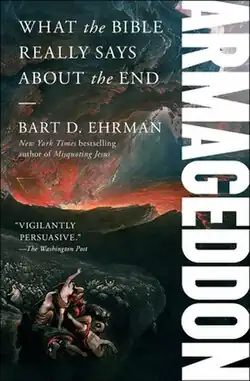
Armageddon: What the Bible Really Says about the End
 | |
| Author | Bart D. Ehrman |
|---|---|
| Language | English |
| Subject | Book of Revelation, Christian eschatology |
| Genre | Nonfiction |
| Publisher | Simon & Schuster |
Publication date | March 21, 2023 |
| Publication place | United States |
| Media type | Print, e-book, audiobook |
| Pages | 272 |
| ISBN | 978-1-982-14799-0 |
Armageddon: What the Bible Really Says about the End is a 2023 nonfiction book by Bart D. Ehrman about the Book of Revelation. It places Revelation within its ancient historical setting, argues that popular rapture scenarios are nineteenth-century innovations, and evaluates the ethical and political effects of apocalyptic readings in contemporary culture.[1][2][3] Simon & Schuster published the book on March 21, 2023, in hardcover, e-book, and audiobook formats narrated by Robert Petkoff, and issued a trade paperback on March 19, 2024.[1][4][5][6]
Contents
| No. | Chapter title | Focus |
|---|---|---|
| 1 | The End Is Near | Introduction to modern American apocalyptic belief, the rapture, and late-modern prophecy movements, with framing of the book's questions and method.[2] |
| 2 | The Most Mystifying Book of the Bible | Overview of Revelation's narrative, images, and compositional features in their first-century context.[7] |
| 3 | A History of False Predictions | Survey of date-setting and prophetic schemes in modern history and why such forecasts repeatedly fail.[7] |
| 4 | Real-Life Consequences of the Imminent Apocalypse | Psychological, social, and political effects produced by imminent-end expectations.[8][9] |
| 5 | How to Read the Book of Revelation | Methodological chapter on reading apocalypses, symbolism, intertextuality, and audience context.[7] |
| 6 | The Lamb Becomes a Lion: Violence in the Book of Revelation | Analysis of divine violence and judgment scenes and their ethical evaluation.[8][7] |
| 7 | The Ideology of Dominance: Wealth and Power in Revelation | Critique of imperial economics, wealth, and domination in Revelation's rhetoric.[8][7] |
| 8 | The Apocalypse of John and the Gospel of Jesus | Contrast between Revelation's portrait of Christ and the ethical teaching of Jesus in the Gospels and implications for Christian practice.[8][7] |
Synopsis and analysis
Ehrman situates Revelation among ancient Jewish and Christian apocalypses and reads it against first-century Roman imperial realities and scriptural intertexts. He traces modern rapture theology to nineteenth-century interpreters rather than to the New Testament text itself and argues that literalist end-timelines misrepresent Revelation's audience, genre, and aims.[2][7] He highlights the persistence of failed prophetic date-setting in popular religion and describes how these forecasts continue to shape public life despite repeated inaccuracies.[2]
Extended chapters analyze the ethics of Revelation's violence and its vision of wealth and power. Ehrman contends that the book's judgment scenes raise moral questions when placed alongside the Gospels' depiction of Jesus, and he explores how interpretive choices inform contemporary social and political behavior.[2][3] He closes by contrasting the Apocalypse of John with the teachings of Jesus and by outlining criteria for responsible engagement with Revelation in modern communities.[8]
Themes
Ehrman presents Revelation as an apocalypse that relies on symbols, visions, and intertextual allusions to address pressures facing its first-century audience.[2] He challenges proof-texting that assembles verses from disparate books into predictive timelines, arguing that such methods ignore narrative structure and historical setting.[2] The book maintains that rapture doctrine emerged in the 1800s through figures such as John Nelson Darby and later writers including Hal Lindsey, rather than in Revelation itself.[2] Ehrman weighs interpretations that present Revelation as purely hopeful and instead emphasizes its rhetoric of judgment, critiques of imperial wealth, and program of divine retribution, setting these themes against Gospel ethics to prompt reflection on contemporary application.[3][10]
Critical reception
The book received a starred review from Library Journal, which called it "lucid and compelling".[11] Kirkus Reviews described it as "well-argued" and "certain-to-be-controversial", while Publishers Weekly judged it "ambitious but uneven" and noted its timeliness for reassessing Revelation.[12][13]
In a full-length review, David Dark in The Washington Post called the book "vigilantly persuasive" for tracing the harms produced by particular readings of Revelation in corridors of power and praised Ehrman for inviting readers to reconsider John's vision in its context.[3] Publishers Weekly emphasized the book's emphasis on refuting alternative interpretations, while the Washington Independent Review of Books lauded Ehrman's prose but disputed his contrast between the Jesus of the Gospels and the Jesus of Revelation.[13][14] The review aggregator Bookmarks reported an overall positive consensus based on trade and newspaper assessments.[15]
References
- ^ a b "Armageddon". Simon & Schuster. Simon & Schuster. 2023-03-21.
- ^ a b c d e f g h "Armageddon, Chapter One excerpt". Simon & Schuster. Simon & Schuster.
Chapter One: The End Is Near
- ^ a b c d Dark, David (2023-03-21). "'Armageddon' reads the Book of Revelation with fresh eyes". The Washington Post.
- ^ "Armageddon, eBook page". Simon & Schuster. Simon & Schuster. 2023-03-21.
- ^ "Armageddon, audiobook page". Simon & Schuster Audio. Simon & Schuster. 2023-03-21. ISBN 9781797151793.
Runtime 7 hours 57 minutes
- ^ "Armageddon, trade paperback product details". Simon & Schuster. Simon & Schuster. 2024-03-19.
Length 272 pages
- ^ a b c d e f g Ehrman, Bart D. (2023). Armageddon: What the Bible Really Says about the End. Simon & Schuster. p. 23.
- ^ a b c d e "Armageddon: what the Bible really says about the end, Table of contents". Marmot Library Network. Marmot Library Network.
- ^ "'Armageddon' by Bart D. Ehrman – review". The Amateur Exegete. 2023-08-07.
Chapter four, Real-Life Consequences of the Imminent Apocalypse
- ^ "Armageddon Has Arrived!". The Bart Ehrman Blog. 2023-03-21.
- ^ "Armageddon: What the Bible Really Says about the End". Library Journal. 2023-03-01.
Lucid and compelling
- ^ "ARMAGEDDON". Kirkus Reviews. 2023-02-01.
Well-argued, certain-to-be-controversial
- ^ a b "Armageddon: What the Bible Really Says about the End". Publishers Weekly. 2023-03-21.
ambitious but uneven
- ^ Looper, Joel (2023-03-28). "Armageddon: What the Bible Really Says about the End". Washington Independent Review of Books.
- ^ "Armageddon: What the Bible Really Says about the End". Bookmarks. 2023-03-21.