Battle of Conagul
| Battle of Conaghul (Conagul) | |||||
|---|---|---|---|---|---|
| Part of Waugh Insurgency | |||||
| |||||
| Belligerents | |||||
.svg.png) British East India Company British East India Company |
 Dhoondia Wagh Dhoondia Wagh | ||||
| Commanders and leaders | |||||
|
Arthur Wellesley |
Dhoondia Wagh | ||||
| Units involved | |||||
|
19th Light Dragoons Mysore Cavalry |
Disbanded Cavalry | ||||
| Strength | |||||
| 1,200 cavalry | 5,000 cavalry | ||||
| Casualties and losses | |||||
| 200–350 killed and wounded | 600+ killed and wounded, 100+ captured, Dhoondia Wagh killed | ||||
The Battle of Conaghul (also spelled Konagal or Conaghalli) was a decisive cavalry engagement fought on 10 September 1800 during the Second Anglo-Mysore War between forces of the British East India Company and the rebel army led by Dhoondia Waug.[1] The battle took place near Conaghul village in present-day Raichur district, Karnataka, India.[2]
Background
Following the fall of Tipu Sultan in 1799, Dhoondia Wagh(also spelled as Dhondia Waug)—formerly a Mysorean commanderescaped captivity and rallied a force of Maratha irregulars, disbanded Mysorean troops, and local insurgents. His growing influence in northern Karnataka posed a threat to British control in the region.
Major-General Arthur Wellesley, commanding British and allied forces in the Deccan, was tasked with suppressing Dhoondia's rebellion. After weeks of pursuit, Wellesley's cavalry caught up with the rebel force near Conaghul.[3]
The Battle
Wellesley led a cavalry force of approximately 1,200, including the 19th Light Dragoons[4] and native horsemen. Dhoondia Wagh's army was estimated to include over 5,000 cavalry, though many were irregular and poorly coordinated.
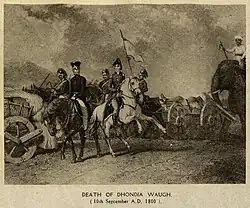
The British cavalry executed a rapid and disciplined charge, breaking through Dhoondia's formation. The rebel army was routed, and Dhoondia Wagh was killed in action, reportedly by a British sepoy.[5]
Aftermath
The victory at Conaghul effectively ended Dhoondia Wagh's rebellion and solidified British control over northern Karnataka. The battle also marked one of Arthur Wellesley's earliest independent field commands, showcasing his tactical decisiveness and leadership—a precursor to his later campaigns in India and Europe.
Wellesley later described the campaign against Dhoondia as a formative experience, and the Battle of Conaghul remains a notable example of cavalry-led tempo warfare in colonial India.[6]
References
- ^ "Indian Culture Portal-Battle of Konagal (1800)".
- ^ "Battle of Conagul". FIBIwiki (Families in British India Society).
- ^ "A History of Mahrattas" by James Grant Duff (1826).
- ^ Davies, Huw J. "Wellington's First Command: The Political and Military Campaign Against Dhoondiah Vagh". Modern Asian Studies. Modern Asian Studies, Vol. 44, No. 5 (2010), pp. 1081–1113. JSTOR 40926542 – via JSTOR.
- ^ "British Library – Eyewitness Descriptions of the Battle of Kongal". British Library: Asian and African Studies.
- ^ "The Life of Arthur Duke of Wellington" by G.R. Gleig (1865).