Bentkowski Tenement
| Bentkowski Tenement | |
|---|---|
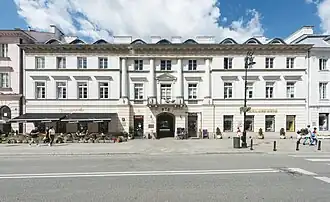 The building in 2024. | |
Interactive map of the Bentkowski Tenement area | |
| General information | |
| Type | Tenement house |
| Architectural style | Neoclassical |
| Location | Downtown, Warsaw, Poland, 49 New World Street |
| Coordinates | 52°14′06.4″N 21°01′06.0″E / 52.235111°N 21.018333°E |
| Construction started | c. 1820 |
| Completed | c. 1822 |
| Technical details | |
| Floor count | 4 |
| Design and construction | |
| Architect | Hilary Szpilowski |
The Bentowski Tenement (Polish pronunciation: [bɛntˈtkɔf.ski]; Polish: Kamienica Bentkowskiego) is a four-storey neoclassical tenement house in Warsaw, Poland, located at 49 New World Street, within the neighbourhood of North Downtown. It was originally built in the early 1820s, and was later rebuilt in the 19th and 20th centuries. Currently, it houses the seat of the Polish Economic Society. The building is included on a heritage list.
History
The tenement house was built between around 1820 and 1822, as a residence of historian and linguist Feliks Jan Bentkowski. It was designed by architect Hilary Szpilowski. In the second half of the 19th century, a sculptor Adam Zelt lived in the tenement house. The building was rebuilt in the 19th century, and again at the beginning of the 20th century.[1]
On 12 November 1943, during the Second World War, in front of the building German soldiers executed 20 prisoners of Pawiak. The event is commemorated with a plaque on its façade.[2][3] The building was burned down and partially demolished during the conflict. It was rebuilt between 1947 and 1949, in accordance to the design by Zygmunt Stępiński and Mieczysław Kuźma.[1]
In 1965, the tenement house, together with its garden and fence, was entered into the heritage list.[4]
Currently, it housed the seat of the Polish Economic Society.[5]
Characteristics
The tenement house is built on a rectangular plan. In the central part of the façade there are four Doric semi-columns. It is an 11-axis and 2-bay building, with a balcony on the first floor, located above the entrance gate.[1]
References
- ^ a b c Barbara Petrozolin-Skowrońska (editor): Encyklopedia Warszawy. Warsaw: Państwowe Wydawnictwo Naukowe, 1975, p. 244. (in Polish)
- ^ Regina Domańska: Pawiak – więzienie Gestapo. Kronika lat 1939–1944. Warsaw: Książka i Wiedza, 1978, p. 370. (in Polish)
- ^ "Tablice wg. projektu Karola Tcholka". ipn.gov.pl (in Polish).
- ^ Wykaz zabytków nieruchomych wpisanych do rejestru zabytków (księga A) – stan na 31 grudnia 2022 roku Woj. mazowieckie (Warszawa). Warsaw: National Institute of Cultural Heritage, 2022, p. 48. (in Polish)
- ^ "Zarząd Krajowy Polskiego Towarzystwa Ekonomicznego". pte.pl (in Polish).