C4orf17 has a total of three known splice variants.[11][5] There are 9 exons found within C4orf17's mRNA sequence. The two additional isoforms have 10 and 7 exons, respectively.
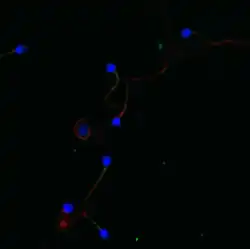
Figure 2: Immunofluorescent staining of human cell line. Sperm shows localization to mid piece
Localization
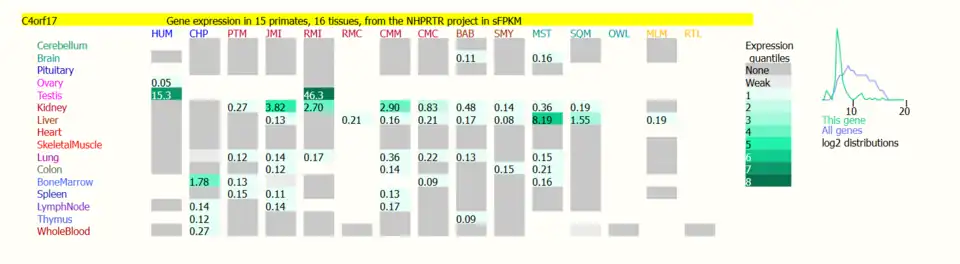
In humans, C4orf17 is specific to the testes.[13] During human fetal development, however, C4orf17 expression appeared in adrenal, intestinal, and renaltissues[14] at 20 weeks after conception.
Interactions
The C4orf17 protein interacts with numerous other proteins, such as ATRX, CHD3, KAT2B, KDM1A, PRMT1, and SUV39H1. These specific interactions suggest that C4orf17’s function is associated with chromatin modifications through histone methylation.[15]
A 2022 study,[17] nevertheless, further investigated the ADH gene cluster. According to the researchers, “Nucleotide variation in ADH genes can affect the catalytic properties of these enzymes and is associated with a variety of traits, including alcoholism and cancer,” (McQuillan et al., 2022). C4orf17 is one of the many genetic mutations listed as having a strong effect on ADH traits.
Table 2: Percent identity accounts for exact matches, such as a DNA base or amino acids. Percent similarity accounts for identical and biochemically similar substitutions, such as substituted amino acids.
Paralogs
The C4orf17 protein is a SPATIAL (stromal protein associated with thymic and lymph node) domain-containing protein,[19] specifically at the interval 27-223 aa.[20] This suggests that it may be involved in spermatiddifferentiation. This family may also be referred to as “TBATA” or “TBATA-like.”
Protein Analysis Through Evolutionary Relationships (PANTHER) Classification System categorizes C4orf17 into the PTHR33772:SF2 protein family.[21]
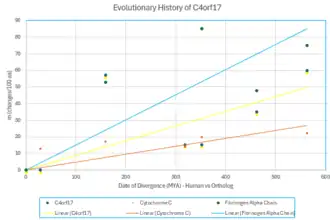
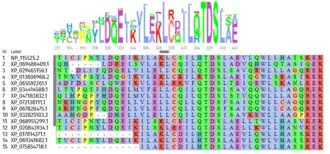
Figure 3: Date of Divergence (MYA): C4orf17 (yellow), cytochrome c (orange), fibrinogen alpha chain (blue)Figure 4: The following figures exhibit conserved regions of C4orf17 among the orthologs listed in Table #. The size of the letters at the top of each figure represents the degree of conservation. Larger letters indicate more conservation compared to smaller letters.Conserved regions of the C4orf17 proteinConserved regions of the C4orf17 protein
Protein Divergence
The figure to the right named "Date of Divergence..." exhibits the evolution of human C4orf17, cytochrome c, and fibrinogen alpha chain. Cytochrome C has a weaker slope indicating fewer mutations over time, while the fibrinogen alpha chain has a taller slope, meaning it has evolved quicker than both human C4orf17 and cytochrome c. [13]
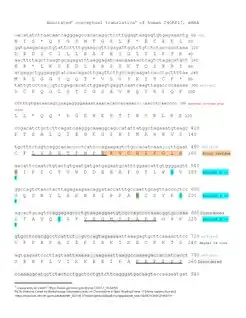
Figure 5: Conceptual translation of (human) C4orf17 mRNA
Figure 5 exhibits a conceptual translation of C4orf17 in humans. It is annotated to highlight exons, start and stop codons, and disordered regions among other genetic features.
SNPs
C4orf17 has a total of 14,681 SNPs recorded in the NCBI Variant Viewer, though only two are clinically significant.[22] Variants rs1397320372 and rs1417597081 are both single nucleotide, missense variants.
^Benayoun L, Granot E, Rizel L, Allon-Shalev S, Behar DM, Ben-Yosef T (April 2007). "Abetalipoproteinemia in Israel: evidence for a founder mutation in the Ashkenazi Jewish population and a contiguous gene deletion in an Arab patient". Molecular Genetics and Metabolism. 90 (4): 453–457. doi:10.1016/j.ymgme.2006.12.010. PMID17275380.




.png)
.png)