Climate change in the Democratic Republic of the Congo
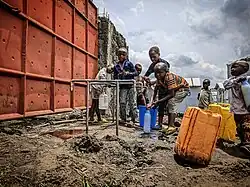
Climate change in Africa is an environmental issue in the Democratic Republic of the Congo, but it is hard for the country to adapt[1] due to ongoing war[2] and corruption.[3] Avoiding carbon loss from further deforestation[4] and preventing loss of peatland is important.[5] Problems might be tackled as part of tackling poverty,[6] as slash-and-burn agriculture for smallholdings is causing most deforestation.[7]
Greenhouse gas emissions
Most of the greenhouse gas emitted from the Democratic Republic of the Congo (DRC) was due to deforestation of Congolian rainforests to make charcoal and to clear land for slash-and-burn agriculture.[8] In 2018 the country’s total was 718 million tonnes CO2e of which over 70% was from land use, land-use change, and forestry.[9]: 25 Most of the Congo Basin is in the DRC and vice-versa and deforestation is projected to continue.[10]
Deforestation
There are two ways that deforestation can cause changes in climate – by changing greenhouse gas emissions and eco-climate impact, or by changing the eco-service patterns, in this case, rainfall. Forests are sinks for carbon. Rainforest, in particular, hold great amounts of carbon with their complex and robust ecosystems. As of 2023 forest within the DRC holds an estimated 23 billion tons of carbon (GtCO2e), which is the largest stock in Africa.[11] The government estimated average annual emissions due to deforestation from 2015 to 2019 at slightly over 1 billion tons.[12] However the 2023 greenhouse gas inventory by the government put 2018 emissions due to forests at about half a billion tons and absorption about the same.[13]: 23
Further, research has demonstrated that increased replacement of tropical rainforest vegetation with savanna grasslands can produce undesired climate changes in Africa. Forests are also providers of rainfall. The destruction of forest prevents such eco-services and leads to changes in landscape. In areas that are heavily deforested, rainfall can decrease throughout the year; and specifically if over deforestation occurs in southern Africa, it may result in increased rainfall in the southern region of the DRC.[14]
This intensifies the loss of topsoil, prevents tall plants from growing back (changing the landscape permanently), and furthers the eco-climate change pattern. Naturally, this change does not only affect plant life but animals as well. Researchers have also begun running simulations to predict future conditions and concluded that great biodiversity loss will result if the DRC continues its current deforestation patterns. The Salonga National Park, for example, stands to lose around 7 species of mammals by 2050, and 19 species by 2080 if the DRC population do not reduce their heat-trapping emissions which result from deforestation.[15]
Impacts on the natural environment
Temperature and weather changes and sea level rise

The temperature has increased by 1.5C as of 2025.[16] Increased evapotranspiration is projected to cause more drought.[17] By 2100 average daily rainfall is projected to decrease, especially in the west of the country.[18] Climate change may be increasing floods,[19] but due to not enough weather stations scientists are not sure as of 2025.[20] The coastline is expected to recede by 50 to 100m by 2100 but sea level rise is not the only reason.[21]
Ecosystems and biodiversity
There are many ecosystems.[22] Biodiversity is expected to be affected.[23] Unlike the Amazon the rainforest is not thought vulnerable to tipping. [24]
Impacts on people
In the early 21st century most people thought climate was changing.[25]
Economic impacts
Agriculture in the DRC is vulnerable.[26]
Health impacts
As of 2025 further study is needed to determine whether increased extreme heat is affected maternal and newborn health.[27]
Impacts on housing, migration and indigenous peoples
Although not the main cause increased rainfall might worsen gullies.[28] Although war is the main cause floods also cause internal migration.[29]
Drought and heatwaves impact indigenous people.[30]
Mitigation
The 2021 Nationally Determined Contribution of the DRC committed to a 21% reduction by 2030 conditional on international help.[31][32] Avoiding carbon loss from peatland in the Central Congolian lowland forests is important.[33] The large Tumba-Ngiri-Maindombe wetland is a major carbon sink.[34]
Clean energy being developed incudes a 1 GW solar power plant.[35] As of 2026 less than a quarter of people have electricity so the African Development Bank aims to increase that.[36] An estimated 2.5% of people use electricity to cook, whereas over 95% of households are estimated to use mainly firewood and charcoal.[37] So the Clean Cooking Alliance promotes improved cookstoves, and the government LPG.[37]
Adaptation
There is a national plan.[38] The World Bank is supporting urban infrastructure more resilient against erosion and flooding.[39] It has been suggested that local climate smart agriculture practices should be supported by the national government.[40]
Society and culture
Family small farming is important.[41]
References
- ^ "Role of Governance in ImplementingClimate Change Adaptation Strategies in the Congo Basin: Case of Cameroon and the Democratic Republic of Congo" (PDF).
- ^ Seyuba, Katongo (2025-03-18). Climate, Peace and Security in Eastern Democratic Republic of the Congo (Report). Stockholm International Peace Research Institute. doi:10.55163/TCSW2134. Archived from the original on 2025-09-26.
- ^ Moulds, Josephine; Rolley, Sonia (2025-11-11). "Violent reprisals after DRC whistleblowers discover profiteering in protected land". The Guardian. ISSN 0261-3077. Retrieved 2026-02-07.
- ^ Nzabarinda, Vincent; Bao, Anming; Tie, Liu; Uwamahoro, Solange; Kayiranga, Alphonse; Ochege, Friday Uchenna; Muhirwa, Fabien; Bao, Jiayu (2025-01-01). "Expanding forest carbon sinks to mitigate climate change in Africa". Renewable and Sustainable Energy Reviews. 207: 114849. doi:10.1016/j.rser.2024.114849. ISSN 1364-0321.
{{cite journal}}: CS1 maint: article number as page number (link) - ^ "Critical ecosystems: Congo Basin peatlands". UNEP. 2023-02-27. Archived from the original on 2026-01-22. Retrieved 2026-02-07.
- ^ "The Democratic Republic of the Congo". Central African Forest Initiative (CAFI). Retrieved 2026-02-07.
- ^ "The Congo Basin". Norway's International Climate and Forest Initiative. 2020-06-05. Retrieved 2026-02-07.
- ^ "It is time to look back: Lessons and achievements from the Forest Investment Program in the Democratic Republic of Congo (DRC)". World Bank. Retrieved 2026-02-07.
Deforestation and land degradation are principally driven by slash-and-burn agriculture and the felling of trees for charcoal.
- ^ "Rapport national d'inventaire des gaz à effet de serre 2000 – 2018 au titre du Premier Rapport Biennal Actualisé de la RDC" (PDF) (in French). 2022.
- ^ Yuh, Yisa Ginath; N’Goran, Kouamé Paul; Kross, Angela; Heurich, Marco; Matthews, H. Damon; Turner, Sarah E. (2024-12-02). "Monitoring forest cover and land use change in the Congo Basin under IPCC climate change scenarios". PLOS ONE. 19 (12): e0311816. doi:10.1371/journal.pone.0311816. ISSN 1932-6203. PMC 11611213. PMID 39621680.
{{cite journal}}: CS1 maint: article number as page number (link) - ^ "How DRC's Land Auction To Big Oil Threatens Africa's Biggest Carbon Sink". Greenpeace Africa. Retrieved 2024-01-13.
- ^ "Report of the technical assessment of the proposed forest reference emission level of the Democratic Republic of the Congo submitted in 2018" (PDF).
- ^ "Rapport national d'inventaire des gaz à effet de serre 2000 – 2018 au titre du Premier Rapport Biennal Actualisé de la RDC" (PDF) (in French).
- ^ Semazzi, FHM; Song, Y (1 January 2001). "A GCM study of climate change induced by deforestation in Africa". Climate Research. 17 (2): 169–182. Bibcode:2001ClRes..17..169S. doi:10.3354/cr017169.
- ^ "Salonga National Park, Democratic Republic of Congo". Climate Hot Map. Retrieved 15 April 2012.
- ^ Cleaver, Josh Gabbatiss, Giuliana Viglione, Joe Goodman, Kerry (2024-02-14). "The Carbon Brief Profile: Democratic Republic of the Congo". Carbon Brief. Retrieved 2026-02-07.
{{cite web}}: CS1 maint: multiple names: authors list (link) - ^ Karam, Sara; Seidou, Ousmane; Nagabhatla, Nidhi; Perera, Duminda; Tshimanga, Raphael M. (2022-02-28). "Assessing the impacts of climate change on climatic extremes in the Congo River Basin". Climatic Change. 170 (3): 40. doi:10.1007/s10584-022-03326-x. ISSN 1573-1480. PMC 8885500. PMID 35250125.
- ^ Bangelesa, Freddy; Abel, Daniel; Pollinger, Felix; Rai, Praveen; Ziegler, Katrin; Ebengo, Dav; Tshimanga, Raphael M.; Mala Ali, Mapatano; Knight, Jasper; Paeth, Heiko (2023-12-01). "Projected changes in rainfall amount and distribution in the Democratic Republic of Congo – Evidence from an ensemble of high-resolution climate simulations". Weather and Climate Extremes. 42: 100620. doi:10.1016/j.wace.2023.100620. ISSN 2212-0947.
{{cite journal}}: CS1 maint: article number as page number (link) - ^ "ClimaMeter - 2025/05/08-09 DR Congo Floods". www.climameter.org. Retrieved 2026-02-07.
- ^ "High vulnerability and exposure main driver behind Kinshasa's deadly floods following heavy, but not unusual rainfall – World Weather Attribution". Retrieved 2026-02-07.
- ^ "Resilience of Muanda's communities from coastal erosion, Democratic Republic of Congo".
- ^ "DR Congo | UNDP Climate Change Adaptation". www.adaptation-undp.org. 2025-09-16. Retrieved 2026-02-07.
- ^ Beekmann, Milena; Gallois, Sandrine; Rondinini, Carlo (2024-09-01). "Uncertain future for Congo Basin biodiversity: A systematic review of climate change impacts". Biological Conservation. 297: 110730. doi:10.1016/j.biocon.2024.110730. ISSN 0006-3207.
{{cite journal}}: CS1 maint: article number as page number (link) - ^ https://www.science.org/doi/10.1126/science.abn7950
- ^ "Democratic Republic of Congo talks climate" (PDF).
- ^ "Climate change / Democratic Republic of the Congo | Interactive Country Fiches". dicf.unepgrid.ch. Retrieved 2026-02-07.
- ^ "Country-level impact of climate change on maternal and newborn health: Associations between temperature, precipitation, maternal mortality, stillbirth, and neonatal mortality in the Democratic Republic of the Congo | Global Heat Health Information Network". heathealth.info. Retrieved 2026-02-07.
- ^ "Massive trenches are swallowing homes across the DRC". dw.com. Retrieved 2026-02-07.
- ^ "Congo DR Case Study | Climate Refugees | Othering & Belonging Institute". belonging.berkeley.edu. Retrieved 2026-02-07.
- ^ "Climate change impacts on Indigenous peoples of the DRC | UNDP Climate Change Adaptation". www.adaptation-undp.org. 2020-08-05. Retrieved 2026-02-07.
- ^ "Contribution Déterminée à l'échelle Nationale révisée" (PDF) (in French). 2021.
- ^ "Democratic Republic of the Congo | NDC Partnership". ndcpartnership.org. Retrieved 2026-02-07.
- ^ Ruiz, Sarah (2024-12-02). "Peatlands in the DRC: A "Carbon Treasure Trove"". Woodwell Climate. Retrieved 2026-02-07.
- ^ "Ngiri-Tumba-Maindombe | Ramsar Sites Information Service". rsis.ramsar.org. Archived from the original on 2025-07-10. Retrieved 2026-02-19.
- ^ "The DRC's growth sectors". African Business. 2026-01-19. Retrieved 2026-02-10.
- ^ "AfDB approves $3.9 mln regional energy support project, DR Congo among beneficiaries".
- ^ a b "Congo, Democratic Republic". Clean Cooking Alliance. Retrieved 2026-02-10.
- ^ "NAP" (PDF).
- ^ "The Republic of Congo Commits to Reducing Climate Risks and Strengthening Urban Infrastructure and Sustainable Development". World Bank. Retrieved 2026-02-07.
- ^ Karume, Katcho; Mondo, Jean M.; Chuma, Géant B.; Ibanda, Angele; Bagula, Espoir M.; Aleke, Alex Lina; Ndjadi, Serge; Ndusha, Bintu; Ciza, Pascaline Azine; Cizungu, Nadege Cirezi; Muhindo, Daniel; Egeru, Anthony; Nakayiwa, Florence Mayega; Majaliwa, Jackson-Gilbert M.; Mushagalusa, Gustave N. (2022-10-20). "Current Practices and Prospects of Climate-Smart Agriculture in Democratic Republic of Congo: A Review". Land. 11 (10): 1850. doi:10.3390/land11101850. ISSN 2073-445X. Archived from the original on 2025-12-01.
- ^ "The Democratic Republic of Congo: Developing family farming without damaging primary forests". AFD - Agence Française de Développement. Archived from the original on 2025-12-13. Retrieved 2026-02-07.