Eleonora Maria Rosalia of Troppau and Jägerndorf
Eleonora Maria Rosalia of Troppau and Jägerndorf | |
|---|---|
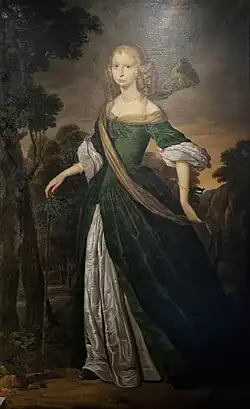 Portrait of Eleonora in about 1670 | |
| Born | 1647 |
| Died | 1704 (aged 56–57) |
| Spouse | Johann Seifried von Eggenberg |
| Father | Karl Eusebius, Prince of Liechtenstein |
| Mother | Johanna Beatrix of Dietrichstein |
Eleonora Maria Rosalia, Duchess of Troppau and Jägerndorf (also called Eleonora of Liechstenstein and Eleonora of Eggenberg, 1647–1704) was a German-Austrian noblewoman who published a popular book of recipes and remedies.
Eleonora was the eldest daughter of Karl Eusebius, Prince of Liechtenstein and his niece, Johanna Beatrix of Dietrichstein.[1] In 1666, she married Prince Johann Seyfried of Eggenberg. They had children including their heir, Johann.[2]
In 1695, under the title of Herzogin (Duchess) of Troppau and Jägerndorf, Eleonora published Freywillig-auffgesprungener Granat-Apffel des Christlichen Samaritans (The Christian Samaritan's Freely Opened Pomegranate),[3][4] which contained over 1800 recipes for cookery and home remedies. It became one of the most popular German remedy books of the eighteenth century, going through twenty editions by 1752.[5]
The book includes food recipes, including one of the earliest published recipes for fried chicken,[6] and advice for preventative and curative health measures through diet.[7] While her recipes usually did not contain magical elements, she included one remedy for epilepsy which involved burning several ingredients including human body parts under a waning moon.[8] The book was intended as a charitable work aimed at rural and non-noble readers, including ingredients which were easy to obtain and largely focusing on the illnesses of women and children.[9]
References
- ^ "RKD Research". research.rkd.nl. Retrieved 2025-11-24.
- ^ "RKD Research". research.rkd.nl. Retrieved 2025-11-24.
- ^ Classen, Albrecht (2007). The Power of a Woman's Voice in Medieval and Early Modern Literatures: New Approaches to German and European Women Writers and to Violence Against Women in Premodern Times. Walter de Gruyter. ISBN 978-3-11-019941-3.
- ^ Medicine (U.S.), National Library of (1989). A Catalogue of Seventeenth Century Printed Books in the National Library of Medicine. U.S. Department of Health and Human Services, Public Health Service, National Institutes of Health, National Library of Medicine. p. 1198.
- ^ Rankin, Alisha (2022-12-22). Panaceia's Daughters: Noblewomen as Healers in Early Modern Germany. University of Chicago Press. p. 209. ISBN 978-0-226-92539-4.
- ^ Fehribach, Paul (2024-05-31). Midwestern Food: A Chef's Guide to the Surprising History of a Great American Cuisine, with More Than 100 Tasty Recipes. University of Chicago Press. ISBN 978-0-226-81952-5.
- ^ Meyer, Paulette Ann (1997). Women Doctors Refashion a Men's Profession: Medical Carees of Nineteenth-century Zürich University Graduates in Germany. University of Minnesota. p. 38.
- ^ Wahrig, Bettina (2024). "Human Placenta in Premodern Europe-a Cultural and Pharmaceutical Agent". Berichte zur Wissenschaftsgeschichte. 47 (4): 396–417. doi:10.1002/bewi.202400004. ISSN 1522-2365. PMC 11656663. PMID 39572912.
- ^ "Cordials, Unguents, and Plasters: Stocking the Early Modern Medicine Cabinet". beckerexhibits.wustl.edu. Archived from the original on 2025-05-17. Retrieved 2025-11-24.