Figure skating at the 2026 Winter Olympics – Team event
| Team event at the XXV Olympic Winter Games | |
|---|---|
| Venue | Forum di Milano Milan, Italy |
| Dates | 6–8 February 2026 |
| Competitors | 23 singles skaters, 9 pairs teams & 11 ice dance teams from 10 nations |
| Winning score | 69 points |
| Medalists | |
| Figure skating at the 2026 Winter Olympics | ||
|---|---|---|
 | ||
| Qualification | ||
| Singles | men | women |
| Pairs | mixed | |
| Ice dance | mixed | |
| Team event | mixed | |
The figure skating team event at the 2026 Winter Olympics was held from 6 to 8 February at the Forum di Milano in Milan, Italy. The team event consisted of competitions in men's singles, women's singles, pair skating, and ice dance. Skaters and teams earned points based on their placements in each individual event, and the medalists were determined based on the total points earned. The team from the United States won the gold, the Japanese team won the silver, and the Italian team won the bronze.
Background
The team event is the newest Olympic figure skating event and was first contested at the 2014 Winter Olympics. The event combines the four Olympic figure skating disciplines (men's singles, women's singles, pairs, and ice dance) into a single event; skaters earn points based on their placement in each discipline, and the gold medals are awarded to the team that earns the most placement points.[1]
The figure skating team event at the 2026 Winter Olympics was held between 6 to 8 February at the Forum di Milano in Milan, Italy.[2] The American team was favored to win the team event, with Japan expected to be strong competition; other teams considered likely to be in medal contention were Italy, Georgia, and Canada.[3] The Americans were the reigning champions in the team event. Although the team representing the Russian Olympic Committee initially placed first at the 2022 Winter Olympics, with American team second, and the Japanese team third,[4] a failed doping test from Kamila Valieva of Russia eventually led to the cancellation of her scores from the event and a reranking,[5] which put the American team first, the Japanese team second, and the Russian team third. The American and Japanese teams ultimately received their medals at a ceremony during the 2024 Summer Olympics in Paris.[6]
The American team included three-time World champions in ice dance Madison Chock and Evan Bates, as well as the World champions in both the men's and women's events: Ilia Malinin and Alysa Liu, respectively. The biggest challenge to the American team was expected to come from the Japanese team. Kaori Sakamoto, the 2022 Winter Olympic bronze medalist and three-time World champion, as well as Yuma Kagiyama, two-time Winter Olympic silver medalist and four-time World medalist, were slated to compete in the first round of the team event. Additionally, Riku Miura and Ryuichi Kihara of Japan were the reigning World champions in pair skating. The Canadian team was also eager to medal in the team event, as they were denied the bronze medals at the 2022 team event due to a controversial decision by the International Skating Union to award them to the Russians. "We want the gold," said Canadian ice dancer Piper Gilles, “but a lot of it is out of our hands. What we can control is our skating, and how we feel about it, and what moment we want to create. That’s when we skate our best."[3]
The only two Russian skaters competing at the 2026 Winter Olympics – Petr Gumennik and Adeliia Petrosian – competed as Individual Neutral Athletes and were not eligible to participate in the team event.[3]
Qualification
For the team event, scores from the 2025 World Figure Skating Championships and the 2025–26 Grand Prix of Figure Skating season were tabulated to establish the ten top nations. Each nation compiled a score from their top performers in each of the four disciplines. The 2025 Grand Prix of Figure Skating Final was the final event to affect the team event score.[7]
| Pl. | Nation | M | W | P | D | Total |
|---|---|---|---|---|---|---|
| 1 |  United States United States
|

|
|
|
|
7069 |
| 2 |  Japan Japan
|
|
|
|
[a] | 6027 |
| 3 |  Italy Italy
|
|
|
|
|
4606 |
| 4 | .svg.png) Canada Canada
|
|
|
|
|
4231 |
| 5 |  Georgia Georgia
|
|
|
|
|
4106 |
| 6 |  France France
|
|
|
|
|
3829 |
| 7 |  Great Britain Great Britain
|
[b] |
|
|
|
2671 |
| 8 |  South Korea South Korea
|
|
|

|
|
2171 |
| 9 |  China China
|
|
|
|
|
2132 |
| 10 |  Poland Poland
|
|
|
|
[c] | 776 |
- Notes
- ^ Although Japan did not qualify an ice dance team for the team event, they were able to use two additional athlete quotas in order to complete their team.[8]
- ^ Although Great Britain did not qualify a men's singles skater for the team event, they were able to use an additional athlete quota in order to complete their team.[8]
- ^ Although Poland did not qualify an ice dance team for the team event, they were able to use two additional athlete quotas in order to complete their team.[8][9]
Entries
- Code key
- SP – Short program
- FS – Free skate
- RD – Rhythm dance
- FD – Free dance
Member nations submitted the following entrants for the indicated segments in each discipline.
| Country | Men | Women | Pairs | Ice dance |
|---|---|---|---|---|
| Canada
|
Stephen Gogolev (SP/FS) | Madeline Schizas (SP/FS) | (SP/FS) | (RD) |
| (FD) | ||||
| China
|
Jin Boyang (SP) | Zhang Ruiyang (SP) | (SP) | (RD) |
| France
|
Kévin Aymoz (SP) | Lorine Schild (SP) | (SP) | (RD) |
| Georgia
|
Nika Egadze (SP/FS) | Anastasiia Gubanova (SP/FS) | (SP/FS) | (RD/FD) |
| Great Britain
|
Edward Appleby (SP) | Kristen Spours (SP) | (SP) | (RD) |
| Italy
|
Daniel Grassl (SP) | Lara Naki Gutmann (SP/FS) | (SP/FS) | (RD/FD) |
| Matteo Rizzo (FS) | ||||
| Japan
|
Yuma Kagiyama (SP) | Kaori Sakamoto (SP/FS) | (SP/FS) | (RD/FD) |
| Shun Sato (FS) | ||||
| Poland
|
Vladimir Samoilov (SP) | Ekaterina Kurakova (SP) | (SP) | (RD) |
| South Korea
|
Cha Jun-hwan (SP) | Shin Ji-a (SP) | No pairs team | (RD) |
| United States
|
Ilia Malinin (SP/FS) | Alysa Liu (SP) | (SP/FS) | (RD/FD) |
| Amber Glenn (FS) |
Required performance elements
Single skating
The women competing in the team event performed their short programs on Friday, 6 February; while the men performed theirs on Saturday, 7 February.[2] Lasting no more than 2 minutes 40 seconds,[11] the short program had to include the following elements:
For men: one double or triple Axel; one triple or quadruple jump; one jump combination consisting of a double jump and a triple jump, two triple jumps, or a quadruple jump and a double jump or triple jump; one flying spin; one camel spin or sit spin with a change of foot; one spin combination with a change of foot; and a step sequence using the full ice surface.[12]
For women: one double or triple Axel; one triple jump; one jump combination consisting of a double jump and a triple jump, or two triple jumps; one flying spin; one layback spin, sideways leaning spin, camel spin, or sit spin without a change of foot; one spin combination with a change of foot; and one step sequence using the full ice surface.[12]
The five teams with the highest cumulative total points after the first round advanced to the final round. Regardless of their scores in the short program, the men and women from the top five teams performed their free skates on Sunday, 8 February.[2] The free skate for both men and women could last no more than 4 minutes,[11] and had to include the following: seven jump elements, of which one has to be an Axel-type jump; three spins, of which one has to be a spin combination, one has to be a flying spin, and one has to be a spin with only one position; a step sequence; and a choreographic sequence.[13]
Pair skating
The pairs couples competing in the team event performed their short programs on Friday, 6 February.[2] Lasting no more than 2 minutes 40 seconds,[11] the short program had to include the following elements: one pair lift, one double or triple twist lift, one double or triple throw jump, one double or triple solo jump, one solo spin combination with a change of foot, one death spiral, and a step sequence using the full ice surface.[14]
Regardless of their scores in the short program, the couples from the top five teams performed their free skates on Sunday, 8 February.[2] The free skate could last no more than 4 minutes,[11] and had to include the following: three pair lifts, of which one had to be a twist lift; two different throw jumps; one solo jump; one jump combination or sequence; one pair spin combination; one death spiral; and a choreographic sequence.[15]
Ice dance
The ice dance couples competing in the team event performed their rhythm dances on Friday, 6 February.[2] Lasting no more than 2 minutes 50 seconds,[11] the theme of the rhythm dance this season was "music, dance styles, and feeling of the 1990s".[16] Examples of applicable dance styles and music included, but were not limited to: pop, Latin, house, techno, hip-hop, and grunge. The rhythm dance had to include the following elements: one pattern dance step sequence, one choreographic rhythm sequence, one dance lift, one set of sequential twizzles, and one step sequence.[16]
Regardless of their scores in the short program, the couples from the top five teams performed their free dances on Saturday, 7 February.[2] The free dance could last no longer than 4 minutes,[11] and had to include the following: three dance lifts, one dance spin, one set of synchronized twizzles, one step sequence in hold, one step sequence while on one skate and not touching, and three choreographic elements.[16]
Judging
For the 2025–26 season, all of the technical elements in any figure skating performance – such as jumps and spins – are assigned a predetermined base point value and are then scored by a panel of seven or nine judges on a scale from -5 to 5 based on their quality of execution.[17] The judging panel's Grade of Execution (GOE) is determined by calculating the trimmed mean (that is, the average after deleting the highest and lowest scores), and this GOE is added to the base value to come up with the final score for each element. The panel's scores for all elements are added together to generate a total elements score.[18] At the same time, judges evaluate each performance based on three program components – skating skills, presentation, and composition – and assign a score from .25 to 10 in .25 point increments.[19] The judging panel's final score for each program component is also determined by calculating the trimmed mean. Those scores are then multiplied by the factor shown on the following chart; the results are added together to generate a total program component score.[20]
| Discipline | Short program or rhythm dance |
Free skate or free dance |
|---|---|---|
| Men | 1.67 | 3.33 |
| Women | 1.33 | 2.67 |
| Pairs | 1.33 | 2.67 |
| Ice dance | 1.33 | 2.00 |
Deductions are applied for certain violations like time infractions, stops and restarts, or falls.[22] The total elements score and total program component score are added together, minus any deductions, to generate a final performance score for each skater or team.[23]
Team event scoring
The ten skaters or teams in each discipline perform their short programs and rhythm dances first, and they are judged just as they would be at any other figure skating competition. The skater or team in each discipline who receives the highest score earns ten points, the next highest score earns nine points, and so on. Once all four events have been held, the points earned in each event are totaled, and the five teams with the highest totals move on to the final round. Teams may elect to substitute up to two skaters or teams at this point.[7] The five skaters or teams in each discipline then perform their free skates and free dances, and again receive scores from the judges. The skater or team in each discipline who receives the highest score earns ten points, the next highest score earns nine points, and so on. Once all four events have been held, the points earned over both rounds are totaled to determine the medalists.
Medal summary
.png)
.jpg)
.jpg)

.jpg)

Ilia Malinin, Alysa Liu, Amber Glenn, Ellie Kam and Daniel O'Shea, and Madison Chock and Evan Bates
Results (qualifying round)
- Code key
- TSS – Total segment score
- TES – Total elements score
- PCS – Program component score
- CO – Composition
- PR – Presentation
- SS – Skating skills
Ice dance
The team competition began on 6 February 2026 with the rhythm dance. Madison Chock and Evan Bates of the United States won the segment, earning a score of 91.06. "To break 90 is always a great feat," Bates said afterward. "To do it at an Olympic Games is even better."[25] Laurence Fournier Beaudry and Guillaume Cizeron of France finished in second place, having recently won the 2026 European Figure Skating Championships in dominant fashion.[26] Cizeron had competed for years with Gabriella Papadakis, winning five World Championship titles and the gold medals at the 2022 Winter Olympics before they ended their partnership in December 2024.[27] Fournier Beaudry had competed for Canada with Nikolaj Sørensen before Sørensen received a six-year suspension from competitive skating in October 2024. Fournier Beaudry and Cizeron announced their new partnership in March 2025 with a stated goal of competing at the 2026 Winter Olympics.[28] Lilah Fear and Lewis Gibson of Great Britain finished in third place with an "energetic, crowd-pleasing performance". Charlène Guignard and Marco Fabbri of Italy, having already indicated that this would be their last season in competitive skating, finished in fifth place.[26]
| Pl. | Team | Nation | TSS | TES | PCS | CO | PR | SS | Pts. |
|---|---|---|---|---|---|---|---|---|---|
| 1 | United States
|
91.06 | 52.77 | 38.29 | 9.61 | 9.68 | 9.50 | 10 | |
| 2 | France
|
89.98 | 51.74 | 38.24 | 9.68 | 9.57 | 9.50 | 9 | |
| 3 | Great Britain
|
86.85 | 50.08 | 36.77 | 9.25 | 9.36 | 9.04 | 8 | |
| 4 | Canada
|
85.79 | 48.74 | 37.05 | 9.32 | 9.32 | 9.21 | 7 | |
| 5 | Italy
|
83.54 | 47.39 | 36.15 | 9.00 | 9.14 | 9.04 | 6 | |
| 6 | Georgia
|
78.97 | 44.81 | 34.16 | 8.54 | 8.64 | 8.50 | 5 | |
| 7 | South Korea
|
70.55 | 39.54 | 31.01 | 7.79 | 7.82 | 7.71 | 4 | |
| 8 | Japan
|
68.64 | 38.66 | 29.98 | 7.54 | 7.64 | 7.36 | 3 | |
| 9 | China
|
64.92 | 35.50 | 29.42 | 7.29 | 7.50 | 7.32 | 2 | |
| 10 | Poland
|
60.23 | 33.01 | 27.22 | 6.79 | 7.04 | 6.64 | 1 |
Pairs
On 2 February, Skate Canada announced that Deanna Stellato-Dudek and Maxime Deschamps would not compete in the team event after Stellato-Dudek suffered an injury during practice. Lia Pereira and Trennt Michaud competed instead.[30]
The pairs' short program was held on 6 February 2026. Riku Miura and Ryuichi Kihara of Japan, the reigning World champions, finished in first place by a significant margin. Their performance featured a triple toe loop and triple Lutz throw. "We’re really proud of the performance today," Kihara stated. "We were calm, managed to focus on executing each and every element with precision."[31] Anastasiia Metelkina and Luka Berulava of Georgia finished in second place. "Everything went well for us in training," Metelkina said. "We had a really good week ahead of the Olympics so we went out calmly and did what we had to do."[31] Sara Conti and Niccolò Macii of Italy finished in third place with their flamenco program. Conti successfully performed a triple Salchow despite suffering a knee injury in January. "I am happy we managed to have fun despite everything," Conti stated afterward. "It was a great emotion to hear the Italian fans from start to finish."[31] Macii added: "We've done our best, that's the important thing, that everyone does their best... we will celebrate with Prosecco."[31] Ellie Kam and Daniel O'Shea of the United States finished in fifth place after Kam fell on a throw jump. "It's disappointing whenever you make a mistake, but I think we did an amazing job of picking ourselves back into the program and really finishing with some really strong elements," O'Shea stated afterward.[32]
| Pl. | Team | Nation | TSS | TES | PCS | CO | PR | SS | Pts. |
|---|---|---|---|---|---|---|---|---|---|
| 1 | Japan
|
82.84 | 45.60 | 37.24 | 9.25 | 9.39 | 9.36 | 10 | |
| 2 | Georgia
|
77.54 | 42.74 | 34.80 | 8.71 | 8.64 | 8.82 | 9 | |
| 3 | Italy
|
76.65 | 41.47 | 35.18 | 8.89 | 8.89 | 8.68 | 8 | |
| 4 | Canada
|
68.24 | 37.12 | 31.12 | 7.86 | 7.79 | 7.75 | 7 | |
| 5 | United States
|
66.59 | 35.57 | 32.02 | 8.11 | 8.00 | 7.96 | 6 | |
| 6 | China
|
65.37 | 34.16 | 32.21 | 8.25 | 7.93 | 8.04 | 5 | |
| 7 | France
|
63.72 | 35.03 | 28.69 | 7.25 | 7.21 | 7.11 | 4 | |
| 8 | Poland
|
60.20 | 32.64 | 27.56 | 7.00 | 6.93 | 6.79 | 3 | |
| 9 | Great Britain
|
57.29 | 30.31 | 27.98 | 7.14 | 6.93 | 6.96 | 2 | |
| 10 | No pairs team | South Korea
|
Did not enter a pairs team in competition | 0 | |||||
Women's singles
The women's short program was held on 6 February 2026. Kaori Sakamoto of Japan, who had announced earlier that she would retire at the end of the season, finished in first place, setting a new personal best score for the season.[32] Sakamoto's performance was described as "dazzling", earning top levels on her spins and step sequence. "I thought I skated really well for my first performance at this Olympics," Sakamoto said in an interview. "I was my usual self. I was nervous like I always am, but it wasn't to a point where my legs were shaking."[34] Alysa Liu of the United States, who had retired from skating after the 2022 Winter Olympics only to return two years later with a renewed love of the sport,[35] finished in second place, while Lara Naki Gutmann of Italy finished in third. Gutmann set a new personal best score, surpassing 70 points in the short program for the first time in her career. A snafu with the music forced Madeline Schizas to restart her program, and she ultimately finished in sixth place.[34]
| Pl. | Skater | Nation | TSS | TES | PCS | CO | PR | SS | Pts. |
|---|---|---|---|---|---|---|---|---|---|
| 1 | Kaori Sakamoto | Japan
|
78.88 | 41.97 | 36.91 | 9.25 | 9.21 | 9.29 | 10 |
| 2 | Alysa Liu | United States
|
74.90 | 39.52 | 35.38 | 8.86 | 9.04 | 8.71 | 9 |
| 3 | Lara Naki Gutmann | Italy
|
71.62 | 38.28 | 33.34 | 8.43 | 8.39 | 8.25 | 8 |
| 4 | Shin Ji-a | South Korea
|
68.80 | 37.93 | 30.87 | 7.75 | 7.57 | 7.89 | 7 |
| 5 | Anastasiia Gubanova | Georgia
|
67.79 | 35.24 | 32.55 | 8.18 | 8.29 | 8.00 | 6 |
| 6 | Madeline Schizas | Canada
|
64.97 | 34.43 | 30.54 | 7.57 | 7.82 | 7.57 | 5 |
| 7 | Lorine Schild | France
|
62.24 | 34.74 | 27.50 | 6.93 | 6.89 | 6.86 | 4 |
| 8 | Zhang Ruiyang | China
|
59.83 | 33.08 | 26.75 | 6.79 | 6.57 | 6.75 | 3 |
| 9 | Ekaterina Kurakova | Poland
|
57.76 | 29.37 | 28.39 | 7.07 | 7.39 | 6.89 | 2 |
| 10 | Kristen Spours | Great Britain
|
48.28 | 24.10 | 24.18 | 6.14 | 6.04 | 6.00 | 1 |
Men's singles
The men's short program was held on 7 February 2026. 2022 Olympic silver medalist in men's singles Yuma Kagiyama finished in first place after performing a pair of "near-perfect" quadruple jumps, scoring 108.67 points in the process. He scored ten points ahead of Ilia Malinin of the United States,[37] who was considered the presumptive front-runner for an Olympic gold medal.[3] "It’s a lot of pressure," Malinin said of being a heavy favorite, "and it’s honestly something that I’ve expected to do coming to these Olympics. But overall, just looking at it, I just need to pace myself correctly. Put myself in the right mindset not to think about that pressure and really just come out here and do what I need to do."[38] After the short program, Malinin said, "You know, I think I got to buckle down and see what happens and get better next time. We will work it out. Being here, I try to enjoy every single moment and be grateful for everything, because there's a lot of unexpected things that can happen in life and I'm taking everything to heart."[37] Malinin's short program featured a quadruple flip and a quadruple Lutz-triple toe loop jump combination, but he seemed stunned when the scores were revealed. "That’s only fifty percent of my full potential here," Malinin stated.[37] Kagiyama's performance included a quadruple toe loop-triple toe loop jump combination, a quadruple Salchow, and a "peerless" triple Axel.[37] "I always receive good motivation from Ilia because he is one of the skaters who created this figure skating moment," Kagiyama said afterward. "I always think that I want to catch him."[37] Stephen Gogolev of Canada finished in third place, guaranteeing that Canada would move on to the second round of competition. Gogolev set a new personal best score of 92.99.[37]
| Pl. | Skater | Nation | TSS | TES | PCS | CO | PR | SS | Pts. |
|---|---|---|---|---|---|---|---|---|---|
| 1 | Yuma Kagiyama | Japan
|
108.67 | 61.12 | 47.55 | 9.43 | 9.50 | 9.54 | 10 |
| 2 | Ilia Malinin | United States
|
98.00 | 52.62 | 45.38 | 9.11 | 9.14 | 8.93 | 9 |
| 3 | Stephen Gogolev | Canada
|
92.99 | 53.63 | 39.36 | 7.96 | 7.79 | 7.82 | 8 |
| 4 | Kévin Aymoz | France
|
88.05 | 43.74 | 44.31 | 8.75 | 9.07 | 8.71 | 7 |
| 5 | Daniel Grassl | Italy
|
87.54 | 46.58 | 40.96 | 8.18 | 8.21 | 8.14 | 6 |
| 6 | Nika Egadze | Georgia
|
84.37 | 44.22 | 40.15 | 8.04 | 7.89 | 8.11 | 5 |
| 7 | Jin Boyang | China
|
84.15 | 45.20 | 38.95 | 7.64 | 7.86 | 7.82 | 4 |
| 8 | Cha Jun-hwan | South Korea
|
83.53 | 41.78 | 41.75 | 8.21 | 8.25 | 8.54 | 3 |
| 9 | Vladimir Samoilov | Poland
|
80.47 | 43.26 | 37.21 | 7.21 | 7.57 | 7.50 | 2 |
| 10 | Edward Appleby | Great Britain
|
69.68 | 35.91 | 33.77 | 6.75 | 6.86 | 6.61 | 1 |
Overall
- Code key
- M-SP – Men's short program
- D-RD – Rhythm dance
- P-SP – Pairs short program
- W-SP – Women's short program
Upon completion of the men's short program, the top five teams were cleared to move on to the second round of competition. The United States was in the lead with 34 points, followed by Japan, Italy, Canada, and Georgia. The bottom five teams – France, South Korea, China, Great Britain, and Poland – were eliminated from the competition.[40]
| Pl. | Nation | D-RD | P-SP | W-SP | M-SP | Pts. | Status |
|---|---|---|---|---|---|---|---|
| 1 | United States
|
10 | 6 | 9 | 9 | 34 | Advanced to final round |
| 2 | Japan
|
3 | 10 | 10 | 10 | 33 | |
| 3 | Italy
|
6 | 8 | 8 | 6 | 28 | |
| 4 | Canada
|
7 | 7 | 5 | 8 | 27 | |
| 5 | Georgia
|
5 | 9 | 6 | 5 | 25 | |
| 6 | France
|
9 | 4 | 4 | 7 | 24 | Did not advance to final round |
| 7 | South Korea
|
4 | 0 | 7 | 3 | 14 | |
| 8 | China
|
2 | 5 | 3 | 4 | 14 | |
| 9 | Great Britain
|
8 | 2 | 1 | 1 | 12 | |
| 10 | Poland
|
1 | 3 | 2 | 2 | 8 |
Results (final round)
- Code key
- TSS – Total segment score
- TES – Total elements score
- PCS – Program component score
- CO – Composition
- PR – Presentation
- SS – Skating skills
Ice dance
The free dance was held on 7 February 2026. Madison Chock and Evan Bates of the United States set a new season best score of 133.23 with their "Paint It Black" routine that featured both flamenco and paso doble elements.[41] "It felt very calm and very present," Chock said afterward. "It was a great feeling to have, taking Olympic ice with that feeling, with that intention and we really savored the moment."[42] Their score was nearly ten points higher than that of Charlène Guignard and Marco Fabbri of Italy,[42] who finished in second place, helping to solidify Italy's overall third place standing at this point in the competition. Both Guignard and Fabbri have spoken of their emotions competing in their hometown of Milan. Marjorie Lajoie and Zachary Lagha of Canada finished in third place.[41]
| Pl. | Team | Nation | TSS | TES | PCS | CO | PR | SS | Pts. |
|---|---|---|---|---|---|---|---|---|---|
| 1 | United States
|
133.23 | 75.37 | 57.86 | 9.68 | 9.68 | 9.57 | 10 | |
| 2 | Italy
|
124.22 | 69.44 | 54.78 | 9.11 | 9.14 | 9.14 | 9 | |
| 3 | Canada
|
120.90 | 67.96 | 52.94 | 8.86 | 8.86 | 8.75 | 8 | |
| 4 | Georgia
|
117.82 | 66.10 | 51.72 | 8.68 | 8.64 | 8.54 | 7 | |
| 5 | Japan
|
98.55 | 54.75 | 43.80 | 7.36 | 7.25 | 7.29 | 6 |
Pairs
The pairs' free skate was held on 8 February 2026. Riku Miura and Ryuichi Kihara of Japan, the reigning World champions, scored a new personal best in the free skate by over eight points to finish in first place. "This season, our base is just much higher than it used to be," Kihara stated. "So it’s not so much our form at the moment, but we’re just showing in competition who we are fundamentally."[44] Ellie Kam and Daniel O'Shea of the United States also set a new personal best score, outscoring Lia Pereira and Trennt Michaud of Canada, who had been expected to score ahead of them.[44] "That was the most fantastic skate I’ve seen from them," said Johnny Weir, figure skater commentator for NBC, "absolutely stunning from start to finish."[45] Anastasiia Metelkina and Luka Berulava of Georgia finished in second place, while Sara Conti and Niccolò Macii of Italy finished in third.[44]
| Pl. | Team | Nation | TSS | TES | PCS | CO | PR | SS | Pts. |
|---|---|---|---|---|---|---|---|---|---|
| 1 | Japan
|
155.55 | 80.88 | 74.67 | 24.80 | 24.80 | 25.07 | 10 | |
| 2 | Georgia
|
139.70 | 72.80 | 67.90 | 22.59 | 22.32 | 22.99 | 9 | |
| 3 | Italy
|
136.61 | 67.85 | 68.76 | 23.07 | 22.99 | 22.70 | 8 | |
| 4 | United States
|
135.36 | 69.65 | 65.71 | 21.84 | 22.03 | 21.84 | 7 | |
| 5 | Canada
|
134.42 | 69.19 | 65.23 | 21.84 | 21.92 | 21.47 | 6 |
Women's singles
The women's free skate was held on 8 February 2026. Kaori Sakamoto of Japan finished in first place, earning ten points for Japan and tying the competition between Japan and the United States. Sakamoto's performance featured ten jumps, including six triple jumps, and earned top scores for her spins and step sequence. "Riku [Miura], Ryu[ichi Kihara], Yuma [Kagiyama], and I talked a lot about the team event since [the team event in] Beijing and we are in this position now tied for first," Sakamoto said afterward. "And the four of us who vowed to win gold all won ten points so I was so proud of us that I cried."[47] Anastasiia Gubanova of Georgia finished in second place, successfully performing seven triple jumps and earning top scores on all of her spins. "I was happy not to let down the team," Gubanova stated. "That’s the most important thing right now, to try to give [Georgia] as many chances as possible to fight for a medal."[47] Amber Glenn of the United States finished in third place, and despite an unstable landing on her triple Axel, she gained momentum as her performance progressed. "I fought for everything. I was very determined regardless of how I felt to fight for as many points as I could," Glenn said. "Honestly, I don't know if I could have felt worse out there. It was really, really rough."[47]
| Pl. | Skater | Nation | TSS | TES | PCS | CO | PR | SS | Pts. |
|---|---|---|---|---|---|---|---|---|---|
| 1 | Kaori Sakamoto | Japan
|
148.62 | 72.93 | 75.69 | 9.39 | 9.39 | 9.57 | 10 |
| 2 | Anastasiia Gubanova | Georgia
|
140.17 | 73.24 | 66.93 | 8.32 | 8.54 | 8.21 | 9 |
| 3 | Amber Glenn | United States
|
138.62 | 70.91 | 67.71 | 8.39 | 8.36 | 8.61 | 8 |
| 4 | Lara Naki Gutmann | Italy
|
126.94 | 61.16 | 65.78 | 8.39 | 8.11 | 8.14 | 7 |
| 5 | Madeline Schizas | Canada
|
125.00 | 65.44 | 60.56 | 7.50 | 7.61 | 7.57 | 6 |
Men's singles
The men's free skate was held on 8 February 2026. Ilia Malinin of the United States won the competition, performing five quadruple jumps and earning a score of 200.03, thereby clinching the gold medals for the American team. Shun Sato performed the "routine of a lifetime", but it was not enough for Japan to win the event.[49] The United States and Japan had entered this last segment of the competition tied with 59 points each; a situation that Malinin appreciated. He stated afterward: "I felt really proud of that attention, that pressure, because to see that it was going to be a tie, and that the deciding factor was going to be my skate, I really went out there and just decided, 'Okay, let the nerves down. You really need to get in that zone and really just let things happen.'"[50] Sato's performance included three quadruple jumps and earned positive scores on all of his elements. "Being honest, I was clinging on to hope that I could outscore Ilia," Sato said, "but he’s a skater on a whole other level, so I just wanted to get as close as I could to him."[51] Matteo Rizzo of Italy delivered a "sparkling performance" to secure the bronze medals for the Italian team. Rizzo fell to the ice upon completion of his routine as the arena filled with applause. "It was great and the team gave me a lot of energy and we did it," Rizzo stated afterward.[51]
| Pl. | Skater | Nation | TSS | TES | PCS | CO | PR | SS | Pts. |
|---|---|---|---|---|---|---|---|---|---|
| 1 | Ilia Malinin | United States
|
200.03 | 110.32 | 89.71 | 29.27 | 30.10 | 30.34 | 10 |
| 2 | Shun Sato | Japan
|
194.86 | 106.49 | 88.37 | 29.27 | 29.00 | 30.10 | 9 |
| 3 | Matteo Rizzo | Italy
|
179.62 | 92.57 | 87.05 | 28.67 | 29.84 | 28.54 | 8 |
| 4 | Stephen Gogolev | Canada
|
171.93 | 92.37 | 79.56 | 26.64 | 26.51 | 26.41 | 7 |
| 5 | Nika Egadze | Georgia
|
154.79 | 78.33 | 76.46 | 25.81 | 24.84 | 25.81 | 6 |
Overall
- Code key
- D-RD – Rhythm dance
- P-SP – Pairs short program
- W-SP – Women's short program
- M-SP – Men's short program
- D-FD – Free dance
- P-FS – Pairs free skate
- W-FS – Women's free skate
- M-FS – Men's free skate
| Pl. | Nation | D-RD | P-SP | W-SP | M-SP | D-FD | P-FS | W-FS | M-FS | Pts. |
|---|---|---|---|---|---|---|---|---|---|---|

|
United States
|
10 | 6 | 9 | 9 | 10 | 7 | 8 | 10 | 69 |

|
Japan
|
3 | 10 | 10 | 10 | 6 | 10 | 10 | 9 | 68 |

|
Italy
|
6 | 8 | 8 | 6 | 9 | 8 | 7 | 8 | 60 |
| 4 | Georgia
|
5 | 9 | 6 | 5 | 7 | 9 | 9 | 6 | 56 |
| 5 | Canada
|
7 | 7 | 5 | 8 | 8 | 6 | 6 | 7 | 54 |


Yuma Kagiyama, Shun Sato, Kaori Sakamoto, Riku Miura and Ryuichi Kihara, and Utana Yoshida and Masaya Morita
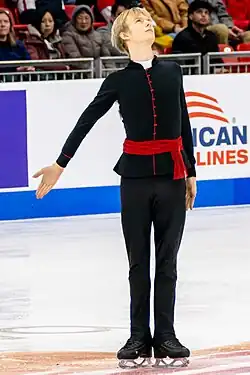


Daniel Grassl, Matteo Rizzo, Lara Naki Gutmann, Sara Conti and Niccolò Macii, and Charlène Guignard and Marco Fabbri
References
- ^ Park, Alice (5 February 2014). "Team figure skating at the Winter Olypmics: What you need to know". Time. Archived from the original on 17 June 2025. Retrieved 30 December 2025.
- ^ a b c d e f g "2026 Olympic Winter Games Competition Schedule Version – Figure Skating". Olympics.com. Archived from the original on 13 January 2026. Retrieved 5 February 2026.
- ^ a b c d Skretta, Dave (5 February 2026). "US Figure Skating squad chasing more Olympic gold as competition begins at the Milan Cortina Games". KTVB-TV. Associated Press. Archived from the original on 6 February 2026. Retrieved 6 February 2026.
- ^ Tétrault-Farber, Gabrielle; Kim, Chang-Ran (7 February 2022). "Figure skating-Russians win team gold, Valieva first woman to land Games quads". Reuters. Archived from the original on 7 February 2022. Retrieved 7 February 2022.
- ^ "ISU Statement – Decision of CAS – Kamila Valieva (ROC)". International Skating Union. 30 January 2024. Archived from the original on 4 May 2024. Retrieved 4 May 2024.
- ^ Iannaconi, Emily (7 August 2024). "More than two years later, U.S. figure skating team receives Olympic gold medals". NBC News. Archived from the original on 7 August 2024. Retrieved 7 August 2024.
- ^ a b c "Communication No. 2754 – Olympic Winter Games 2026 – Entries/Participation Figure Skating Team Event" (PDF). International Skating Union. 10 December 2025. Archived (PDF) from the original on 5 February 2026. Retrieved 10 December 2025.
- ^ a b c "Qualification System – XXV Olympic Winter Games – Milano Cortina 2026" (PDF). International Skating Union. 20 January 2025. Archived (PDF) from the original on 29 May 2025. Retrieved 29 May 2025.
- ^ "Polska wystawi pełną drużynę podczas Zimowych Igrzysk Olimpijskich Mediolan-Cortina 2026" [Poland will field a full team at the Milan-Cortina 2026 Winter Olympic Games.]. Polish Figure Skating Association (in Polish). 26 January 2026. Archived from the original on 31 January 2026.
- ^ Smirnova, Lena (6 February 2026). "Ilia Malinin, Alysa Liu, Sakamoto Kaori lead USA and Japan into figure skating team event at Winter Olympics 2026: All skaters competing - complete list". Olympics.com. Archived from the original on 6 February 2026. Retrieved 8 February 2026.
- ^ a b c d e f S&P/ID 2024, p. 82.
- ^ a b S&P/ID 2024, p. 106.
- ^ S&P/ID 2024, pp. 110–111.
- ^ S&P/ID 2024, p. 119.
- ^ S&P/ID 2024, p. 122.
- ^ a b c "Communication No. 2704: Ice Dance Requirements for Technical Rules, Season 2025/26" (PDF). International Skating Union. 8 August 2025. Archived (PDF) from the original on 20 September 2025. Retrieved 31 August 2025.
- ^ S&P/ID 2024, pp. 83–84.
- ^ S&P/ID 2024, pp. 15–16.
- ^ S&P/ID 2024, pp. 84–85.
- ^ S&P/ID 2024, pp. 16–17.
- ^ S&P/ID 2024, p. 17.
- ^ S&P/ID 2024, pp. 18–19.
- ^ S&P/ID 2024, p. 20.
- ^ "Figure Skating Team Event". Olympics.com. Retrieved 8 February 2026.
{{cite web}}: CS1 maint: url-status (link) - ^ Busbee, Jay (6 February 2026). "Winter Olympics 2026: Alysa Liu, Chock and Bates stake U.S. to early lead in figure skating team event". Yahoo! Sports. Archived from the original on 6 February 2026. Retrieved 6 February 2026.
- ^ a b Barrington, Talia (6 February 2026). "Team USA takes early lead in Olympic figure skating team event". NBC Olympics. Archived from the original on 8 February 2026. Retrieved 8 February 2026.
- ^ "Malinin wins men's figure skating at French Grand Prix". France 24. 19 October 2025. Archived from the original on 19 October 2025. Retrieved 19 October 2025.
- ^ Rainbird, Daniel (4 March 2025). "Figure skater Fournier Beaudry talks new partnership after Sorensen suspension". The Albertan. Archived from the original on 5 April 2025. Retrieved 19 October 2025.
- ^ "Olympic Winter Games Milano Cortina 2026 – Team Event Ice Dance Rhythm Dance – Result Details". International Skating Union. 6 February 2026. Archived from the original on 6 February 2026. Retrieved 6 February 2026.
- ^ "Canadian pair Stellato-Dudek, Deschamps out of figure skating team event". Toronto Star. The Canadian Press. 2 February 2026. Archived from the original on 5 February 2026. Retrieved 2 February 2026.
- ^ a b c d Smirnova, Lena (6 February 2026). "Milano Cortina 2026: Miura Riku / Kihara Ryuichi put Japan back into medal conversation in figure skating team event". Olympics.com. Archived from the original on 6 February 2026. Retrieved 6 February 2026.
- ^ a b Treisman, Rachel (6 February 2026). "The U.S. leads on day one of the figure skating team event. Here's how it works". NPR. Archived from the original on 6 February 2026. Retrieved 6 February 2026.
- ^ "Olympic Winter Games Milano Cortina 2026 – Team Event Pair Skating Short Program – Result Details". International Skating Union. 6 February 2026. Archived from the original on 6 February 2026. Retrieved 6 February 2026.
- ^ a b Smirnova, Lena; Kano, Shintaro (6 February 2026). "Winter Olympics 2026: USA and Japan sit one and two after first day of figure skating team event as Alysa Liu and Sakamoto Kaori show off peak form". Olympics.com. Archived from the original on 6 February 2026. Retrieved 6 February 2026.
- ^ Maine, D'Arcy (25 March 2025). "World figure skating championships preview: Everything to know". ESPN. Archived from the original on 8 April 2025. Retrieved 29 August 2025.
- ^ "Olympic Winter Games Milano Cortina 2026 – Team Event Women Single Skating Short Program – Result Details". International Skating Union. 6 February 2026. Archived from the original on 6 February 2026. Retrieved 6 February 2026.
- ^ a b c d e f Skretta, Dave (7 February 2026). "Defending champ US takes lead into final day of team figure skating at the Milano Cortina Olympics". AP News. Archived from the original on 8 February 2026. Retrieved 8 February 2026.
- ^ Thompson II, Marcus (7 February 2026). "Ilia Malinin dazzles in Olympic debut, but invincibility? Not quite yet". The New York Times. Archived from the original on 8 February 2026. Retrieved 7 February 2026.
- ^ "Olympic Winter Games Milano Cortina 2026 – Team Event Men Single Skating Short Program – Result Details". International Skating Union. 7 February 2026. Archived from the original on 8 February 2026. Retrieved 7 February 2026.
- ^ a b Smirnova, Lena (7 February 2026). "Winter Olympics 2026: Ilia Malinin strong, but not invincible in Olympic debut". Olympics.com. Archived from the original on 7 February 2026. Retrieved 7 February 2026.
- ^ a b Barrington, Talia (7 February 2026). "Madison Chock and Evan Bates reign supreme in Olympic team event". NBC Olympics. Archived from the original on 8 February 2026. Retrieved 8 February 2026.
- ^ a b Smirnova, Lena (7 February 2026). "Winter Olympics 2026: USA figure skating team maintains solid lead after Madison Chock/Evan Bates free-dance masterclass". Olympics.com. Archived from the original on 9 February 2026. Retrieved 8 February 2026.
- ^ "Olympic Winter Games Milano Cortina 2026 – Team Event Ice Dance Free Dance – Result Details". International Skating Union. 7 February 2026. Archived from the original on 8 February 2026. Retrieved 7 February 2026.
- ^ a b c McCarvel, Nick (8 February 2026). "Winter Olympics 2026: Rock-solid Miura Riku and Kihara Ryuichi top pairs free skate as team Japan closes in on U.S. lead". Olympics.com. Retrieved 9 February 2026.
{{cite web}}: CS1 maint: url-status (link) - ^ Price, Caroline (8 February 2026). "Olympic figure skating team event results: U.S. narrowly edges Japan for Gold". Forbes. Archived from the original on 9 February 2026. Retrieved 9 February 2026.
- ^ "Olympic Winter Games Milano Cortina 2026 – Team Event Pair Skating Free Skating – Result Details". International Skating Union. 8 February 2026. Archived from the original on 9 February 2026. Retrieved 8 February 2026.
- ^ a b c Smirnova, Lena (8 February 2026). "Winter Olympics 2026: Sakamoto Kaori fulfills "teammate's vow" to tie Japan with USA in team event". Olympics.com. Retrieved 9 February 2026.
{{cite web}}: CS1 maint: url-status (link) - ^ "Olympic Winter Games Milano Cortina 2026 – Team Event Women Single Skating Free Skating – Result Details". International Skating Union. 8 February 2026. Archived from the original on 9 February 2026. Retrieved 8 February 2026.
- ^ Intarasuwan, Kiki (8 February 2026). "Ilia Malinin leads Team USA to 2nd consecutive gold in Olympic figure skating team event". CBS News. Archived from the original on 8 February 2026. Retrieved 9 February 2026.
- ^ Park, Alice (8 February 2026). "U.S. wins the first figure skating event of the Milano Cortina Olympics". Time. Retrieved 9 February 2026.
{{cite web}}: CS1 maint: url-status (link) - ^ a b c McCarvel, Nick (8 February 2026). "Winter Olympics 2026: Ilia Malinin delivers under pressure, securing Team USA second straight figure skating gold". Olympics.com. Retrieved 9 February 2026.
{{cite web}}: CS1 maint: url-status (link) - ^ "Olympic Winter Games Milano Cortina 2026 – Team Event Men Single Skating Free Skating – Result Details". International Skating Union. 8 February 2026. Archived from the original on 9 February 2026. Retrieved 8 February 2026.
Works cited
- "Special Regulations & Technical Rules – Single & Pair Skating and Ice Dance 2024" (PDF). International Skating Union. Archived (PDF) from the original on 3 June 2025. Retrieved 15 August 2025.