Iran–United States relations during the second Trump administration
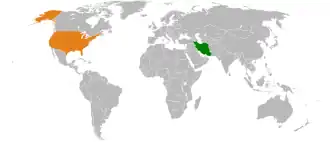 | |
 Iran |
 United States |
|---|---|
| Diplomatic mission | |
| Interests Section in the Pakistani Embassy, Washington, D.C. | Interests Section in the Swiss Embassy, Tehran |
| Envoy | |
| Director of the Interest Section Mehdi Atefat | United States Special Representative for Iran Abram Paley |
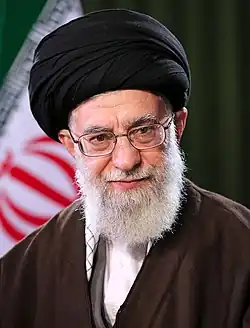
.jpg)
_(3x4_close_cropped).jpg)


Relations between Iran and the United States during Donald Trump's second term as the president of the United States (2025–present) were shaped by alternating diplomacy and pressure.
State of Iran-U.S. relations in January 2025
At the outset of the second Trump administration in January 2025, Iran was led by president Masoud Pezeshkian. He was a member of the reformist faction, and during his presidential campaign he promised to steer Iran in a less conservative direction and mend relations with Western states.[1] The ultimate authority rested with Supreme Leader Ali Khamenei, who held decisive power over Iran’s foreign and security policies. Relations between the U.S. and Iran were deeply strained, with no formal diplomatic ties since 1980. Since Trump's first presidency, the United States had withdrawn from the nuclear deal JCPOA, and previous president Joe Biden saw no possibility of reviving it.[2] In January 2025, there were no ongoing talks between Iran and the U.S.[3]
Iran and Iran-backed groups
By early 2025, Iran's regional influence significantly declined, after setbacks among its proxies and allies. Its proxies—Hamas, Hezbollah, and the Houthis—suffered major setbacks following the October 7 Hamas-led attack on Israel and the subsequent conflicts. The collapse of Bashar al-Assad's regime in Syria critically disrupted Iranian supply routes, severely impacting Hamas and Hezbollah.[4] Russia, Iran's key ally, struggled to provide support as its prolonged war in Ukraine drained resources, further weakening the regional influence of the Iran-led axis.[5]
During Trump's first term (2017–2021), the U.S. withdrew from the 2015 Joint Comprehensive Plan of Action (JCPOA) and imposed maximum-pressure sanctions, severely restricting Iran's oil exports and financial access. His administration sought to renegotiate the deal to impose stricter limits on Iran's nuclear program and curb its funding of regional proxies but failed to reach a new agreement.[6] Under Biden (2021–2025), Iran's economy remained strained, though sanctions enforcement fluctuated. By early 2025, inflation soared, the currency collapsed, and domestic unrest intensified as Iran faced economic isolation while advancing its nuclear program.[7]
Iran's uniquely weakened position now presents a rare opportunity for the United States to reshape the region. During his first term, Trump abandoned the JCPOA in hopes of forging a tougher deal that would impose stricter limits on Iran's nuclear program and its proxy funding—a move that ultimately failed. Many analysts argue that had the original deal remained intact, it could have paved the way for regional stability and a structured U.S. withdrawal, reducing America's long-term military footprint.[8][9] Now, with his second term just beginning, the stakes are high. If decisive steps are taken to secure a new comprehensive agreement, Iran's ambitions could be reined in, fostering stability and paving the way for an orderly exit of American forces. Conversely, without such bold action, there is a significant risk that U.S. troops could remain entrenched in the Middle East for decades to come.[10]
Elon Musk met with Iran's UN Ambassador, Saeid Iravani, on November 11, 2024.[11][12] In January 2025, Elon Musk reportedly helped Italy's prime minister Giorgia Meloni secure the release of Italian citizen Cecila Sala from an Iranian prison.[13]
Maximum pressure campaign
In February 2025, President Donald Trump signed a National Security Presidential Memorandum[14] reinstating the "maximum pressure" campaign against Iran, aiming to compel Tehran to negotiate a new nuclear agreement while preventing its development of nuclear weapons and countering its regional influence. The memorandum mandates heightened economic sanctions targeting Iran's oil exports, with the objective of reducing them to zero, and directs the revocation of existing sanctions waivers. Trump stated he would rather make a deal than take military action against Iran,[15] framing the pressure campaign as a means to force diplomacy. This policy has led to significant economic challenges within Iran, including a sharp currency depreciation and political instability, as evidenced by the resignation of key officials such as Vice President Mohammad Javad Zarif and the impeachment of Economy Minister Abdolnaser Hemmati.[16] While proponents argue that these measures are necessary to curb Iran's nuclear ambitions and support for militant groups, critics contend that the campaign exacerbates humanitarian issues and regional tensions without effectively altering Iran's strategic behavior.
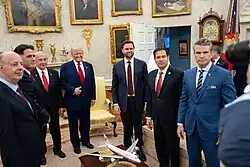
Bilateral talks
In March 2025, U.S. President Donald Trump confirmed that he sent a letter to Iran's Supreme Leader Ayatollah Ali Khamenei, urging negotiations for a new nuclear agreement to replace the 2015 deal from which he withdrew in 2018. Emphasizing a preference for diplomacy, Trump warned of potential military action should negotiations fail.[17][18] Iran officially responded to Trump's letter via Oman on March 26, rejecting direct talks under pressure but leaving the door open to indirect negotiations.[19] Days later the U.S. deployed four B-2 Spirit stealth bombers to Diego Garcia—over 20% of the total B-2 fleet. Though officially aimed at deterring Iran-backed Houthi rebels in Yemen, some analysts suggest the scale and capabilities of the deployment point to preparations for a potential strike on hardened Iranian nuclear targets like Fordow or Natanz, possibly in coordination with Israel.[20] On March 30, President Trump escalated pressure by threatening bombing “the likes of which [Iran has] never seen” and warning of secondary tariffs. The deployment and rhetoric are widely seen as part of a calculated pressure campaign to force Tehran back to the table, as Iran's uranium enrichment levels continue to exceed the limits set by the original 2015 accord.[21]
On April 25, 2025, Trump said he would not let Netanyahu drag him into a war with Iran and was interested in meeting with Iran's Ayatollah Ali Khamenei, but threatened a joint Israeli-US military operation to thwart Iran's nuclear program if diplomacy failed.[22]
Iran–backed Houthis in Yemen
On March 15, 2025, the U.S. launched airstrikes on Houthi targets in Yemen to counter attacks on Red Sea shipping. President Trump stated the strikes aimed to restore navigation freedom and deter further aggression. The Houthi-run health ministry reported 31 deaths and over 100 injuries. The Iran-backed group vowed to continue targeting vessels until Israel lifted its Gaza blockade. Trump warned of further action, urging Iran to withdraw support.[23]
In March 2025, the Trump administration accidentally included The Atlantic editor Jeffrey Goldberg in a Signal group chat discussing classified military plans to strike Houthi targets in Yemen. The chat involved top officials including Vice President JD Vance and Defense Secretary Pete Hegseth. The leak, dubbed “Signalgate,” sparked bipartisan outrage and serious concerns over national security and operational discipline. President Trump dismissed the incident as a minor error, but critics called it a major intelligence failure.[24]
Iran–Israel war
In March 2025, US Director of National Intelligence, Tulsi Gabbard, testified that the US intelligence community, "continues to assess Iran is not building a nuclear weapon and Supreme Leader Khamenei has not authorized a nuclear weapons program".[25] In April 2025, Trump announced negotiations between the US and Iran regarding Iran's nuclear program. The White House declared that Iran had two months to secure a deal, which expired the day before Israel's strikes.[26]
On June 13, 2025, President Trump praised the Israeli strikes on Iran as "excellent" and "very successful,"[27] and warned that Iran must "make a deal now" over its nuclear program or face "even more destructive and deadly military action."[28] Trump authorized US forces to assist in intercepting the initial Iranian missile barrage. The US warned Iran against attacking American interests or personnel, emphasizing it would respond militarily if such attacks occurred.[29] On June 17, Trump stated that a "real end" was better than a ceasefire.[30] He then demanded unconditional surrender by Iran.[31] Trump also threatened Iran's Supreme Leader Ali Khamenei saying that he is an "easy target" and could assassinate him at any moment. The threat came two days after it was reported that Trump allegedly vetoed a plan by Israel to assassinate the ayatollah.[32] Some supporters of Trump in the United States have criticized Trump's support for Israeli strikes against Iran,[33] and the possible involvement of the United States in the war.[34] In a poll of Trump voters, 53% said the U.S. should not get involved in the Iran–Israel conflict.[35]
On June 19, 2025, the White House said that Trump would decide "within two weeks" whether to join Israel's war against Iran.[36] Trump's special envoy Steve Witkoff and Iranian Foreign Minister Abbas Araghchi have spoken by phone several times since the start of the Israeli strikes on Iran.[37]
United States strikes on Iranian nuclear sites
On June 22, 2025, the U.S. launched direct strikes on Iranian nuclear sites.[38] The attack was the United States's only offensive action in the Iran–Israel war, which began on June 13 with surprise Israeli strikes[39][40] and ended with the ceasefire on June 24, 2025.[41]
On October 13, 2025, Trump stated that the United States was ready to reach an agreement with Iran. He expressed optimism that an agreement could be achieved. In response, Iranian foreign minister Araqchi said Tehran would consider any proposal from the United States that was “fair and balanced,” though he noted that no concrete framework for talks had yet been presented and that messages between the two sides were exchanged through intermediaries.[42] Despite the conciliatory language from Trump, his administration maintained a firm stance toward Iran, and observers noted that significant barriers still stood in the way of improved relations between the two nations.[43]
2025–2026 Iranian protests
In early January 2026, amid a widespread and increasingly violent crackdown on protesters on the 2025–2026 Iranian protests, President Donald Trump said the United States was considering a range of responses, including possible military options, if Iranian actions crossed what he described as a red line.[44][45] He publicly encouraged Iranians to escalate mass protests and take over regime institutions, while stating that US assistance was forthcoming.[46] He added that the US military was assessing “very strong options” and that senior advisers were preparing to discuss potential measures, while also noting that Iranian leaders had reached out for negotiations.[47]
Iranian officials warned that any United States attack would trigger retaliation against United States forces and allied interests in the region.[47] On January 16, 2026, Trump announced that the Iranian leadership had reportedly canceled over 800 planned executions,[48] and he backed away from his threats to attack Iran.[49]
While the protests in Iran were taking place, the US began building up a military force in the Middle-East, that was deployed near Iran.[50] On 27 January 2026, a day after the deployment of the USS Abraham Lincoln to the region, the United States announced a multi-day aerial military exercise.[51] The same day, Trump said that another naval fleet was heading toward Iran.[52][53] Separately, the Pentagon ordered US Air Force F-15E Strike Eagles based at Royal Air Force Lakenheath in Britain to redeploy to American air bases in Jordan.[53] Reports from February 2026, claim that according to satellite imagery the US force build up includes fighter jets, warships and missile-defense systems. According to analysts the deployments are visible at bases in Qatar, Oman and Jordan, and say they can support both offensive operations and defenses against Iranian retaliation.[54][55]
Renewed talks
Indirect negotiations between Iran and the United States resumed in Oman on February 6, 2026. These were the first negotiations between the two sides since the Iran–Israel war the previous summer. The discussions were mediated by Oman, and they involved Iranian Foreign Minister Abbas Araghchi and United States envoy Steve Witkoff. The two sides disagreed over the scope of the discussions, but did agree to hold follow up meetings. The talks were held against the backdrop of a United States military buildup in the Middle East and followed threats by President Trump to strike Iran if it used lethal force against protesters or refused to conclude a nuclear agreement.[56][57]
See also
- American Iranian Council
- Correspondence between Barack Obama and Ali Khamenei
- Foreign relations of Iran
- Foreign policy of the second Trump administration
- Iran–America Society
- Iran and state-sponsored terrorism
- Iran nuclear deal framework
- Iran–United States relations
- Iran–United States relations during the George W. Bush administration
- Iran–United States relations during the Obama administration
- Iran–United States relations during the first Trump administration
- Iran–United States relations during the Biden administration
- Iranian Americans
- List of ambassadors of Iran to the United States
- Famous Americans in Iran
- Great Satan and Little Satan
- Global arrogance
- Views on military action against Iran
- Shia crescent
- Tehrangeles
- Academic relations between Iran and the United States
- United States cultural diplomacy in Iran
References
- ^ Persian, Tom Bennett & BBC (July 8, 2024). "Masoud Pezeshkian: The reformist now Iran's president-elect". BBC Home. Retrieved September 16, 2025.
- ^ Barak Ravid, Hans Nichols (December 20, 2022). "Iran nuclear deal is "dead," Biden says in newly surfaced video". Axios. Retrieved September 16, 2025.
- ^ Lotz, Avery (June 23, 2025). "How past U.S. presidents have approached Iran's nuclear program". Axios. Retrieved September 16, 2025.
- ^ Haltiwanger, John (March 6, 2025). "How Weakened Is Iran, Actually?". Foreign Policy. Retrieved March 6, 2025.
- ^ "New Russia-Iran Treaty Reveals the Limits of Their Partnership". Carnegie Endowment for International Peace. Retrieved March 6, 2025.
- ^ "President Donald J. Trump is Ending United States Participation in an Unacceptable Iran Deal – The White House". trumpwhitehouse.archives.gov. Retrieved March 6, 2025.
- ^ "MSN". www.msn.com. Retrieved March 6, 2025.
- ^ Schumann, Anna (May 11, 2020). "A worthless withdrawal: Two years since President Trump abandoned the JCPOA". Center for Arms Control and Non-Proliferation. Retrieved March 6, 2025.
- ^ Admin (September 9, 2024). "JCPOA: Understanding the Iran Nuclear Deal - The Asian Politico". Retrieved March 6, 2025.
- ^ Panikoff, Jonathan (March 6, 2025). "Will Trump Strike Iran or Strike a Deal?". Foreign Policy. Retrieved March 6, 2025.
- ^ "Iranian official met with Musk in a possible step to ease tensions with Trump". Associated Press. November 16, 2024. Archived from the original on November 27, 2024. Retrieved November 16, 2024.
Iran's U.N. Ambassador Amir Saeid Iravani met with Musk — a Trump ally named this week to advise his administration on ways to cut the federal government — on Monday in New York, according to a U.S. official briefed on the meeting by a foreign colleague.
- ^ "Musk met with Iran's U.N. ambassador, Iranian officials say". The Spokesman-Review. November 14, 2024. Archived from the original on November 26, 2024. Retrieved November 15, 2024.
- ^ Fassihi, Farnaz; Bubola, Emma; Wong, Edward (January 15, 2025). "Musk Said to Have Intervened to Help Free Italian Jailed in Iran". The New York Times.
- ^ "Fact Sheet: President Donald J. Trump Restores Maximum Pressure on Iran". The White House. February 5, 2025. Retrieved March 3, 2025.
- ^ "Netanyahu seeks to draw Trump into future attack on Iranian nuclear sites". The Guardian. February 17, 2025.
- ^ Wintour, Patrick (March 3, 2025). "Iran's vice-president and most prominent reformist resigns". The Guardian. ISSN 0261-3077. Retrieved March 3, 2025.
- ^ "Trump says he sent a letter to Iran's supreme leader over country's advancing nuclear program". AP News. March 7, 2025. Retrieved March 7, 2025.
- ^ Crane, Emily (March 7, 2025). "Trump says he's pushing to negotiate nuclear deal with Iran". Retrieved March 7, 2025.
- ^ "Iran responds to Trump letter on nuclear talks, state media reports". Al Jazeera. Retrieved March 29, 2025.
- ^ Filseth, Trevor (March 28, 2025). "Diego Garcia Buildup: Is America Preparing to Attack Iran?". The National Interest. Retrieved March 29, 2025.
- ^ Chiacu, Doina; Ljunggren, David (March 30, 2025). "Trump threatens bombing if Iran does not make nuclear deal". reuters.
- ^ "Trump: Israel won't drag us into war with Iran, but we'll lead the pack if no deal made". The Times of Israel. April 25, 2025.
- ^ "US launches wave of air strikes on Yemen's Houthis". www.bbc.com. March 16, 2025. Retrieved March 19, 2025.
- ^ Goldberg, Jeffrey (March 24, 2025). "The Trump Administration Accidentally Texted Me Its War Plans". The Atlantic. Retrieved March 29, 2025.
- ^ "Israel says Iran was racing toward a nuclear weapon. US intel says it was years away". CNN. June 17, 2025.
- ^ Balmer, Crispian (June 13, 2025). "After years of waiting, Israel's Netanyahu finally makes his move on Iran". Reuters. Retrieved June 13, 2025.
- ^ "Make a deal or attacks will be 'more brutal', Trump warns Iran after Israeli strikes - live updates". BBC News. June 13, 2025. Retrieved June 13, 2025.
- ^ "Trump tells Iran to make a deal or face 'even more brutal' attacks". The Times of Israel. June 13, 2025. Retrieved June 13, 2025.
- ^ Levitt, Matthew (June 13, 2025). "Israel Strikes Iran: Initial Assessments from Washington Institute Experts". The Washington Institute for Near East Policy.
- ^ Kaitlan Collins; Kevin Liptak (June 17, 2025). "'A real end' better than a ceasefire between Israel and Iran, Trump says". CNN. Retrieved June 17, 2025.
- ^ "Trump demands 'UNCONDITIONAL SURRENDER' from Iran as he issues chilling threat to Supreme Leader Khamenei". The Independent. June 17, 2025.
- ^ Breuninger, Kevin (June 17, 2025). "Trump threatens Iran's leader, demands 'unconditional surrender'". CNBC. Retrieved June 17, 2025.
- ^ "'Drop Israel': How military escalation with Iran divides Trump's base". Al Jazeera English. June 14, 2025.
- ^ Pager, Tyler; Broadwater, Luke (June 13, 2025). "Republicans Are Divided Over Iran. Will Trump Pick a Side?". The New York Times. ISSN 0362-4331. Retrieved June 17, 2025.
- ^ Luscombe, Richard (June 18, 2025). "Most Trump supporters want to keep US military out of Israel-Iran conflict, poll finds". The Guardian. Retrieved June 18, 2025.
- ^ "Trump to decide whether US will strike Iran 'within next two weeks'". Al Jazeera. June 19, 2025.
- ^ "Iran holding direct talks with US, says it could bend on nukes if attacks stop". The Times of Israel. June 19, 2025.
- ^ Nagourney, Eric; Haberman, Maggie (June 21, 2025). "U.S. Enters War With Iran, Striking Fordo Nuclear Site: Live Updates". The New York Times. Archived from the original on June 21, 2025. Retrieved June 21, 2025.
- ^ "The U.S. Enters Israel's War Against Iran: What to Know". The New York Times. June 13, 2025. ISSN 0362-4331. Archived from the original on June 22, 2025. Retrieved June 22, 2025.
- ^ Magid, Jacob; Agencies. "US bombs Fordo, 2 other nuclear facilities, joining Israel's war in Iran". The Times of Israel. Archived from the original on June 22, 2025. Retrieved June 22, 2025.
- ^ "Israel says Iran's nuclear plans set back 'many years' after US report casts doubt on impact - live updates". BBC News. Archived from the original on June 26, 2025.
- ^ Jana Choukeir, Ahmed Elimam (October 13, 2025). "US is ready for deal with Iran when Tehran is, Trump says". Reuters. Retrieved October 17, 2025.
- ^ Osgood, Brian (October 13, 2025). "Reviving US-Iran diplomacy difficult despite Trump's 'hand of friendship'". Al Jazeera. Retrieved October 17, 2025.
- ^ "Donald Trump says US 'looking' at military operations in Iran". Financial Times.
- ^ "Trump warns of 'very strong action' if Iran follows through with threats of hanging protestors". Le Monde. January 13, 2026.
- ^ Elwely Elwelly, Bo Erickson (January 14, 2026). "Trump urges Iranians to keep protesting, saying 'help is on its way'". Reuters. Retrieved February 7, 2026.
- ^ a b "Donald Trump says US 'looking' at military operations in Iran". Financial Times. January 12, 2026.
- ^ Christou, William (January 17, 2026). "Ali Khamenei says thousands killed in Iran protests, some in 'inhuman, savage manner'". The Guardian.
- ^ Shamim, Sarah (January 30, 2026). "US-Iran tensions: The diplomatic scramble to prevent a war". Al Jazeera. Retrieved February 7, 2026.
- ^ "Satellite imagery shows where the U.S. military is positioned near Iran". The Washington Post. February 3, 2026. ISSN 0190-8286. Retrieved February 10, 2026.
- ^ Roth, Andrew (January 27, 2026). "US announces multi-day aerial military drills in the Middle East amid Iran tensions". The Guardian. ISSN 0261-3077. Retrieved January 28, 2026.
- ^ "Trump: Another war fleet heading toward Iran". LBCIV7. Retrieved January 28, 2026.
- ^ a b "Trump says another "armada" sailing toward Iran - People's Daily Online". en.people.cn. Retrieved January 28, 2026.
- ^ "Satellite images show US military build-up near Iran ahead of nuclear talks". ABC News. February 5, 2026. Retrieved February 10, 2026.
- ^ "Satellite imagery shows where the U.S. military is positioned near Iran". The Washington Post. February 3, 2026. ISSN 0190-8286. Retrieved February 10, 2026.
- ^ Ebrahim, Nadeen; Salem, Mostafa (February 6, 2026). "US and Iran conclude high-stakes talks in Oman. Here's what to know". CNN. Retrieved February 7, 2026.
- ^ Simon Lewis, Humeyra Pamuk,Parisa Hafezi (February 4, 2026). "US and Iran agree to Friday talks in Oman but still at odds over agenda". Reuters. Retrieved February 7, 2026.
{{cite web}}: CS1 maint: multiple names: authors list (link)
| Diplomatic posts |
|
|---|---|
| Diplomacy |
|
| Conflicts | |
| Incidents after 1979 |
|
| Legislation |
|
| Groups and individuals |
|
| Related |
|
 Category Category | |
| |||||||||
| Life and politics |
| ||||||||
| Family |
| ||||||||
| Campaigns |
| ||||||||
| Legal affairs |
| ||||||||
| Related |
| ||||||||
Second presidency of Donald Trump (2025–present) | |||||||||||||||
|---|---|---|---|---|---|---|---|---|---|---|---|---|---|---|---|
| General |
| ||||||||||||||
| Events |
| ||||||||||||||
| Policies |
| ||||||||||||||
| Democratic backsliding |
| ||||||||||||||
| Protests |
| ||||||||||||||
| Related |
| ||||||||||||||
| |||||||||||||||