List of military conflicts involving Hungary (1301–1526)
| History of Hungary |
|---|
 |
 Hungary portal Hungary portal |
This is a list of military conflicts in which Hungarian armed forces participated in or took place on the historical territory of Hungary.
By timeline:
- List of military conflicts involving Hungary (800–1300)
- List of military conflicts involving Hungary (1301–1526)
- List of military conflicts involving Hungary (1527–1700)
- List of military conflicts involving Hungary (1701–1900)
- List of military conflicts involving Hungary (1901–2000)
- List of military conflicts involving Hungary (2001–)
For major wars, see:
The list includes the name, date, Hungarian allies and enemies, and the result of each conflict, using the following legend:
- Victory
- Defeat
- Result of civil or internal conflict
- Treaty or peace without a clear result, status quo ante bellum, an unknown or indecisive result
- Ongoing conflict
Wars between 1301 and 1526
| Date | Conflict | Allies | Enemies | Result |
|---|---|---|---|---|
| 1301–1308 | Árpád war of succession, after the extinction of the Árpád dynasty | .svg.png) Charles Robert of Anjou Charles Robert of Anjou Duchy of Austria Duchy of Austria Matthew III Csák's army László Kán's army |
 Kingdom of Bohemia Kingdom of Bohemia  Duchy of Bavaria Duchy of Bavaria Kőszegi Hungarian noble family |
Angevin victory
|
| 1310–1321 | King Charles I's wars for the centralized power against the Hungarian aristocracy | Kingdom of Hungary.svg.png) Order of Saint John Order of Saint JohnZipser Saxons |
Matthew III Csák Aba dynasty Borsa family Apor family Kőszegi family |
Royal victory
|
| 1312 | Battle of Rozgony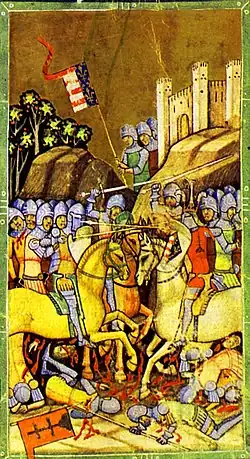 |
Kingdom of Hungary Order of Saint John Zipser Saxons |
Aba dynasty Matthew III Csák |
Decisive victory for King Charles I, weakening of the magnates |
| 1319 | Belgrade and Banate of Mačva | Charles I of Hungary
|
.svg.png) Kingdom of Serbia (medieval), Stefan Milutin Kingdom of Serbia (medieval), Stefan Milutin
|
Victory for Charles I |
| 1322–1337 | Hungarian – Austrian War, restoration of the western borders, defeat of Austria, Kőszegi and Babonić families | Kingdom of Hungary
|
Duchy of Austria .svg.png) Holy Roman Empire Holy Roman EmpireKőszegi family Babonić Croatian noble family |
Hungarian victory |
| 1321–1324 | Hungarian–Serbian War | Kingdom of Hungary Bosnia Stephen Vladislav II of Syrmia |
Kingdom of Serbia (medieval)
|
Hungarian defeat |
| 1330 | Battle of Posada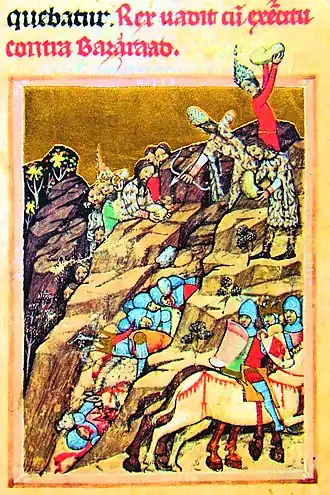 |
Kingdom of Hungary
|
.svg.png) Wallachia Wallachia
|
Hungarian defeat
|
| 1344 | King Louis the Great's invasion and occupation of Wallachia and Moldavia[1] | .svg.png) Kingdom of Hungary Kingdom of Hungary
|
Wallachia Moldavia Moldavia
|
Hungarian victory, Wallachia and Moldavia became vassal states of King Louis the Great[2] |
| 1345–1358 | Hungarian – Venetian War, Venice had to pay annual tribute to Louis. Venetians also had to raise the Angevin flag on Piazza San Marco. | Kingdom of Hungary
|
 Republic of Venice Republic of Venice
|
Decisive Hungarian victory Treaty of Zadar |
| 1345 | The campaign of King Louis I against the rebellious Croatian nobles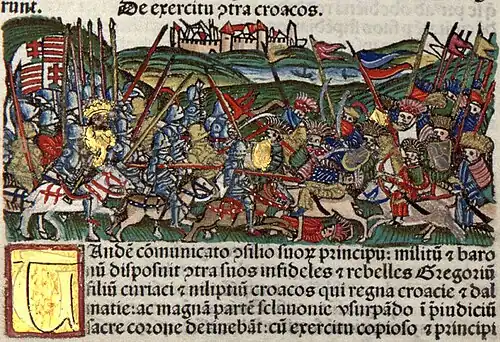 |
Kingdom of Hungary
|
Croatian nobles | Hungarian victory |
| 1345 | Hungary's war with the Golden Horde | Kingdom of Hungary
|
 Golden Horde Golden Horde
|
Hungarian victory |
| 1347–1349, 1350–1352 | Hungarian-Naples Wars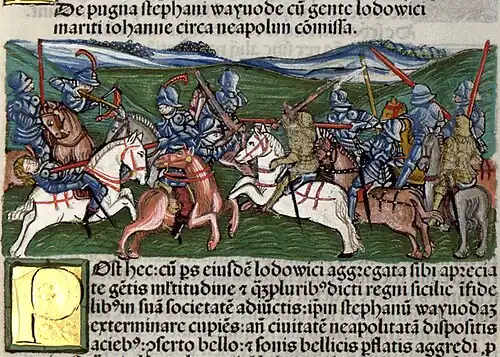 |
Kingdom of Hungary
|
 Kingdom of Naples Kingdom of Naples
|
First campaign: temporary Hungarian victory Second campaign: status quo ante bellum |
| 1348 | Battle of Capua | Kingdom of Hungary
|
Kingdom of Naples
|
Hungarian victory, occupation of the kingdom |
| 1356–1359 | Crusade against Francesco Ordelaffi | Pope Innocent VI | Francesco II Ordelaffi | Victory |
| 1360–1369 | Louis I's balcanic wars (against Serbia, Bulgaria, Wallachia and Bosnia) | Kingdom of Hungary
|
 Serbian Empire Serbian Empire  Second Bulgarian Empire Second Bulgarian Empire Bosnia  Wallachia Wallachia
|
Temporary Hungarian victories |
| 1366–1367 | Hungarian – Ottoman War | Kingdom of Hungary Duchy of Savoya Duchy of Savoya Padua Republic of Venice Padua Republic of Venice.svg.png) Kingdom of France Kingdom of France Byzantine Empire Byzantine Empire
|
 Ottoman Empire Ottoman Empire Second Bulgarian Empire Second Bulgarian Empire
|
Christian victory |
| 1369 | Wallachian campaign | Kingdom of Hungary
|
Wallachia
|
Hungarian victory |
| 1372–1381 | War of Chioggia, Hungary defeated the Venetians in several times, and finally expelled Venetians from Dalmatia, however Genoa, Padoa and Austria lost the War. The war resulted in the Treaty of Turin (1381) | Kingdom of Hungary
|
Republic of Venice Milan Ottoman Empire Milan Ottoman Empire Kingdom of Cyprus Kingdom of Cyprus
|
Hungarian victory, Venice had to pay annual tribute to King of Hungary |
| 1375–1377 | Hungarian–Ottoman War |
Kingdom of Hungary
|
 Ottoman Empire Ottoman Empire.png) Second Bulgarian Empire Second Bulgarian Empire
|
Hungarian victory |
| 1377 | Hungarian – Lithuanian war | Kingdom of Hungary
|
 Grand Duchy of Lithuania Grand Duchy of Lithuania
|
Hungarian victory, Louis I enters Vilnius[3] |
| 1384–1394 | Civil war between a part of the Hungarian nobility and Mary, Queen of Hungary and Sigismund king | Kingdom of Hungary
|
Horváti family Kingdom of Naples
|
Sigismund's victory |
| 1394–1395 | Wallachian campaign |  Kingdom of Hungary Kingdom of Hungary
|
Wallachia
|
Wallachia became a Hungarian vassal, Mircea I the Great accepted the lordship of King Sigismund without any fight. |
| 1394–1395 | Moldavian campaign | Kingdom of Hungary
|
Moldavia
|
Hungarian victory |
| 1396 | Battle of Nicopolis_1.jpg) |
Kingdom of Hungary Holy Roman Empire.svg.png) Kingdom of France Knights Hospitaller Kingdom of France Knights Hospitaller Duchy of Burgundy Duchy of Burgundy Duchy of Savoy Wallachia Duchy of Savoy Wallachia Lands of the Bohemian Crown Lands of the Bohemian Crown Kingdom of Poland Kingdom of Poland Kingdom of Croatia Kingdom of Croatia Swiss Confederacy Swiss Confederacy Kingdom of England Republic of Venice Kingdom of England Republic of Venice Republic of Genoa Republic of Genoa.svg.png) Crown of Castile Crown of Castile Crown of Aragon Crown of Aragon Kingdom of Navarre Second Bulgarian Empire Kingdom of Navarre Second Bulgarian Empire Teutonic Order Byzantine Empire Teutonic Order Byzantine Empire
|
Ottoman Empire Moravian Serbia Moravian Serbia
|
Crusader defeat
|
| 1407–1408 | Bosnian campaign
|
Kingdom of Hungary
|
 Kingdom of Bosnia Kingdom of Bosnia
|
Hungarian victory
|
| 1411–1433 | Hungarian – Venetian War | Kingdom of Hungary Milan
|
Republic of Venice
|
Dalmatia became part of Venice |
| 1412 | Battle of Motta | Kingdom of Hungary
|
Republic of Venice
|
Venetian victory |
| 1415–1419 | Hungarian – Ottoman War | Kingdom of Hungary
|
Ottoman Empire
|
Stalemate |
| 1419–1434 | Hussite Wars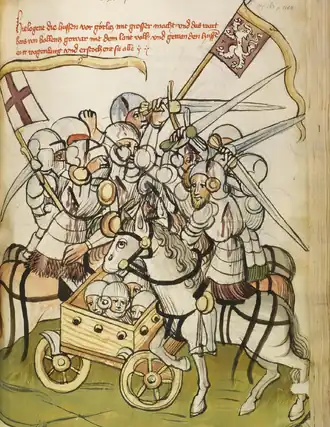 |
Holy Roman Empire Kingdom of Hungary
Moderate Hussites (since 1423) |
Hussites (mostly united until 1434) Radical Hussites (since 1434) | Victory of the moderate Hussites and Catholics over the radical Hussites.
|
| 1420–1432 | War of the South Danube | Kingdom of Hungary Wallachia Wallachia.svg.png) Grand Duchy of Lithuania Grand Duchy of Lithuania
|
Ottoman Empire
|
Armistice |
| 1420 | Battle of Vítkov Hill | Holy Roman Empire Kingdom of Hungary
|
Hussites | Hussite victory |
| 1420 | Battle of Vyšehrad | Holy Roman Empire Kingdom of Hungary
|
Hussites | Hussite victory |
| 1421 | Battle of Kutná Hora | Holy Roman Empire Kingdom of Hungary
|
Hussites | Hussite victory |
| 1421 | Battle of Nebovidy | Holy Roman Empire Kingdom of Hungary
|
Hussites | Hussite victory |
| 1422 | Battle of Německý Brod | Holy Roman Empire Kingdom of Hungary
|
Hussites | Hussite victory |
| 1428 | Siege of Golubac | Kingdom of Hungary
|
Ottoman Empire
|
Ottoman victory |
| 1430 | Battle of Trnava | Holy Roman Empire Kingdom of Hungary
|
Hussites | Hussite victory |
| 1431 | Battle of Ilava | Kingdom of Hungary
|
Orphans | Hungarian-Royalists victory |
| 1437 | Raid on Kruševac | Kingdom of Hungary
|
Ottoman Empire
|
Hungarian victory |
| 1437 | Transylvanian peasant revolt of Budai Nagy Antal | Transylvanian aristocracy | Transylvanian peasants | Defeat of the rebels
|
| 1437 | Battle of Smederevo | Kingdom of Hungary
|
Ottoman Empire
|
Hungarian victory[4]
|
| 1438 | Transylvanian campaign | Kingdom of Hungary
|
Ottoman Empire
|
Ottoman victory |
| 1437–1442 | Hungarian–Ottoman War |  Kingdom of Hungary Kingdom of Hungary
|
Ottoman Empire
|
Hungarian victory |
| 1440 | Siege of Belgrade | .svg.png) Kingdom of Hungary Kingdom of Hungary
|
Ottoman Empire
|
Hungarian victory |
| 1440–1442 | Hungarian Civil War (1440–1442) |
|
|
Peace agreement, Vladislaus is accepted as Hungarian king
|
| 1441 | Battle of Smederevo |
Kingdom of Hungary
|
Ottoman Empire
|
Hungarian victory |
| 1442 | Battle of the Iron Gate (Szeben by older historiography)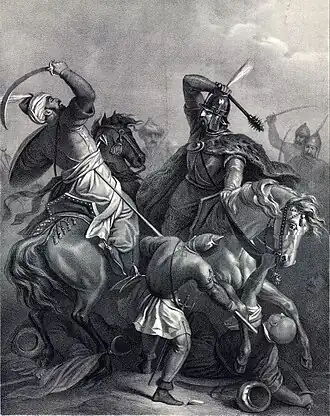 |
Kingdom of Hungary
|
Ottoman Empire
|
Hungarian victory
|
| 1442 | Battle of the Ialomița (Iron Gate by older historiography) |
Kingdom of Hungary
|
Ottoman Empire
|
Hungarian victory
|
| 1443–1444 | Long campaign |
Kingdom of Hungary
|
Ottoman Empire
|
Hungarian victory |
| 1443 | Battle of Nish | Kingdom of Hungary Kingdom of Poland Serbian Despotate Wallachia Moldavia Serbian Despotate Wallachia Moldavia
|
Ottoman Empire
|
Crusader Victory |
| 1443 | Battle of Zlatitsa | Kingdom of Hungary Kingdom of Poland Serbian Despotate.svg.png) Papal States Papal States
|
Ottoman Empire
|
Stalemate |
| 1444 | Battle of Kunovica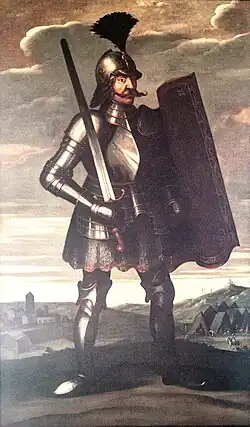 |
Kingdom of Hungary Kingdom of Poland Serbian Despotate
|
Ottoman Empire
|
Crusader Victory |
| 1444 | Battle of Varna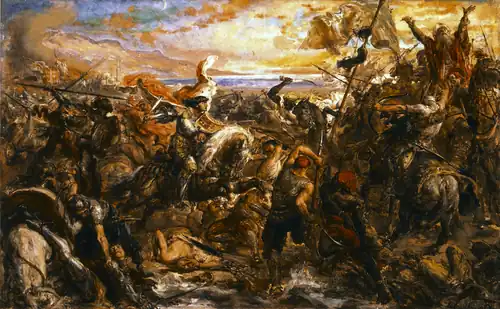 |
Kingdom of Hungary Kingdom of Poland Kingdom of Croatia Grand Duchy of Lithuania Crown of Bohemia WallachiaBulgarian rebelsKingdom of BosniaPapal StatesTeutonic Knights Grand Duchy of Lithuania Crown of Bohemia WallachiaBulgarian rebelsKingdom of BosniaPapal StatesTeutonic Knights
|
Ottoman Empire
|
Crusader defeat
|
| 1447 | Wallachian campaign | .svg.png) Kingdom of Hungary Kingdom of Hungary
|
Wallachia Ottoman Empire
|
Hungarian victory
|
| 1448 | Second Battle of Kosovo / Rigómező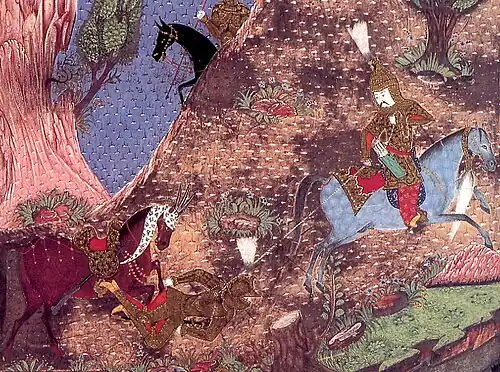 |
Kingdom of Hungary Wallachia
|
Ottoman Empire Wallachia (Switched to the Ottoman side on the third day of the battle)[11][12][13][14][15]
|
Ottoman victory |
| 1454 | Battle of Kruševac | Kingdom of Hungary
|
Ottoman Empire
|
Hungarian victory
|
| 1456 | Siege of Belgrade / Nándorfehérvár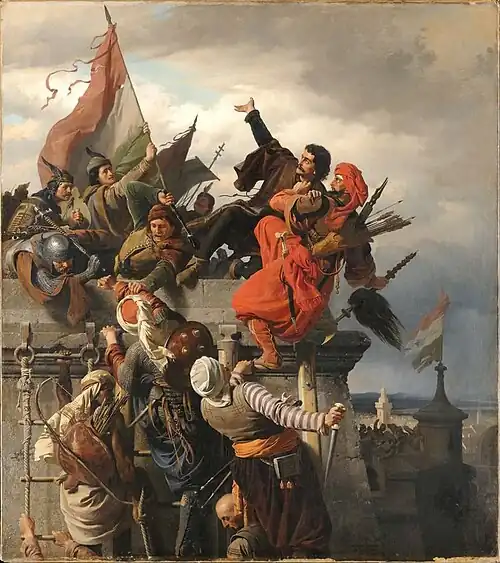 |
Kingdom of Hungary
|
Ottoman Empire
|
Hungarian victory
|
| 1458–1459 | Matthias I's war with Ján Jiskra | .svg.png) Kingdom of Hungary Kingdom of Hungary
|
Jiskra's soldiers | Royal victory |
| 1458–1465 | War in Bosnia |  Kingdom of Hungary Kingdom of Hungary
|
Ottoman Empire
|
Partial Bosnian territory occupied by the Ottoman Empire. |
| 1460 | Battle of Pozazin |  Troops of Michael Szilágyi Troops of Michael Szilágyi
|
Ottoman raiding army of Ali Bey Mihaloğlu
|
Ottoman victory
|
| 1464 | Siege of Jajce | Kingdom of Hungary
|
Ottoman Empire
|
Hungarian victory |
| 1465–1471 | Hussite uprising in North-Hungary | Kingdom of Hungary
|
Czech hussite rebels | Hungarian victory |
| 1467 | Hungarian - Moldavian war | Kingdom of Hungary
|
Moldavia
|
Both side claimed victory |
| 1468–1478 | Bohemian War (1468–1478) | Kingdom of Hungary
|
Kingdom of Bohemia
|
Treaty of Olmütz, Matthias became king of Bohemia |
| 1471 | Hungarian – Polish war. King Matthias I forced King Casimir IV to withdraw from Hungary | Kingdom of Hungary
|
Kingdom of Poland
|
Hungarian victory |
| 1471–1476 | Matthias's intervention in the Moldovian – Ottoman War | Kingdom of Hungary Moldavia
|
Ottoman Empire
|
After initial Hungarian-moldavian victories Hungary stopped the advocating of Moldavia, so Stephen III moldavian ruler became vasal of the Ottoman Empire. |
| 1474 | Siege of Wrocław / Breslau / Boroszló | Kingdom of Hungary
|
Kingdom of Poland Kingdom of Bohemia
|
Between 1469 and 1490, Wrocław was part of the Kingdom of Hungary. In 1474, the city was besieged by combined Polish–Czech forces. Kings Casimir IV of Poland, his son Vladislaus II of Bohemia, and Matthias Corvinus of Hungary met in the nearby village, and a ceasefire was signed according to which the city remained under Hungarian rule. |
| 1475 | Battle of Vaslui | Moldavia Kingdom of Hungary Kingdom of Poland
|
Ottoman Empire Wallachia
|
Moldavian–Hungarian–Polish victory |
| 1476 | Siege of Šabac / Szabács | Kingdom of Hungary
|
Ottoman Empire
|
King Matthias besieged and seized Šabac, an important Ottoman border fort |
| 1479 | Battle of Breadfield / Kenyérmező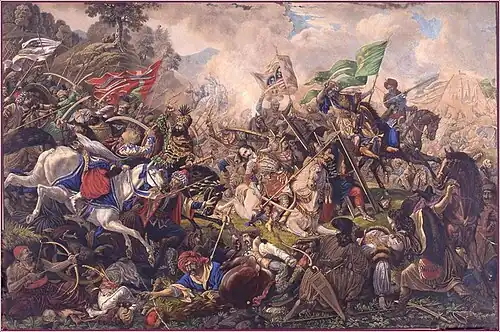 |
Kingdom of Hungary
|
Ottoman Empire Wallachia
|
Hungarian victory
|
| 1480–1481 | Battle of Otranto | Kingdom of Hungary Kingdom of Naples Crown of Aragon Kingdom of Naples Crown of Aragon.svg.png) Kingdom of SicilyPapal States Kingdom of SicilyPapal States
|
Ottoman Empire
|
Christian victory |
| 1482–1488 | Austrian – Hungarian War | Kingdom of Hungary
|
Holy Roman Empire
|
Decisive Hungarian victory
|
| 1482 | Siege of Hainburg | Kingdom of Hungary
|
Holy Roman Empire
|
Holy Roman Empire victory
|
| 1482 | Siege of Hainburg | Kingdom of Hungary
|
Holy Roman Empire
|
Hungarian victory
|
| 1484 | Battle of Leitzersdorf | Kingdom of Hungary
|
Holy Roman Empire
|
Hungarian victory |
| 1485 | Siege of Vienna / Bécs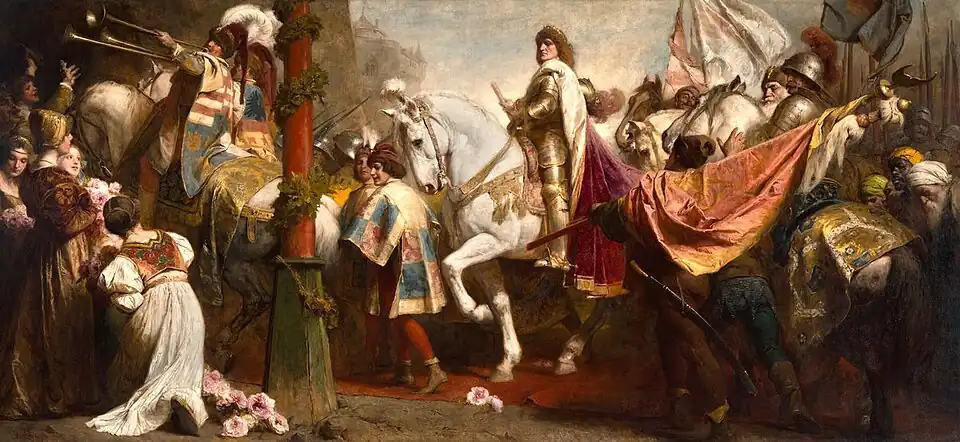 |
Kingdom of Hungary
|
Holy Roman Empire
|
Hungarian victory
|
| 1486 | Siege of Retz | Kingdom of Hungary
|
Holy Roman Empire
|
Hungarian victory |
| 1486–1487 | Siege of Wiener Neustadt / Bécsújhely | Kingdom of Hungary
|
Holy Roman Empire
|
Hungarian victory
|
| 1490–1491 | War of the Hungarian Succession | .svg.png) Kingdom of Hungary Kingdom of Bohemia Kingdom of Hungary Kingdom of Bohemia
|
Kingdom of Poland
|
Treaty |
| 1490 | Battle of Bonefield | The supporters of John Corvinus | The supporters of Beatrice of Naples | The supporters of Beatrice of Naples, Stephen Báthory and Paul Kinizsi defeated John Corvinus. |
| 1491–1495 | Hungarian – Ottoman war | Kingdom of Hungary
|
Ottoman Empire
|
Stalemate |
| 1492–1493 | The Black Army's uprising | Kingdom of Hungary
|
Black Army | Destruction of the Black Army |
| 1497 | Battle of the Cosmin Forest | Moldavia
|
Kingdom of Poland
|
Moldavian victory |
| 1499–1504 | Hungarian – Ottoman war | Kingdom of Hungary
|
Ottoman Empire
|
Stalemate |
| 1512–1520 | Hungarian – Ottoman war | Kingdom of Hungary
|
Ottoman Empire
|
Successful defensive operations against the Ottomans |
| 1514 | Peasants revolt, led by György Dózsa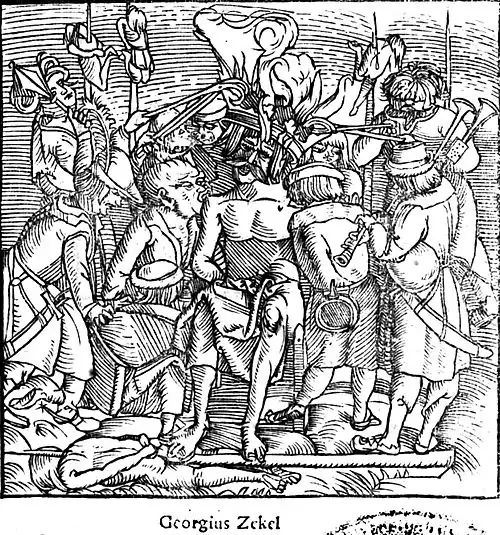 |
Kingdom of Hungary
|
Peasants | Revolt suppressed |
| 1520–1526 | Hungarian-Ottoman War | Kingdom of Hungary
|
Ottoman Empire
|
Hungarian defeat |
| 1523 | Battle of Szávaszentdemeter | Kingdom of Hungary
|
Ottoman Empire
|
Hungarian victory[23] |
| 1526 | Battle of Mohács |
Kingdom of Hungary
|
Ottoman Empire
|
Hungarian defeat
|
References
- ^ Ion Grumeza: The Roots of Balkanization: Eastern Europe C.E. 500–1500, University Press of America, 2010 [1]
- ^ Robert Maddock (2016). The 1,300 Years' War: Volume One. Xlibris Corporation. p. 449. ISBN 9781524533762.
- ^ Liviu Pilat; Ovidiu Cristea (2017). The Ottoman Threat and Crusading on the Eastern Border of Christendom During the 15th Century. Brill Publishers. p. 67. ISBN 9789004353800.
- ^ Bánlaky, József. "Az 1437. évi szendrői hadjárat" [The Campaign of Smederevo in 1437]. A magyar nemzet hadtörténelme [The Military History of the Hungarian Nation] (in Hungarian). Budapest.
- ^ Jefferson 2012, p. 69–118: The Reign of Murad II and Renewed Ottoman Expansion.
- ^ Babinger 1978, p. 20.
- ^ Weiss, David (2020). The Ottoman campaign in Wallachia and the Battle on the River Ialomița (1442).
- ^ a b Bánlaky, József. "A szebeni csata 1442. március 25-én" [The Battle of Szeben on 25 March 1442]. A magyar nemzet hadtörténelme [The Military History of the Hungarian Nation] (in Hungarian). Budapest.
- ^ Bánlaky, József. "A vaskapui diadal 1442 július havában" [The Triumph of the Iron Gate in July 1442]. A magyar nemzet hadtörténelme [The Military History of the Hungarian Nation] (in Hungarian). Budapest.
- ^ a b Jefferson 2012, p. 286–292.
- ^ Bury, J.B. The Cambridge Medieval History volumes 1-5. Plantagenet Publishing.
- ^ Treadgold, W.T. (1997). A History of the Byzantine State and Society. History e-book project. Stanford University Press. ISBN 978-0-8047-2630-6.
- ^ Bánlaky, József (1928). A magyar nemzet hadtörténelme (The Military History of the Hungarian Nation) (in Hungarian).
- ^ Mesut Uyar Ph.D., Edward J. Erickson (2009). A Military History of the Ottomans: From Osman to Ataturk (PDF).
- ^ Chalkokondyles, Laonikos (1464). The Histories of Laonikos Chalkokondyldes, Volume I (Translated by Anthony Kaldellis, 2014).
- ^ Mureşanu 2001, p. 183.
- ^ Teke 1980, p. 198.
- ^ Mureşanu 2001, pp. 184–185.
- ^ Engel 2001, p. 294.
- ^ Teke 1980, pp. 198, 231.
- ^ Babinger 1978, p. 110.
- ^ Britannica Dózsa Rebellion
- ^ Bánlaky, József. "Az 1522–1524. évi hadiesemények. Bel- és külföldi rendelkezések a török veszély elhárítására. Az 1524. évi rákosi országgyűlés főbb határozatai." [Annual military events of 1522–1524. Domestic and foreign provisions to prevent the Turkish threat. The main decisions of the Diet of Rákos in 1524.]. A magyar nemzet hadtörténelme [The Military History of the Hungarian Nation] (in Hungarian). Budapest.