List of military ranks of imperial Iran
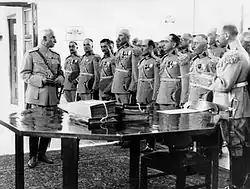
This list includes all military ranks of Iran from the beginning of the Achaemenid Empire to the end of Pahlavi Iran.
Military ranks in ancient Iran
The Achaemenid Empire army (spāda) was organized on a decimal system, which was highly superior to its Greek rivals and had not been used in any Asian army until the Mongol era.[1][2]
- Commander-in-Chief of the army: (kārana*), «کارَنَ», tentative term; the general with full national authority
- «بَیوَرَپَتی» (baivarapati*): Commander of a ten-thousand-strong army
- «هَزارَپَتی» (hazārapati*): Commander of a thousand-strong regiment
- «ثَتَپَتی» (θatapati*): Commander of a hundred-strong battalion
- «دَثَپَتی» (daθapati): Commander of a ten-strong squad
The Ancient Persia army was divided into controllable units under a single commander. These units were based on a Decimal system. For example, in the Achaemenid Empire army, the smallest unit consisted of 10 soldiers, called a Group (daθa "ten"), commanded by a Sergeant (daθapati "daθapati"). Next was a 100-soldier unit called a Company (military unit) (θata "hundred") led by a Captain (armed forces) (θatapati "θatapati"). A 1,000-strong unit was called a Regiment (hazāra) led by a Colonel (hazārapati "hazārapati"), and a 10,000-strong unit was a Division (military) (baivara) led by a major general (baivarapati "baivarapati"). The entire Achaemenid armed forces formed a Corps (spāda-), commanded by a lieutenant general (spādapati "spādapati").[3]
| Achaemenid Army | ||
|---|---|---|
| Units | Number of troops | Commander |
| -daθa* | 10 troops | -daθapati* |
| -θata* | 100 troops | -θatapati* |
| -hazāra* | 1,000 troops | -hazārapati* |
| -baivara* | 10,000 troops | -baivarapati* |
| -spāda* | 60,000 troops | -spādapati* or -kārana* |
During the Parthian Empire, the armed forces were called spāδ («سپاذ»), and the Commander-in-Chief was spāδbad («سپاذبد»). In the Parthian army, a company was called wast («وَست»), a regiment was drafš («درفش»), and a division was gund («گُند»). Their commanders were wast-sālār («وستسالار»), drafš-sālār (درفشسالار), and gund-sālār (گندسالار), respectively.[4]
| Parthian Army | ||
|---|---|---|
| Units | Number of troops | Commander |
| radag* | 10 troops | radagpān* |
| wast | 100 troops | wast-sālār |
| drafš | 1000 troops | drafš-sālār |
| gund | 10,000 troops | gund-sālār |
| spāδ | 60,000 troops | spāδpat or spāδbad |
During the Sasanian Empire, the Corps (spāh) was also organized based on the Decimal system,[5] and the commander was referred to as Lieutenant general (spāhbed). A Squad was called "radag" (radag) and a Company was called "tahm" (tahm), with its commander being called Lieutenant (tahmdār).[6] Five-hundred-strong Battalion (wašt) units were led by a Washt Salaar (wašt-sālār). A 1,000-strong Derafsh (drafš) was led by a DerafshSalaar (drafš-sālār), and a 5,000-strong Division called Gond (gund) and was led by a GondSalaar (gund-sālār).[7]
| Sasanian Army | ||
|---|---|---|
| Units | Number of troops | Commander |
| radag | 10 troops | radagbān* |
| tahm | 100 troops | tahmdār |
| wašt | 500 troops | wašt-sālār |
| drafš | 1,000 troops | drafš-sālār |
| gund | 5,000 troops | gund-sālār |
| spāh | 10,000 troops | spāhbed |
| artēštārān | An army | artēštārān-sālār |
Military ranks in the Safavid, Afsharid, Zand, and early Qajar periods
.jpg)
.jpg)

The names of these ranks are primarily derived from the Azerbaijani language, and there was not much change in them until the Qajar period. These ranks were often defined based on the number of subordinates under each commander.[8]
- "Khan": Commander of eight to ten thousand soldiers
- "Sultan": Initially, he was a rank higher than "MeenBaashi" and lower than "Khan", but later he was demoted to the command of one hundred men (YoozBaashi) and was eventually called "SarWaan" (equivalent with the Captain).
- "EekeeominBaashi" or "DovvominBaashi": Commander of two thousand soldiers
- "MeenBaashi": Commander of a thousand soldiers
- "BashYoozBaashi" or "PaansadBaashi": Commander of five hundred soldiers
- "YoozBaashi" (Centurion): Commander of one hundred soldiers
- "AalliBaashi" or "PanjaahBaashi": Commander of fifty soldiers
- "OonBaashi" or "DahBaashi": Commander of ten soldiers
Military ranks of Iran during the Qajar era
Military ranks of Iran during the Pahlavi monarchy were as follows:[9]
| Military ranks of Qajar era | |
|---|---|
| Modern title | Qajar era title |
| ArteshBod | Noyan A'zam |
| SepahBod | Amir Noyan |
| SarLashgar | Amir Toman |
| SarTeep | MeerPanj |
| SarHang | Sarhang |
| SarHang II | Nayeb Sarhang |
| SarGord | Yaavar |
| SarWaan | Sultan |
| SotWaan I | Nayeb Avval |
| SotWaan II | Nayeb Dovvom |
| Ostowaar I | Moeen Nayeb I |
| Ostowaar II | Moeen Nayeb II |
| SarGoroohBaan | Vakil Avval |
| GoroohBaan I | Vakil Raast |
| GoroohBaan II | Vakil Chap |
| SarJookheh | SarJooqeh |
| Soldier I | Taabeen Avval |
| Soldier II | Taabeen Dovvom |
| Soldier | Taabeen |
After the reforms initiated by Brigadier General Claude Matthieu, Count Gardane in the Iranian military, transformations in this area also took place. It is important to note that at that time, ranks or degrees of swordsmen were mentioned, each having three levels.[10]
- "Noyan" or "Amir Noyan": This rank was also referred to as commander-in-chief or general. The first-level Noyan was called "Noyan-e A'zam." If considered a rank above "Amir Toman", it would be equivalent to Lieutenant general in modern armies; however, in ancient writings, Noyan was considered the commander of a hundred thousand men, making it equivalent to "ArteshBod" (Colonel general). Although the entire Iranian army on that time, did not have this many soldiers, it rendered the "Amir Noyan" as a ceremonial rank.
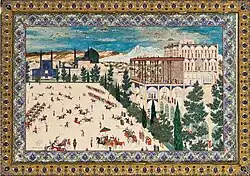
- "Amir Toman": The term "Toman" in Mongolian language means ten thousand, and the "Amir Toman" was regarded as the commander of ten thousand men.

.jpg)
Following these, the following ranks are listed that do not include three levels:
- "VakilBaashi"
- "Vakil"
- "SarJooqeh"
Below these ranks is "Taabeen," which has two levels:
- "Taabeen I"
- "Taabeen II"
During the tenure of Mirza Aqa Khan Nuri, a rank called "Amir Panjeh" or "MeerPanj", lower than "Amir Toman" and higher than "SarTeep", was introduced with three levels. Later, it was abolished, and "MeerPanj" became equivalent to "First-class SarTeep".
In the late Qajar era, further modifications were made to the ranks.
Ranks in the "State Gendarmerie of Iran" (called "Amniyeh") were largely taken from French language, e.g., "General," "Colonel," "Major," "Captain," "Lieutenant," "Aspirant," "Gendarme," etc.[11]
The ranks of the police force
The ranks of the police force (called Shahrbani or Nazmiyeh) from 1936 to around 1946, during the Pahlavi dynasty, were as follows:[12]
| Police rank | Army equivalent | Old name in Nazmiyeh |
|---|---|---|
| SarPaas | SarTeep | SarTeep |
| PaasYaar I | Sarhang | Sarhang |
| Sarhang II | Sarhang | Nayeb Sarhang |
| Yaavar | Sargord | Yaavar |
| SarBahr | Sarvan | Sultan |
| RasadBaan I | Sotvan I | Nayeb I |
| RasadBaan II | Sotvan II | Nayeb II |
| SarPaasBaan I | GoroohBaan I | VakilBaashi |
| SarPaasBaan II | GoroohBaan II | Vakil Raast |
| SarPaasBaan III | GoroohBaan III | Vakil Chap |
| PaasBaan | Sarbaz | Aazhaan |
See also
References
- ^ ""گارد جاویدان پیاده نظام ویژه هخامنشیان"" [Military ranks in ancient Iran: The Achaemenid army (spāda)] (PDF).
- ^ "درجههای نظامی در ایران باستان سازمان سپاه هخامنشی (سْپادَ)" [The Immortal Guard: Special Infantry of the Achaemenids].
- ^ "A. Sh. Shahbazi, "ARMY i. Pre-Islamic Iran," Encyclopædia Iranica, II/5, pp. 489-499".
- ^ Farrokh, Kaveh. Sassanian Elite Cavalry AD 224-642. Oxford: Osprey, 2005. ISBN 1-84176-713-1. — pp. 6—7
- ^ NIKONOROV, Valery. (2005), "K voprosu o Parfīanskom nasledii v Sasanidskom Irane: voennoe delo" [The issue of Parthian inheritance in Iran: warfare], in Tsentral ‘naia Aziia ot Akhemenidov do Timuridov: Arkheologiia, Istoriia, Etnologiia, Kul’tura [Central Asia from the Achaemenids to the Timurids: Archaeology, History, Ethnology, Culture], Valery NIKONOROV (ed.), Saint Petersburg: Oriental Department of the St. Petersburg State University, 141-182.
- ^ "Asha R. The Dates in the Pahlavīg and Pārsīg Inscriptions of Durā (Europos)" (PDF). Archived from the original (PDF) on 7 August 2016. Retrieved 18 January 2019.
- ^ Kaveh Farrokh, Gholamreza Karamian, Katarzyna Maksymiuk. A Synopsis of Sasanian Military Organization and Combat Units, Siedlce-Tehran 2018. — ISBN 978-83-62447-22-0 — c. 13
- ^ Encyclopaedia Iranica, "ARMY i. Pre-Islamic Iran"
- ^ شهیدی, یحیی (1350). "نشانهای دوره قاجار" [Military ranks of Qajar era]. بررسیهای تاریخی (in Persian) (34): 183–240.
- ^ رجبی, پرویز (July 2010). کریم خان زند و زمان او (تیرماه ۱۳۸۹ شمسی) [Karim Khan Zand and his era] (in Persian). کتاب آمه. p. 215. ISBN 978-600-5757-19-4.
- ^ Nafisi, Saeed, Social and Political History of Iran during the Qajar Era, Foundation Publishing, 2nd edition, p. 261, نفیسی، سعید، تاریخ اجتماعی و سیاسی ایران در دورهٔ قاجار، مؤسسهٔ انتشارات بنیاد، چاپ دوم، صفحهٔ ۲۶۱
- ^ Ahmadi, Ali-Hossein, History of the Army and Conscription in Iran (Zand Period) احمدی، علیحسین، تاریخچهٔ ارتش و سربازی در ایران (دورهٔ زندیه)، مجلهٔ «سرباز»، سال سیوسوم، شمارهٔ ۱۹۰، خرداد ۱۳۹۱، صفحههای ۳۲ و ۳۳, Journal "Sarbaz", Vol. 33, No. 190, May 2012, pp. 32–33
Military history of Asia | |
|---|---|
| Sovereign states |
|
| States with limited recognition |
|
| Dependencies and other territories |
|
| |


 Military of Iran Military of Iran | ||||||||
|---|---|---|---|---|---|---|---|---|
| Armed Forces |
|  | ||||||
| Other | ||||||||
| ||||||||