List of rulers who converted to Christianity
This is a list of rulers who converted to Christianity. The conversion of monarchs was often an important step in the process of Christianization.
1st century
4th century
- Tiridates III of Armenia, King of Armenia, in 301
- Ezana of Axum, King of Aksum, 320
- Constantine I, Roman emperor, in 337
- Mirian III of Iberia, King of Iberia, c. 337
-
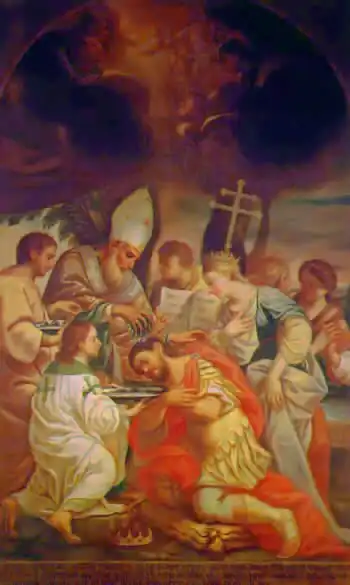 Baptism of Tiridates III
 -
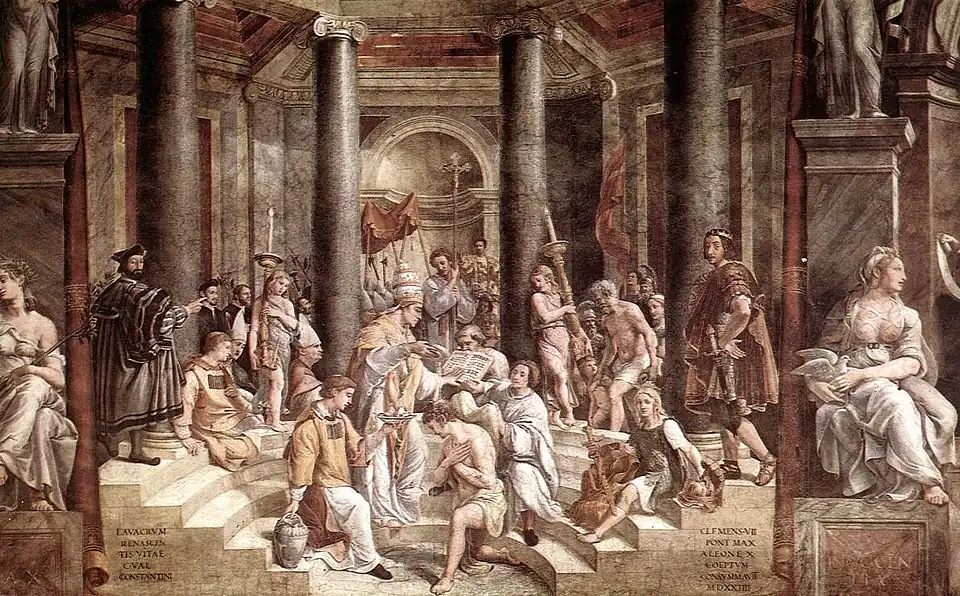
-
 Mirian III
5th century
- Óengus mac Nad Froích, King of Munster
- Clovis I, King of the Franks, circa 496-506
- Rechiar, King of the Suebi
-
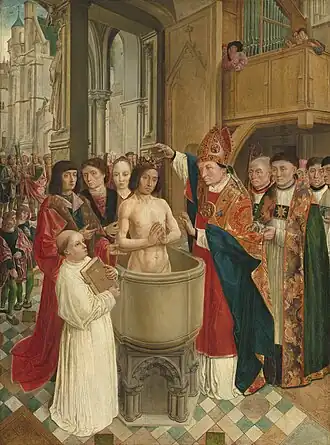 The baptism of Clovis I by Saint Remigius
 -
 The baptism of Óengus mac Nad Froích by Saint Patrick
6th century
- Constantine of Dumnonia
- Saint Constantine of Strathclyde
- Rædwald of East Anglia
- Reccared I, king of visigoths, and Hermenegild, sub-king in Baetica, converted from Arianism to the Nicene faith.
7th century
- Æthelberht of Kent before 601 (see Gregorian mission)
- Cenwalh of Wessex
- Cynegils of Wessex
- Sigeberht of East Anglia
- Riderch I of Alt Clut
- Peada of Mercia
- Edwin of Northumbria[1]
9th century
- Mojmir I of Moravia (818 or 824)
- Boris I of Bulgaria (864)
- Guthrum (878)
- Borivoj I, Duke of Bohemia (883)
- Rorik of Dorestad
- Harald Klak
-
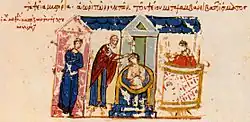 Baptism of Boris I
 -
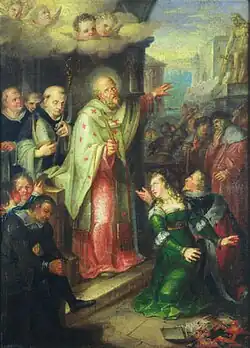 Baptism of Borivoj I by Saint Methodius
10th century
- Mieszko I of Poland (966)
- Géza, Grand Prince of the Hungarians (970s)
- Vladimir I of Kiev (980s)
- Olaf Tryggvason
- Harald Bluetooth of Denmark and Norway
- Eric the Victorious
- Haakon the Good
-
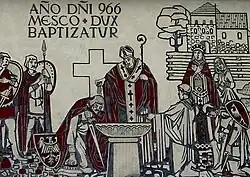 Baptism of Mieszko
 -
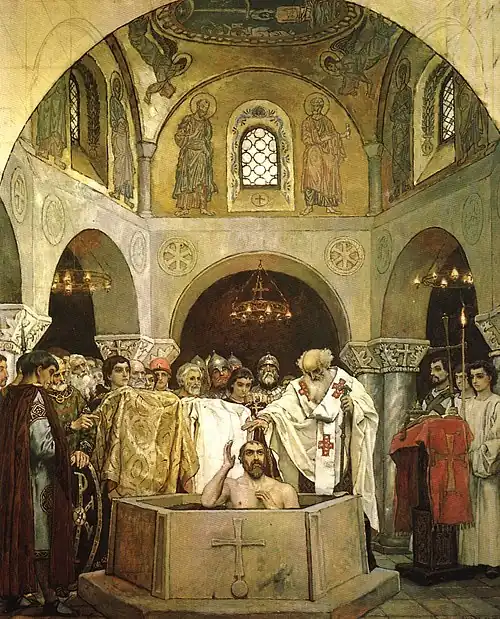 The Baptism of Saint Prince Vladimir, by Viktor Vasnetsov (1890)
 -
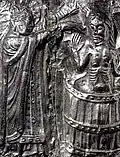 Harald being baptized by Poppo the monk, probably c. 960
11th century
- Olof Skötkonung, King of Sweden (1008)
14th century
- Jogaila, Grand Duke of Lithuania and King of Poland (1386)
16th century
- Nzinga of Ndongo and Matamba
- Afonso I of Kongo
- Humabon, Rajah of Cebu (1521)
- Bunao Lakan Dula, Lakan of Tondo (c. 1571)
- Rajah Matanda of Maynila (1572)
- Ōtomo Sōrin (although not a direct royalty, Japanese daimyo were de facto independent rulers of their territories)
- Arima Harunobu
- Ōmura Sumitada
19th century
- Hone Heke
- Keopuolani
- Ka'ahumanu
- Kamehameha III
- Tamati Waka Nene
- Ranavalona II of Madagascar
- Pomare II
- Duleep Singh[2]
References
- ^ Cramp, Rosemary (23 September 2004). "Eadwine [St Eadwine, Edwin]". Oxford Dictionary of National Biography (online ed.). Oxford University Press. doi:10.1093/ref:odnb/8567.
About 624 Eadwine had obtained as his second wife a Kentish princess, Æthelburh (d. 647), a Christian, whose family agreed to the marriage only if Eadwine respected her religion and agreed to consider conversion himself. Despite this and the pressure brought by Æthelburh's chaplain, Bishop Paulinus, Eadwine did not easily become the first non-Kentish ruler to embrace the new faith. On the night of the assassination attempt the queen gave birth to a daughter, and in thanksgiving Eadwine allowed Paulinus to baptize her, 'the first of the Northumbrian race to be baptized, together with eleven members of his household' (Bede, Hist. eccl., 2.9), but agreed to renounce the idols of his own religion only after his punitive campaign against the West Saxons.
(Subscription, Wikipedia Library access or UK public library membership required.) - ^ Singh Madra, Amandeep (23 September 2004). "Singh, Duleep". Oxford Dictionary of National Biography (online ed.). Oxford University Press. doi:10.1093/ref:odnb/41277.
Fatehgarh, famed for its Christian missionary activity, was where Duleep Singh was converted to Christianity in 1853. This act, although facilitated by his guardians, was none the less more rapidly accomplished than even they had expected.
(Subscription, Wikipedia Library access or UK public library membership required.)