Meripilus sumstinei
| Meripilus sumstinei | |
|---|---|
| |
Scientific classification 
| |
| Kingdom: | Fungi |
| Division: | Basidiomycota |
| Class: | Agaricomycetes |
| Order: | Polyporales |
| Family: | Meripilaceae |
| Genus: | Meripilus |
| Species: | M. sumstinei
|
| Binomial name | |
| Meripilus sumstinei (Murrill) M.J.Larsen & Lombard (1988)
| |
| Synonyms[1] | |
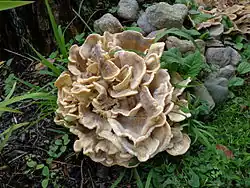
Meripilus sumstinei, commonly known as the giant polypore or the black-staining polypore, is a species of fungus in the family Meripilaceae.
Taxonomy
Originally described in 1905 by William Alphonso Murrill as Grifola sumstinei, the species was transferred to Meripilus in 1988.[1]
Description
The cap of this polypore is 5–20 centimetres (2–8 in) wide, with folds of flesh up to 8–20 millimetres (1⁄4–3⁄4 in) thick. It has white to brownish concentric zones and tapers toward the base; the stipe is indistinct.[2]
Distribution and habitat
It is found in eastern North America from June to September. It grows in large clumps on the ground around hardwood (including oak) trunks, stumps, and logs.[3][2]
Uses
References
- ^ a b "GSD Species Synonymy: Meripilus sumstinei (Murrill) M.J. Larsen & Lombard, Mycologia 80(5): 615 (1988)". Species Fungorum. CAB International. Retrieved 2014-07-23.
- ^ a b Audubon (2023). Mushrooms of North America. Knopf. p. 234. ISBN 978-0-593-31998-7.
- ^ a b Russell, B. (2010). Field Guide to Wild Mushrooms of Pennsylvania and the Mid-Atlantic. Penn State Press. p. 128. ISBN 978-0-271-04526-9.