Osborne Vixen
 | |
| Also known as | Osborne 4 |
|---|---|
| Developer | Adam Osborne |
| Type | Portable computer |
| Released | 1984 |
| Introductory price | US$1,298 (equivalent to $3,900 in 2024) |
| Operating system | CP/M, CP/M Plus |
| CPU | Zilog Z80 @ 4 MHz |
| Memory | 64 KB |
| Storage | Two half-height DSDD 5.25-inch floppy drives |
| Display | 7-inch amber monochrome CRT, 80 × 24 character text |
| Connectivity | Serial port, Parallel port |
| Weight | 18 lb (8.2 kg) |
| Predecessor | Osborne Executive |
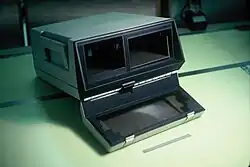
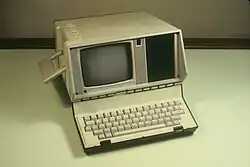
The Osborne Vixen is a "luggable" portable computer announced by the Osborne Computer Corporation in November 1984, as a follow-up to their Osborne 1 and Osborne Executive system.[1][2][3]
The Vixen has a 4 MHz Zilog Z80 microprocessor with 64 KB dynamic random-access memory (DRAM) and 4 KB EPROM.[4] It has a 7-inch diagonal amber display that can show 24 lines by 80 columns of memory mapped video. It uses two 400 KB disk drives, utilizing double-density double-sided 5.25" diskettes. As a luggable, it weighs about 18 pounds. Contemporary advertising pointed out that it could fit under the seat in an airplane, with dimensions of 125⁄8 by 161⁄4 by 61⁄4 inches (321 by 413 by 159 mm).
When it was released, the Vixen had a retail price of $1298.[3] Customers also had the option of purchasing an external 10 megabyte hard disk for $1495.[3]
The Vixen used version 2.2 of the CP/M operating system. It was also bundled with a number of software packages: WordStar, the popular word processing package; SuperCalc, a spreadsheet; MBASIC, a programming language; Osboard, a graphics and drawing program; TurnKey, a system utility; Media Master, a data interchange program that allowed compatibility with over "200 other computers"; and Desolation, a game.[5][3]
The Vixen was also known as the Osborne 4.[3] It was developed and released after the bankruptcy of the Osborne Computer Corporation. An earlier system also called "Vixen" was never released.[6] Due to technical problems with prototypes and the corporate bankruptcy, by the time the CP/M Vixen was introduced, it had already been made obsolete by MS-DOS IBM PC compatibles.[7] A last ditch effort to design and market a fully IBM PC compatible produced three prototypes, but too late to save the company from bankruptcy.
Software
| Program Name | Version | Published by | Program Type |
|---|---|---|---|
| Desolation | Game | ||
| Osboard Software | Graphics | ||
| WordStar/MailMerge | 3.3 | MicroPro International | Application |
| SuperCalc | 2 | Sorcim | Application |
| MBASIC | Microsoft | Application | |
| Media Master | Utility | ||
| TurnKey | Utility |
References
- ^ Watt, Peggy (November 12, 1984). "Osborne shows new computer". InfoWorld. p. 15.
- ^ "Osborne Vixen". Vintage Computer. 15 January 2013. Retrieved 2023-04-16.
- ^ a b c d e The Osborne Vixen (PDF). Osborne Computer Corporation.
- ^ OSBORNE 4 Theory of Operation Manual. Osborne Computer Corporation. August 1985.
- ^ "VIXEN (OCC4) Osborne Corp". www.old-computers.com. Retrieved 2023-04-16.
- ^ John Dvorak, Adam Osborne, Hypergrowth: the rise and fall of Osborne Computer Corporation, Idthekkethan Pub. Co., 1984 ISBN 0-918347-00-9, page 70
- ^ Robert J. Thierauf, A problem-finding approach to effective corporate planning, Greenwood Publishing Group, 1987 ISBN 0-89930-262-9, pages 15–16