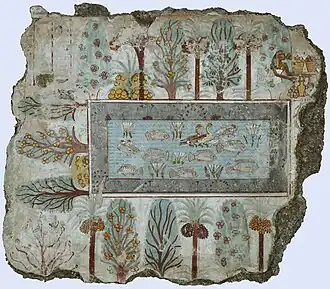
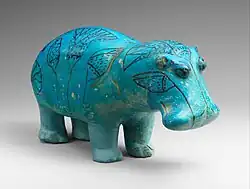
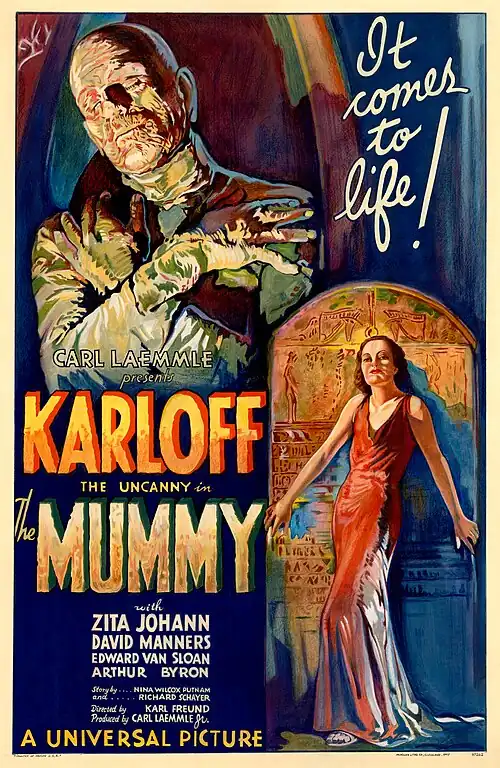
Portal:Ancient Egypt

|
THE ANCIENT EGYPT PORTAL
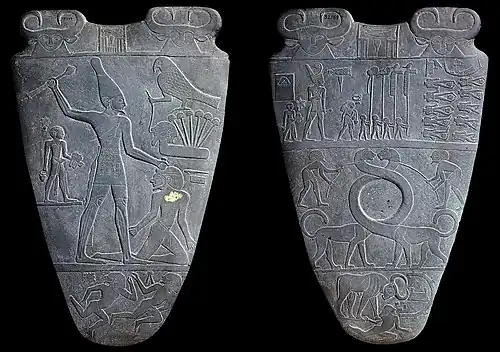
Showcased content about Ancient Egypt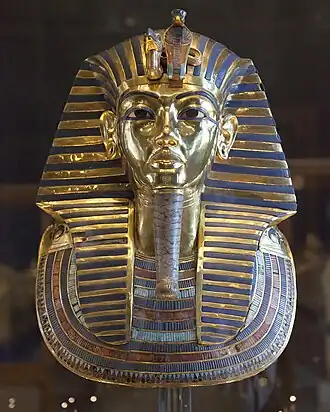 Ancient Egypt was a cradle of civilization concentrated along the lower reaches of the Nile River in Northeast Africa. It emerged from prehistoric Egypt around 3150 BC (according to conventional Egyptian chronology), when Upper and Lower Egypt were united by Menes, who is believed by the majority of Egyptologists to have been the same person as Narmer. The history of ancient Egypt unfolded as a series of stable kingdoms interspersed by the "Intermediate Periods" of relative instability. These stable kingdoms existed in one of three periods: the Old Kingdom of the Early Bronze Age; the Middle Kingdom of the Middle Bronze Age; or the New Kingdom of the Late Bronze Age. The pinnacle of ancient Egyptian power was achieved during the New Kingdom, which extended its rule to much of Nubia and a considerable portion of the Levant. After this period, Egypt entered an era of slow decline. Over the course of its history, it was invaded or conquered by a number of foreign civilizations, including the Hyksos, the Kushites, the Assyrians, the Persians, and the Greeks and then the Romans. The end of ancient Egypt is variously defined as occurring with the end of the Late Period during the Wars of Alexander the Great in 332 BC or with the end of the Greek-ruled Ptolemaic Kingdom during the Roman conquest of Egypt in 30 BC. In AD 642, the Arab conquest of Egypt brought an end to the region's millennium-long Greco-Roman period. The success of ancient Egyptian civilization came partly from its ability to adapt to the Nile's conditions for agriculture. The predictable flooding of the Nile and controlled irrigation of its fertile valley produced surplus crops, which supported a more dense population, and thereby substantial social and cultural development. With resources to spare, the administration sponsored the mineral exploitation of the valley and its surrounding desert regions, the early development of an independent writing system, the organization of collective construction and agricultural projects, trade with other civilizations, and a military to assert Egyptian dominance throughout the Near East. Motivating and organizing these activities was a bureaucracy of elite scribes, religious leaders, and administrators under the control of the reigning pharaoh, who ensured the cooperation and unity of the Egyptian people in the context of an elaborate system of religious beliefs.[1] Among the many achievements of ancient Egypt are: the quarrying, surveying, and construction techniques that supported the building of monumental pyramids, temples, and obelisks; a system of mathematics; a practical and effective system of medicine; irrigation systems and agricultural production techniques; the first known planked boats; Egyptian faience and glass technology; new forms of literature; and the earliest known peace treaty, which was ratified with the Anatolia-based Hittite Empire. Its art and architecture were widely copied and its antiquities were carried off to be studied, admired, or coveted in the far corners of the world. Likewise, its monumental ruins inspired the imaginations of travelers and writers for millennia. A newfound European and Egyptian respect for antiquities and excavations that began in earnest in the early modern period has led to much scientific investigation of ancient Egypt and its society, as well as a greater appreciation of its cultural legacy. (Full article...) Selected article - The writing systems used in ancient Egypt were deciphered in the early nineteenth century through the work of several European scholars, especially Jean-François Champollion and Thomas Young. Ancient Egyptian forms of writing, which included the hieroglyphic, hieratic and demotic scripts, ceased to be understood in the fourth and fifth centuries AD, as the Coptic alphabet was increasingly used in their place. Later generations' knowledge of the older scripts was based on the work of Greek and Roman authors whose understanding was faulty. It was thus widely believed that Egyptian scripts were exclusively ideographic, representing ideas rather than sounds. Some attempts at decipherment by Islamic and European scholars in the Middle Ages and early modern times acknowledged the script might have a phonetic component, but perception of hieroglyphs as purely ideographic hampered efforts to understand them as late as the eighteenth century. The Rosetta Stone, discovered in 1799 by members of Napoleon Bonaparte's campaign in Egypt, bore a parallel text in hieroglyphic, demotic and Greek. It was hoped that the Egyptian text could be deciphered through its Greek translation, especially in combination with the evidence from the Coptic language, the last stage of the Egyptian language. Doing so proved difficult, despite halting progress made by Antoine-Isaac Silvestre de Sacy and Johan David Åkerblad. Thomas Young, building on their work, observed that demotic characters were derived from hieroglyphs and identified several of the phonetic signs in demotic. He also identified the meaning of many hieroglyphs, including phonetic glyphs in a cartouche containing the name of an Egyptian king of foreign origin, Ptolemy V. He was convinced, however, that phonetic hieroglyphs were used only in writing non-Egyptian words. In the early 1820s Champollion compared Ptolemy's cartouche with others and realised the hieroglyphic script was a mixture of phonetic and ideographic elements. His claims were initially met with scepticism and with accusations that he had taken ideas from Young without giving credit, but they gradually gained acceptance. Champollion went on to roughly identify the meanings of most phonetic hieroglyphs and establish much of the grammar and vocabulary of ancient Egyptian. Young, meanwhile, largely deciphered demotic using the Rosetta Stone in combination with other Greek and demotic parallel texts. (Full article...) Selected picture
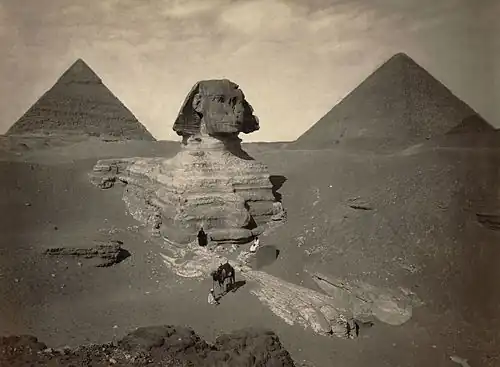
The Great Sphinx of Giza, partially excavated, with two pyramids in the background. Did you know...
News5th September 2018. Rock-cut Tomb discovered in a 4,000-year-old Elite Cemetery August 2018: in the tomb of the mayor of Memphis Ptahmose who dates around 1300 BC was found well preserved cheese, more than 3000 years old. [1] Selected biography -Maaibre Sheshi (also Sheshy) was a ruler of areas of Egypt during the Second Intermediate Period. The dynasty, chronological position, duration and extent of his reign are uncertain and subject to ongoing debate. The difficulty of identification is mirrored by problems in determining events from the end of the Middle Kingdom to the arrival of the Hyksos in Egypt. Nonetheless, Sheshi is, in terms of the number of artifacts attributed to him, the best-attested king of the period spanning the end of the Middle Kingdom and the Second Intermediate period; roughly from c. 1800 BC until 1550 BC. Hundreds of scaraboid seals bearing his name have been found throughout the Levant, Egypt, Nubia, and as far away as Carthage, where some were still in use 1,500 years after his death. Three competing hypotheses have been put forth for the dynasty to which Sheshi belonged. The first hypothesis is supported by Egyptologists such as Nicolas Grimal, William C. Hayes, and Donald B. Redford, who believe that he should be identified with Salitis, founder of the 15th Dynasty according to historical sources and king of the Hyksos during their invasion of Egypt. Salitis is credited with 19 years of reign and would have lived sometime between c. 1720 BC and 1650 BC. The second hypothesis is supported by Egyptologist William Ayres Ward and the archaeologist Daphna Ben-Tor, who propose that Sheshi was a Hyksos king and belongs to the second half of the 15th Dynasty, reigning between Khyan and Apophis. Alternatively, Manfred Bietak has proposed that Sheshi was a vassal of the Hyksos, ruling over some part of Egypt or Canaan. The very existence of such vassals is debated. The final hypothesis says Sheshi could be a ruler of the early 14th Dynasty, a line of kings of Canaanite descent ruling over of the Eastern Nile Delta immediately before the arrival of the Hyksos. Proponents of this theory, such as Kim Ryholt and Darrell Baker, credit Sheshi with 40 years of reign starting ca. 1745 BC. (Full article...) General imagesThe following are images from various ancient Egypt-related articles on Wikipedia.
Related portalsWikiProjects
Main topics
Notable Pharaohs
Categories Select [►] to view subcategories
Ancient Egypt Early Dynastic Period of Egypt Old Kingdom of Egypt First Intermediate Period of Egypt Middle Kingdom of Egypt Second Intermediate Period of Egypt New Kingdom of Egypt Third Intermediate Period of Egypt Late Period of ancient Egypt Ancient Egypt-related lists 1st millennium BC in Egypt 2nd millennium BC in Egypt 3rd millennium BC in Egypt 4th millennium BC in Egypt Ancient Egyptian architecture Dynasties of ancient Egypt Ancient Egyptians Egyptology People executed by ancient Egypt Foreign contacts of ancient Egypt Geography of ancient Egypt Historians of ancient Egypt Ancient Jewish Egyptian history Ancient Egyptian language Ancient Egyptian medicine Military history of ancient Egypt Nomes of ancient Egypt Ancient Egypt in popular culture Ptolemaic Kingdom Ancient Egyptian science Ancient Egyptian society Ancient Egyptian technology Works about ancient Egypt Ancient Egypt stubs Recognized content
Featured articles
Featured listsGood articles
Did you know? articles
Featured pictures
In the News articlesMain page featured articles
Main page featured listsPicture of the day pictures
Things to do
WikimediaThe following Wikimedia Foundation sister projects provide more on this subject:
Sources
Discover Wikipedia using portals
|
.jpg)





.JPG)

.png)


_-_2009.jpg)








.svg.png)