Prelude and Fugue in F-sharp minor, BWV 883
The Prelude and Fugue in F-sharp minor, BWV 883, is the fourteenth piece of the second book of The Well-Tempered Clavier by Johann Sebastian Bach, compiled between 1739 and 1744.
The prelude is noted for its elaborate melodic writing and its correspondence with the only triple fugue in book 2. The fugue, as brilliant as fugue in C-sharp minor, BWV 849 from book 1, is recognized for the clarity of its structure and texture and is often regarded as one of the most accomplished fugues in the collection.
![\version "2.18.2"
\header { tagline = ##f }
\score {
\new Staff \with { }
<<
\relative c' { \clef bass \key fis \minor \time 4/4
\set Staff.midiInstrument = #"harpsichord"
%% SUJET fugue CBT II-14, BWV 883, fa-dièse mineur
r4 r8 cis8 a fis d'4~ d8 cis16 b cis4~ cis8 fis b,4~ b8 a16 gis a8 fis gis2\trill
{
% suppression des warnings :
#(ly:set-option 'warning-as-error #f)
#(ly:expect-warning (_ "stem does not fit in beam")) %% <= à traduire éventuellement
#(ly:expect-warning (_ "beam was started here")) %% <= à traduire éventuellement
\set stemRightBeamCount = #1
fis4*1/2[ s]
}
}
>>
\layout { \context { \Score \remove "Metronome_mark_engraver" } }
\midi {}
}](./_assets_/c0509faabd9912f68abeee76be11f907/gjjnxxh3.png)
Prelude
The prelude, written in 3
4 and comprising 43 measures,[1] is noted for its serene character.[2][3]
It is written in three voices and takes the form of an arioso[4] structured in sonata form, with the first section ending on a fermata. A brief transitional passage in the bass at measure 29 leads to a restatement of the theme in the tonic. The final measure ends with a Picardy third featuring A-sharp.[5]
The alternation of duple and triple rhythmic patterns—superimposed only in measure 15—has been compared to similar techniques in the Benedictus of the Mass in B minor and in the allemande of the Partita in D major (BWV 828).[6]
![\version "2.18.2"
\header { tagline = ##f }
upper = \relative c' { \clef treble \key fis \minor \time 3/4
\tempo 4 = 52 % tempo de Keller
\set Staff.midiInstrument = #"harpsichord"
%% PRÉLUDE CBT II-14, BWV 883, fa-dièse mineur
fis'8 cis4 a16 b \tuplet 3/2 { cis16[ b a] } \tuplet 3/2 { b a gis } | a16 b a gis a cis fis gis \tuplet 3/2 { a gis fis } \tuplet 3/2 { gis[ fis eis] } fis16 cis8 eis16 fis cis8 eis16 fis cis fis gis | a eis fis a b, a' gis fis \tuplet 3/2 { b a gis } \tuplet 3/2 { a[ gis fis] } | eis16 bis8 cis16 fis16 bis,8 cis16 \tuplet 3/2 { gis' b, cis } \tuplet 3/2 { d[ cis b] } | a4~ \tuplet 3/2 { a16 gis fis } \tuplet 3/2 { eis[ fis gis] } \tuplet 3/2 { fis[ eis fis] } dis'16. fis,32 | fis8~ fis16 eis32 dis \tuplet 3/2 { eis16 cis dis } \tuplet 3/2 { eis[ fis gis] } \tuplet 3/2 { fis eis fis } \tuplet 3/2 { gis[ a b] } | a32 gis fis16~ fis a32 cis \tuplet 3/2 { fis16 cis dis } \tuplet 3/2 { eis[ fis gis] } \tuplet 3/2 { a gis fis } \tuplet 3/2 { gis[ fis e] } | dis16 e fis8~ fis16 e dis a' \tuplet 3/2 { gis fis e } \tuplet 3/2 { fis[ e dis] } e16 dis cis8~ cis16 dis cis bis cis e a, gis a bis fis e fis bis cis dis \tuplet 3/2 { e dis cis } \tuplet 3/2 { dis[ cis bis] } | cis8
}
lower = \relative c' { \clef bass \key fis \minor \time 3/4
\set Staff.midiInstrument = #"harpsichord"
<< { r8 a8 cis fis~ fis eis fis cis4 a16 b \tuplet 3/2 { cis b a } \tuplet 3/2 { b[ a gis] } a8 b cis gis' fis eis | fis[ cis] fis, eis fis[ b] | r8 gis a fis eis4~ \tuplet 3/2 { eis16 eis fis } \tuplet 3/2 { gis[ fis eis] } \tuplet 3/2 { fis gis a } \tuplet 3/2 { b[ a gis] } a4~ a16 gis32 fis gis8~ gis4 r4 r4 r4 r8 a8~ | a8. a16 gis8 fis e dis cis2~ cis8 cis fis4 r4 r8 fis8~ | fis8 } \\ { fis4.~ fis16 gis a8 cis | fis,2.~ fis8 gis a b a gis | fis e d2 cis2.~ cis4 r4 r8 bis8 | cis4. cis8 dis eis | fis fis, a cis fis4~ fis8 dis bis4 r8 gis8 cis8. b16 a8 gis fis4~ | fis8 gis a fis gis4 | cis4.*1/4 } >>
}
\score {
\new PianoStaff <<
\set PianoStaff.instrumentName = #"BWV 883"
\new Staff = "upper" \upper
\new Staff = "lower" \lower
>>
\layout { \context { \Score \remove "Metronome_mark_engraver"
\omit TupletNumber
\omit TupletBracket
\override SpacingSpanner.common-shortest-duration = #(ly:make-moment 1/2)
}
}
\midi { }
}](./_assets_/e73e7a021f2a423e67a2ee25cebb5d07/7qmit3a0.png)
Fugue
The three-voice fugue is written in  and consists of 70 measures.
Ferruccio Busoni described the fugue as exhibiting "a marvelous youth" despite the depth of experience it conveys, noting the balance between intellect and expression.[7] Characteristic of Bach's mature style, the fugue is a highly developed work distinguished by its clarity of conception and texture.[8]
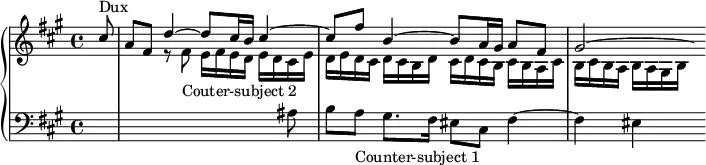
It is the only triple fugue in the volume, paralleling Bach's use of a five-voice fugue in the first book. The principal subject is combined with two additional countersubjects at measures 55, 60, and 67. The subject consists of fifteen notes built entirely on disjunct intervals—a descending tonic arpeggio followed by a leap of a sixth—with three sequential patterns that become obscured once the answer enters. These sequences are fully articulated when combined with the second countersubject, which is written in continuous sixteenth notes.[9]
After the exposition (measure 11), the fugue proceeds with a first episode in which Bach combines the subject with inversions of its opening motif: first in its original form (measures 9–10), then in inversion (measures 10–12), followed by a combination of both (measures 13–15).[10]
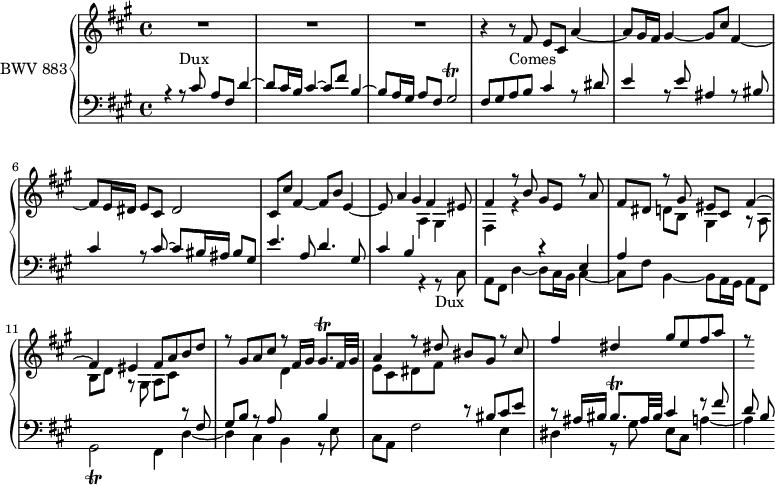
The first countersubject appears in measure 20. It is brief and is immediately treated in canonic imitation. In the second episode, Bach combines this countersubject in canon with an inversion of its opening motif (soprano) and the subject (alto in measure 29, then bass in measure 34). In the Schwencke manuscript copy, a mordent is placed on the second note, emphasizing the entry of this new thematic element within the contrapuntal texture.[7]
![\version "2.18.2"
\header { tagline = ##f }
\score {
\new Staff \with { }
<<
\relative c' { \clef bass \key fis \minor \time 4/4
\set Staff.midiInstrument = #"harpsichord"
%% CONTRE-SUJET fugue CBT II-14, BWV 883, fa-dièse mineur
\partial 4. a8[ gis8.-\parenthesize-\prall fis16] | eis8 cis fis2 eis8 e
}
>>
\layout { \context { \Score \remove "Metronome_mark_engraver" } }
\midi {}
}](./_assets_/1ea950c53a104db6465428e38726e99d/hq7bppir.png)
The second countersubject appears in measure 36, during the double exposition,[3] and remains present throughout the central section of the fugue.[1][11] It is treated in combination with itself and with the inversion of the subject's opening motif.[12]
![\version "2.18.2"
\header { tagline = ##f }
\score { \new Staff \with { }
<<
\relative c'' { \key fis \minor \time 4/4
\set Staff.midiInstrument = #"harpsichord"
%% CONTRE-SUJET fugue CBT II-14, BWV 883, fa-dièse mineur
\partial 2. s8 gis8 fis16 gis fis e fis e dis fis | e fis e dis e dis cis e dis8 gis cis, eis
{
% suppression des warnings :
#(ly:set-option 'warning-as-error #f)
#(ly:expect-warning (_ "stem does not fit in beam")) %% <= à traduire éventuellement
#(ly:expect-warning (_ "beam was started here")) %% <= à traduire éventuellement
\set stemRightBeamCount = #2
fis4*1/4[ s]
}
}
>>
\layout { \context { \Score \remove "Metronome_mark_engraver" } }
\midi {}
}](./_assets_/5979b6655697cea40c72502527adba9b/2dry2jc2.png)
During the counter-exposition (measure 51), the subject is introduced in the alto, after which the counterpoint alternates among the three thematic elements.[11] This section forms a structural climax in which the subject, first and second countersubjects are successively superimposed in varying voice combinations—soprano, bass, and alto—while retaining their distinct identities.[13]
Manuscripts
The manuscripts[5] considered the most important are written either by Bach himself or by Anna Magdalena. They are:
- Source "A", British Library, London (Add. MS. 35 021), compiled between 1739 and 1742.[14] It contains 21 pairs of preludes and fugues; those in C minor, D major, and F minor (nos. 4, 5, and 12) are missing, having been lost.[14]
- Source "B",” Berlin State Library (P 430), a copy dated 1744 by Johann Christoph Altnickol.[15] In his copy, Altnickol replaces measures 7 and 8, written in triplets, with a triplet figure.[8]
Legacy
Théodore Dubois produced a four-hand piano version of the work,[16] published in 1914.
Heitor Villa-Lobos arranged the prelude for a cello orchestra at the request of violinist Antonio Lysy; the arrangement was published by Max Eschig.[17][18] In this version, Villa-Lobos positions Prelude No. 22 first and alternates four fugues with two other preludes: Fugue No. 5 (Book 1), Prelude No. 14, Fugue No. 1 (Book 1), Prelude and Fugue No. 8 (Book 1), and Fugue No. 21 (Book 1).[19]
References
- ^ a b Tranchefort 1987, p. 39
- ^ Candé 1984, p. 333
- ^ a b Sacre 1998, p. 219
- ^ Schulenberg 2006, p. 260
- ^ a b "Praeludium und Fuge fis-Moll (Das Wohltemperierte Klavier, Teil 2)" [Prelude and Fugue in F-sharp minor (The Well-Tempered Clavier, Part 2)] (in German). Retrieved December 14, 2025.
- ^ Ledbetter 2002, p. 294
- ^ a b Keller 1973, p. 189
- ^ a b Ledbetter 2002, p. 295
- ^ Schulenberg 2006, p. 262
- ^ Ledbetter 2002, p. 297
- ^ a b Gray 1938, p. 118
- ^ "Das wohltemperierte Klavier I, BWV 846-869 (Bach, Johann Sebastian)" [The Well-Tempered Clavier I, BWV 846-869 (Bach, Johann Sebastian)]. IMSLP (in German). Retrieved December 15, 2025.
- ^ Keller 1973, p. 188
- ^ a b Tomita 2007, p. X
- ^ "Jean-Sébastien Bach, « Le clavier bien tempéré », vol. II — copie d'Altnikol" [Prelude and Fugue in F-sharp minor (The Well-Tempered Clavier, Part 2)] (PDF). International Music Score Library Project (in French). Archived from the original (PDF) on November 12, 2017.
- ^ "Preludio XIV" [Prelude XIV] (in French). Paris, M. Senart. 1914.
- ^ Bach, J. S; Villa-Lobos, H (1980). Preludes et fugues d'après Jean-Sébastien Bach : pour orchestre de violoncelles [Preludes and fugues based on Johann Sebastian Bach: for cello orchestra] (in French). Editions Max Eschig. OCLC 52608598. Retrieved December 14, 2025.
- ^ Harris, Cliff (2018). "South America". Yarlung Records: 10–11. OCLC 1031317943.
- ^ Wright, Simon (1992). Villa-Lobos. Oxford University Press. ISBN 978-0193154759.
Sources
- Candé, Roland de [in French] (1984). Jean-Sébastien Bach (in French). Paris: Seuil. ISBN 2-02-008505-4. OCLC 319750728.
- Gray, Cecil (1938). Forty-Eight Preludes and Fugues of J.S .Bach. Oxford University Press. pp. 115–118. OCLC 603425933.
- Keller, Hermann (1973). Le clavier bien tempéré de Johann Sebastian Bach : l'œuvre, l'interprétation [Johann Sebastian Bach's Well-Tempered Clavier: the work, the interpretation]. Études (in French). Paris: Bordas. pp. 186–190. OCLC 373521522. Retrieved December 12, 2025.
- Ledbetter, David (2002). Bach's Well-tempered Clavier : the 48 Preludes and Fugues. New Haven/London: Yale University Press. pp. 329–332. ISBN 0-300-09707-7. OCLC 5559558992.
- Tomita, Yo (2007). "préface" [preface]. Clavier bien tempéré, Livre II [The Well-Tempered Clavier, Book II] (in French). Henle. OCLC 786251450.
- Tranchefort, François-René (1987). Guide de la musique de piano et de clavecin [Guide to Piano and Harpsichord Music]. Les Indispensables de la musique (in French). Paris: Fayard. p. 39. ISBN 978-2-213-01639-9. OCLC 17967083.
- Sacre, Guy (1998). La musique pour piano : dictionnaire des compositeurs et des œuvres [Piano Music: Dictionary of Composers and Works]. Bouquins (in French). Vol. I (A-I). Paris: Robert Laffont. p. 219. ISBN 2-221-05017-7.
- Schulenberg, David (2006). The keyboard music of J.S. Bach. New York: Routledge. pp. 260–262. ISBN 0-415-97399-6. OCLC 63472907. Retrieved December 12, 2025.
Further reading
- Riemann, Hugo (1893). Analysis of J. S. Bach's Wohltemperirtes Clavier. Vol. 2. London: Augener & Co. Retrieved December 12, 2025.
- Tomita, Yo (1990). J. S. Bach's 'Das Wohltemperierte Clavier II' : A Study of its Aim, Historical Significance and Compiling Process (PDF). Leeds: University of Leeds. OCLC 246834603. Retrieved December 12, 2025.
- Tomita, Yo (1995). J. S. Bach's 'Das Wohltemperierte Clavier II' : A Critical Commentary, vol. 2 : All the extant manuscripts. Leeds: Household World Publisher. pp. 57–62. ISBN 978-0-9521516-7-8. OCLC 313150901.
External links
- "Prélude et fugue en fa-dièse mineur" [Prelude and fugue in F-sharp minor] (PDF) (in French). Archived from the original (PDF) on November 16, 2017.
- "Fugue 14: F-Sharp minor". Archived from the original on April 2, 2017.
- "Prelude and Fugue in F-sharp minor, BWV 883 (Bach, Johann Sebastian)".