Régie des Voies Aériennes de la République Démocratique du Congo
| Predecessor | Service d'Aéronautique Civile (SAC) |
|---|---|
| Formation | 21 February 1972 |
| Founder | Government of the Democratic Republic of the Congo |
| Founded at | Barumbu |
| Legal status | State-owned commercial enterprise |
| Purpose | Management and regulation of civil aviation infrastructure and air navigation services in the Democratic Republic of the Congo |
| Headquarters | Barumbu, Kinshasa, Democratic Republic of the Congo |
Official language | French |
The Air Transport Authority of the Democratic Republic of the Congo (French: Régie des Voies Aériennes de la République Démocratique du Congo, abbreviated as RVA) is a state-owned enterprise responsible for managing, operating, and controlling the country's civil aviation infrastructure and airspace.[1][2] Technically placed under the responsibility of the Ministry of Transport and Channels of Communication and administratively under the Ministry of Portfolio,[3][1] the RVA oversees airport operations, air navigation services, and the maintenance of aeronautical facilities across the national territory.[1][4]
The RVA was officially founded through Law No. 72-013 of 21 February 1972, following earlier legislative frameworks, such as Law No. 78-002 of 6 January 1978 and Ordinance No. 78-200 of 5 May 1978, which outlined general corporate and regulatory provisions.[1][3][5] Since Decree No. 09/11/2009 of 24 April 2009, issued to guide the transformation of public enterprises, the RVA has operated as a commercial entity with legal status and financial independence.[4][6] Its headquarters are located near N'Dolo Airport, at the intersection of Avenue Kabasele Tshiamala in Barumbu, Kinshasa.[7][8][1] As part of its operational mandate, the RVA manages a nationwide network of 54 airports.[9][4]
Mission
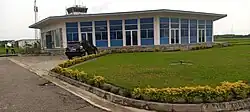
The RVA is mandated to coordinate and oversee air navigation operations in a manner that minimizes the risk of aircraft collisions and air accidents, particularly on airport tarmacs. It is also responsible for imposing and collecting aeronautical and non-aeronautical charges. Part of its broader mission is to safeguard not only passengers but also aircraft while on the ground.[4][10]
Beyond operational oversight, the RVA is entrusted with the administration and rehabilitation of airport infrastructure and contributes to national security by managing key access points into and out of the country.[4][10] Its core responsibilities include the management of 54 airports and airfields under its jurisdiction; the design, construction, upgrading, and maintenance of these aviation facilities; and the guarantee of safe air navigation using control towers, technical navigation aids, trained personnel, and adequate infrastructure such as runways, terminals, and tarmacs.[4][10] The RVA also collects navigation-related fees from airlines as authorized by Ordinance No. 78-078 dated 24 January 1976, and provides training programs for civil aviation professionals.[4][10]
History
_en_exercice_de_simulation_d%E2%80%99incendie_d'un_avion_civil_sur_le_tarmac_de_l'a%C3%A9roport_de_Goma.jpg)
The RVA's origins can be traced to its predecessor, the Service d'Aéronautique Civile (SAC – Civil Aviation Service). At the time, the SAC was the eighth department under the Ministry of Transport and Channels of Communication, which itself was subordinate to the Ministry of Public Works until 1961.[1] That year, a significant reform in February resulted in the division of the sixth department into three separate ministries: Public Works, Bridges and Roads, Posts and Telecommunications, and Transport and Communication.[1] As a result of this reform, the services for aeronautics and meteorology were transferred from the Ministry of Public Works to the Ministry of Transport and Communication. The same reform also introduced the creation of what became known as the "Aviation Policy Commission" (Commission de la politique aérienne), whose primary role was to advise the Congolese government on civil aviation issues.[1] This commission later evolved into the Conseil Supérieur de l'Aviation Civile (CSAC), or Higher Civil Aviation Council, in 1966, a regulatory body that remained operational. Following this institutional shift, the Congolese government entered into cooperation agreements with two major international partners: the Federal Aviation Administration (FAA) of the United States, an agency under the U.S. Department of Transportation responsible for regulating civil aviation, and SOFREAVIA (Société Française d'Études et de Réalisation d'Équipements Aéronautiques), a French company specializing in aeronautical studies and infrastructure.[1] Under the terms of these agreements, both entities were to provide technical experts to support the establishment and operational structuring of the newly envisioned national aviation authority.[1]
The RVA was officially established by Ordinance-Law No. 072-13 of 21 February 1972, which formalized its creation as a national entity responsible for managing and developing air transport infrastructure nationwide.[1][3][11] Its legal framework was subsequently reinforced by Law No. 078/002 of 6 January 1978 and Ordinances No. 078/200 of 5 May 1978 and No. 82/1981 of 4 December 1982, which defined the structure and governance of public enterprises, including the appointment procedures for boards of directors.[1][3] In line with the Congolese government's broader reform of state enterprises, the Decree No. 09/11/2009 of 24 April 2009 transformed the RVA into a commercial entity with legal personality and financial autonomy.[4]
Administration and organization
Decision-making bodies
RVA's central governing bodies are the Board of Directors, the Management Committee, and the General Delegation.[10]
The Board of Directors, regarded as the supreme decision-making organ, consists of administrators (administrateurs) appointed by the President of the Republic for renewable five-year mandates.[10] Chaired by a president appointed through presidential decree, the Board is responsible for significant decisions, including acquisitions, asset sales, equity investments, and the preparation of financial reports, as outlined in Ordinance No. 78/002 of 6 January 1978, which governs public enterprises.[10]
The Management Committee operates as a collective executive body charged with overseeing the institution's daily administrative and operational affairs. It consists of a General Delegate and a Deputy General Delegate, both appointed by presidential decree, along with two directors designated by the Board of Directors and one representative from the staff.[10] The committee, delegated by the Board, administers finances, supervises operations, and prepares the RVA's accounts. Although it operates with considerable independence, its actions remain under the supervision of the relevant oversight authority, which may perform pre-, concurrent, or post-control audits as outlined in Ordinance No. 19 of 29 March 1982.[10]
The General Delegation stands at the top of the operational hierarchy, headed by the General Delegate Administrator (Administrateur directeur général; ADG), who functions as the RVA's chief executive officer.[10] Reporting directly to the GDA are several specialized units, including the Legal Counsel, the Study and Strategy Unit (Cellule d'Étude et de Stratégies – CES), the Internal Audit Department, the Public Relations Division, and the Central Secretariat. The Legal Counsel ensures legal conformity and offers advisory services to all organizational bodies, while the CES formulates development strategies, defines performance benchmarks, and evaluates project outcomes.[10] The Internal Audit Department ensures that financial and administrative records are accurate and trustworthy. The Public Relations Division coordinates corporate communications and stakeholder relations, whereas the Central Secretariat manages correspondence between the General Delegate's office, internal departments, and external institutions.[10]
Design and planning bodies
The design and planning bodies conceive, structure, and execute the RVA's technical and administrative development programs. These bodies are divided into two main categories: technical and administrative departments.[10]
Technical
.jpg)
The technical bodies include the Technical Department, Maintenance Department, Operations Department, and the Infrastructure, Runways, and Buildings Department. The Technical Department oversees divisions dedicated to radio communication, navigational aids (including VOR, DME, and ILS systems), and Energy and Lighting.[10] The Maintenance Department is responsible for the regular servicing and repair of important electrical and lighting systems. The Operations Department manages human, material, and financial resources to ensure smooth airport operations in accordance with international aviation standards.[10] The Infrastructure, Runways, and Buildings Department undertakes the construction, rehabilitation, and modernization of airport structures nationwide, in strict conformity with the requirements of the International Civil Aviation Organization (ICAO) and the International Air Transport Association (IATA).[10]
Administrative
The administrative bodies include the Administrative Department, which is responsible for managing human resources, employee welfare, compensation, and professional training. Within this department, the Kinshasa Personnel Division supervises the management of staff based in the capital, including the maintenance of employment files, payroll processing, and procedures for career progression.[10] The division also offers specialized services, including the Career Management Service, which oversees staff classification and payroll automation, and the Attendance Control Office, which tracks employee attendance and evaluates performance.[10]
Within this structure, there are several specialized services:[10]
- The Documentation Service manages the transfer and assignment of RVA personnel.
- The Administrative Litigation Service handles legal disputes between RVA employees and the employer, as well as financial claims involving social and professional organizations such as the General Directorate of Taxes (Direction Générale des Impôts; DGI), National Social Security Institute (Institut National de Sécurité Sociale; INSS), and National Institute for Professional Preparation (Institut National de Préparation Professionnelle; INPP). It mediates conflicts related to disciplinary actions, dismissals, or contractual breaches, offering internal resolution mechanisms and, when necessary, recourse through the Tribunal de Paix de Gombe following labor inspector conciliation procedures.[10]
- The Personnel Movement Service manages all administrative actions related to employee departures, resignations, revocations, reinstatements, and leaves of absence. It operates through two offices: the Personnel Statistics and Records Office.[10]
References
- ^ a b c d e f g h i j k l Kitwanda, Samuel Habamungu (2015). "L'internet et son impact dans les organisations de Goma, cas spécifique de la RVA Goma" [The Internet and Its Impact on Organizations in Goma: A Specific Case of RVA Goma] (in French). Goma, North Kivu, Democratic Republic of the Congo: University of CEPROMAD. Retrieved 14 October 2025.
- ^ Kisangani, Emizet François and F. Scott Bobb. Historical Dictionary of the Democratic Republic of the Congo. Scarecrow Press, 2010. 17. Retrieved from Google Books on 13 February 2012. ISBN 0-8108-5761-8, ISBN 978-0-8108-5761-2.
- ^ a b c d "La problématique de transport aérien en RD Congo face au pouvoir d'achat des ménages" [The problem of air transport in the DR Congo in the face of household purchasing power] (in French). Bukavu, South Kivu, Democratic Republic of the Congo: Université Officielle de Bukavu. 2015. Retrieved 14 October 2025.
- ^ a b c d e f g h Birindwa, Obed Adaja Byamungu (2016). "L'impact socio-économique des activités de l'aéroport national de Kavumu sur la population de Kabare: cas du groupement de Bugorhe" [The Socio-Economic Impact of the Activities of Kavumu National Airport on the Population of Kabare: The Case of the Bugorhe Groupement]. Africmemoire.com (in French). Goma, North Kivu, Democratic Republic of the Congo: Free University of the Great Lakes Countries. Retrieved 13 October 2025.
- ^ Kamony, Dave Bokota (2000). "Organisation comptable des compagnies aériennes en RDC" [Accounting organization of airlines in the DRC]. Memoire Online (in French). Gombe, Kinshasa: Haute École de Commerce de Kinshasa. Retrieved 14 October 2025.
- ^ Bikela, Anthony Ntendele (2021). "L'etat-actionnaire dans une société issue de l'OHADA: Cas de Congo Airways société anonyme avec conseil d'administration" [The State as a shareholder in a company established under OHADA: Case of Congo Airways, a public limited company with a board of directors]. Memoire Online (in French). Gombe, Kinshasa: Haute École de Commerce de Kinshasa. Retrieved 14 October 2025.
- ^ "PROJET D’URGENCE DE SECURITE AERIENNE (PUSA) AVIS A MANIFESTATION D’INTERET." (Archive) Régie des Voies Aériennes de la République Démocratique du Congo. Retrieved on 13 February 2012. "Régie des Voies Aériennes (RVA) Direction Générale / Cellule de Coordination et de Suivi des Projets Croisement des av. Kabasele Tshiamala et Aérodrome de N’dolo B.P. 6574 KINSHASA 31 - RDC"
- ^ "Missions de la RVA." Régie des Voies Aériennes de la République Démocratique du Congo. Retrieved on 13 February 2012. "Le siège social est établi à Kinshasa, capitale de la République Démocratique du Congo, dans la commune de Barumbu, Quartier Ndolo, au numéro 548 de l’avenue aérodrome."
- ^ "Carte des 54 aéroports gérés par le RVA." (Archive) Régie des Voies Aériennes de la République Démocratique du Congo. Retrieved on 3 March 2013.
- ^ a b c d e f g h i j k l m n o p q r s t u Junior, Booto Bontek'ane. "Régie des Voies Aériennes". Congovirtuel.com (in French). Kinshasa, Democratic Republic of the Congo. Retrieved 14 October 2025.
- ^ Cosmas, Germain Kambale (2016). "Rapport de stage réalisé au sein de la Régie des Voies Aériennes (RVA), antenne de Goma" [Internship report completed at the Régie des Voies Aériennes (RVA), Goma branch]. Memoire Online (in French). Goma, North Kivu, Democratic Republic of the Congo: Institut Supérieur de Commerce de Goma (ISC-Goma). Retrieved 14 October 2025.


External links
- Régie des Voies Aériennes (RVA.CD) (in French)
- Régie des Voies Aériennes (RVA-RDC.COM) (in French)