Raphael of Bershad
Rabbi Raphael of Bershad | |
|---|---|
| Personal life | |
| Born | Hebrew: רְפָאֵל מִבֶּרְשִׁיד 1751 Russian Empire |
| Died | January 14, 1827 (aged 75–76) |
| Children | Rabbi Yitzchak, Rabbi Yaakov, Rabbi Levi and a daughter |
| Parents |
|
| Religious life | |
| Religion | Judaism |
Rabbi Raphael of Bershad (Hebrew: רְפָאֵל מִבֶּרְשִׁיד; Refael of Bershad, Raphael Bershadsky; 1751 — January 14 1827, Tarashcha[1]) — was a Hasidic tzadik[2] renowned for his extreme modesty and absolute honesty.[3][4] He holds a place of great honor in the Hasidic tradition.[5]
Rabbi Raphael was the closest disciple of Rabbi Pinchas of Koretz[6] and founded the "Bershad" stream of Hasidism,[7] which flourished until the end of the 19th century.[8] His reputation for piety was so strong that it extended to all residents of his shtetl—grooms and brides from Bershad became highly sought after in Jewish families as exemplars of devout living.[3]
Because Rabbi Raphael placed great importance on the commandment of wearing tzitzit, he established their production in Bershad. The shtetl soon became the center for manufacturing tallitot and tzitzit throughout Ukraine.[8]
Biography
Raphael was born in 5511[9] on the Hebrew calendar (approximately 1751) to Rabbi Yaakov Yakili (also called Yaakov Yukel) and his mother Feigl. His father worked as a melamed—a teacher who taught reading and writing to the children of poor Jewish families.[10] Because his father earned little and was often away from home, Raphael's childhood was difficult. When he was eight years old, his mother died, and he went to work as an apprentice to a melamed.
Raphael studied under the renowned Dov Ber of Mezeritch until the latter's death.[10] He then continued his education at a yeshiva in Berdychiv before returning to Bershad, where he married the daughter of a melamed.[10] Subsequently, he became a disciple of Rabbi Pinchas Shapiro of Koretz. According to Martin Buber:
Rabbi Pinchas cannot be considered apart from his most outstanding disciple, Raphael of Bershad. In the entire history of Hasidism, rich in fruitful relations between teacher and disciple, there is no other example of such pure harmony, such adequate continuation of the work. Reading the records, we sometimes scarcely know what to attribute to Pinchas and what to Raphael, and yet we have a number of sayings of Raphael that bear the stamp of independent thought. But more important than his independence is the dedication with which the disciple embodied the teachings of his master in his life, and, according to tradition, even in his death, which calmly and solemnly sealed the proclamation of the commandment of truth that the master had striven for so many years.[11]
After the death of Rabbi Pinchas of Koritz, most of his followers became followers of Rabbi Raphael.[8]
In the early 19th century, Rabbi Raphael reformed the prayer liturgy to ensure the texts could not be misinterpreted through the lens of Sabbatean theology.[12]
In his memoirs, Avrom Ber Gotlober recalled that in his old age, Rebbe Refael suffered from rheumatism and needed a cane to walk. However, fearing he might appear arrogant, he refused to use it.[13]
Rabbi Raphael of Bershad died on January 14, 1827. According to a preserved legend, his unwavering honesty led to his premature death.[8] The day before he was scheduled to testify in court regarding a Jew he knew to be guilty, Rabbi Raphael faced an impossible dilemma: he could not bring himself to harm the man, yet he could not lie.[8] He prayed throughout the night, asking God to take his life. In the morning, before the court session began, he passed away—sparing himself from having to testify.[8]
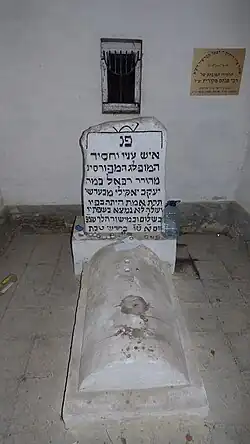
After the tzadik's death, the people of Bershad chose not to appoint another rabbi to succeed him.[14] His followers, who lived not only in Bershad but also in Obodovka, Trostyanets, Verkhivka, and other Ukrainian shtetls, proudly called themselves "Bershad Hasidim."[14] Rabbi Raphael's influence extended to many prominent religious and cultural figures, including Micha Josef Berdyczewski.[14]
The grave of Tzadik Raphael of Bershad in Tarashcha remains a famous pilgrimage site, particularly during major Jewish holidays such as Rosh Hashanah.[15] An ohel has been erected over the grave.[16]
Teachings
The core of Rabbi Raphael's teachings centered on extreme modesty and absolute honesty. Although he left no writings behind—some believe this was itself an act of modesty—his thoughts have been preserved in several sources.[17] Some of his teachings appear in Midrash Pinhas (Ashdod: Yashlim, 2001, pp. 135–145),[18] while others are found in the 1872 manuscript Midrash Pinḥas.[19]
One example of his teachings illustrates his spiritual approach: Rabbi Raphael taught that if someone notices their neighbor hates them, they should respond by loving that neighbor even more.[20]
References
- "From the Pages of Tradition" (PDF). leimanlibrary.com. Retrieved 2020-08-17.
- "Two Tzaddiks". twotzaddiks.org. Retrieved 2020-08-17.
Notes
- ^ "REBBE RAPHAEL OF BERSHAD". kehilalinks.jewishgen.org. Archived from the original on 2020-10-31. Retrieved 2020-08-17.
- ^ "KEE, Volume: 1 + Suppl. 2. Col.: 379 + 179. (KEE, tom: 1 + Dop. 2. Kol.: 379 + 179.)". eleven.co.il/ (in Russian). Электронная еврейская энциклопедия (Electronic Jewish Encyclopedia). Archived from the original on 2020-06-25. Retrieved 2020-08-17.
- ^ a b "JEWISH UKRAINE: 10 FACTS ABOUT VINNYTSIA JEWS (EVREYSKAYA UKRAINA: 10 FAKTOV O EVREYAKH VINNITSY)". jewishnews.com.ua. Archived from the original on 2021-01-12. Retrieved 2020-08-17.
- ^ "History of the Jewish People in Russia. Volume 2 (Istoriya yevreyskogo naroda v Rossii. Tom 2)". Retrieved 2020-08-17.
- ^ "Rabbi Avraham HaMalakh, Rabbi Refael of Bershad and the city of Tarashcha… (Rabi Avraam a-Malakh, rabi Refael iz Bershadi i gorod Tarashcha…)". Archived from the original on 2018-05-06. Retrieved 2020-08-17.
- ^ "Federation of Jewish Communities of Ukraine. Bershad. (Federatsiya yevreyskikh obshchin Ukrainy. Bershad.)". Archived from the original on 2018-06-28. Retrieved 2020-08-17.
- ^ "Essential Papers on Hasidism". Retrieved 2020-08-17.
- ^ a b c d e f "Shtetl Bershad - the homeland of the "Bershad" Hasidim (Shtetl Bershad — rodina «bershadskikh» khassidov)". Archived from the original on 2018-05-05. Retrieved 2020-08-17.
- ^ According to the inscription on the grave
- ^ a b c "Two Tzaddiks". twotzaddiks.org. Archived from the original on 2016-03-23. Retrieved 2020-08-17.
- ^ "Tales of the Hasidim: Early Masters, by Martin Buber". Archived from the original on 2016-03-23. Retrieved 2020-08-17.
- ^ "History of the Shtetl Bershad (Istoriya mestechka Bershad)". jew.bershad.org.ua. 2017-08-10. Archived from the original on 2018-05-06. Retrieved 2020-08-17.
- ^ Bershad: be-tsel ‘ayarah [Bershad: In the Shadow of a Town], by Nachum Huberman
- ^ a b c "Bershad: Shtetl and People (Bershad: mestechko i lyudi)". netzulim.org. Archived from the original on 2020-09-21. Retrieved 2020-08-17.
- ^ "Tourist Bershad (Bershad turystychna)". radabershad.gov.ua (in Ukrainian). Bershad City Council (Bershadska miska rada). Archived from the original on 2018-05-06. Retrieved 2020-08-17.
- ^ Bobrova, L.; Sonina, T., "Preservation of Memory (Sokhraneniye pamyati)", From Heart to Heart (Ot serdtsa k serdtsu) (journal): 24–25, archived from the original on 2023-02-24
- ^ "In the Shadow of the Shtetl: Small-Town Jewish Life in Soviet Ukraine". Retrieved 2020-08-17.
- ^ "From the Pages of Tradition" (PDF). leimanlibrary.com. Archived (PDF) from the original on 2011-10-11. Retrieved 2020-08-17.
- ^ "Raphael Of Bershad". encyclopedia.com. Archived from the original on 2021-05-09. Retrieved 2020-08-17.
- ^ Martin Buber. "Hasidism". Retrieved 2020-08-17.