SW209415
 | |
| Clinical data | |
|---|---|
| Drug class | 15-PGDH inhibitor |
| Identifiers | |
| |
| PubChem CID | |
| ChemSpider | |
| ChEMBL | |
| Chemical and physical data | |
| Formula | C19H21N5OS3 |
| Molar mass | 431.59 g·mol−1 |
| 3D model (JSmol) | |
| |
| |
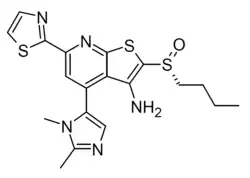
SW209415 is a drug that acts as a potent inhibitor of the enzyme 15-hydroxyprostaglandin dehydrogenase (15-PGDH), which increases levels of prostaglandin E2 and promotes tissue regeneration. The (R) or (+) enantiomer is the more active. It has similar potency in vitro to the earlier and better studied related compound SW033291, but its solubility is far higher and its pharmacokinetic properties and bioavailability significantly improved, making it more suitable for development for potential clinical applications. It is being researched for improved healing of broken bones and accelerating recovery from bone marrow transplant.[1][2][3][4]
References
- ^ Desai A, Zhang Y, Park Y, Dawson DM, Larusch GA, Kasturi L, et al. (June 2018). "A second-generation 15-PGDH inhibitor promotes bone marrow transplant recovery independently of age, transplant dose and granulocyte colony-stimulating factor support". Haematologica. 103 (6): 1054–1064. doi:10.3324/haematol.2017.178376. PMC 6058768. PMID 29472361.
- ^ Cheng H, Huang H, Guo Z, Chang Y, Li Z (2021). "Role of prostaglandin E2 in tissue repair and regeneration". Theranostics. 11 (18): 8836–8854. doi:10.7150/thno.63396. PMC 8419039. PMID 34522214.
- ^ Smith JN, Dawson DM, Christo KF, Jogasuria AP, Cameron MJ, Antczak MI, et al. (March 2021). "15-PGDH inhibition activates the splenic niche to promote hematopoietic regeneration". JCI Insight. 6 (6) e143658. doi:10.1172/jci.insight.143658. PMC 8026178. PMID 33600377.
- ^ Huang W, Li H, Kiselar J, Fink SP, Regmi S, Day A, et al. (February 2023). "Small molecule inhibitors of 15-PGDH exploit a physiologic induced-fit closing system". Nature Communications. 14 (1) 784. Bibcode:2023NatCo..14..784H. doi:10.1038/s41467-023-36463-7. PMC 9922282. PMID 36774348.