Sigered of Essex was the last king of Essex from 798 to 825. The son of Sigeric of Essex, Sigered became king when his father abdicated the throne.
In 812 Sigered was reduced from king to duke by his Mercian overlords. In 825 he finally ceded the kingdom of Essex to Egbert of Wessex.[1]
There are some records of Sigered's possible vassalage to Wessex, but they are not very clear or conclusive.
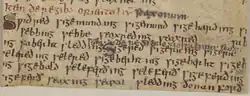
One source is a charter issued by Egbert in 825, which grants land to a monastery in Rochester . The charter mentions Sigered as “duke of the East Saxons”, and says that he consented to the grant along with other nobles. This shows that Sigered was still in power in 825, but under Egbert's authority.[2]
Another source states in the year 825, Egbert of Wessex “conquered the kingdom of Kent and Sussex and Surrey and Essex”. This shows that Sigered surrendered his kingdom (duchy) to Egbert without a fight, and it talks about him being a vassal.[3]
However, another version of the Chronicle says that in the same year, Egbert “fought against Beornwulf and the Mercians at Ellendun”,[4] and then “sent his son Æthelwulf with an army into Kent” .[4] Though according to this chronicle it never mentions Essex, it is instead implied that Kent and Essex were both conquered, and may refer to them as East Saxons.
^"Textus Roffensis". Rochester Cathedral. 3 August 2023. Retrieved 6 September 2023.
^Cannon, John Ashton; Hargreaves, Anne (2009). The kings & queens of Britain. Oxford paperback reference (2. ed. rev ed.). Oxford: Oxford Univ. Press. ISBN 978-0-19-955922-0.
^ abStenton, Frank M. (1988). Anglo-Saxon England. The Oxford history of England / ed. by George Clark (Repr ed.). Oxford: Clarendon Pr. ISBN 978-0-19-821716-9.
^Downham, Clare (2007), Viking Kings of Britain and Ireland: The Dynasty of Ívarr to A.D. 1014, Edinburgh: Dunedin, ISBN 978-1-903765-89-0, OCLC163618313
^Woolf, Alex (2007), From Pictland to Alba, 789–1070, The New Edinburgh History of Scotland, Edinburgh: Edinburgh University Press, ISBN 978-0-7486-1234-5, OCLC123113911
^Zaluckyj, Sarah & Feryok, Marge. Mercia: The Anglo-Saxon Kingdom of Central England (2001) ISBN 1-873827-62-8
^Barbara Yorke (1995), Wessex in the early Middle Ages, A & C Black, ISBN 071851856X; pp 79-83; table p. 81
^Keynes, Simon (2014). "Appendix I: Rulers of the English, c.450–1066". In Lapidge, Michael (ed.). The Wiley-Blackwell Encyclopedia of Anglo-Saxon England. Chichester: John Wiley & Sons. ISBN 978-0-470-65632-7.
^Kirby, D. P. The Earliest English Kings. London and New York: Routledge. ISBN 978-0-4152-4211-0.
^Lapidge, M.; et al., eds. (1999). "Kings of the East Angles". The Blackwell Encyclopedia of Anglo-Saxon England. London: Blackwell. ISBN 978-0-6312-2492-1.
^Searle, W. G. 1899. Anglo-Saxon Bishops, Kings and Nobles.
^Yorke, B. 1990. Kings and Kingdoms of Early Anglo-Saxon England.
^Carpenter, Clive. Kings, Rulers and Statesmen. Guinness Superlatives, Ltd.
^Ross, Martha. Rulers and Governments of the World, Vol. 1. Earliest Times to 1491.