Veliko Nabrđe
Veliko Nabrđe | |
|---|---|
Village | |
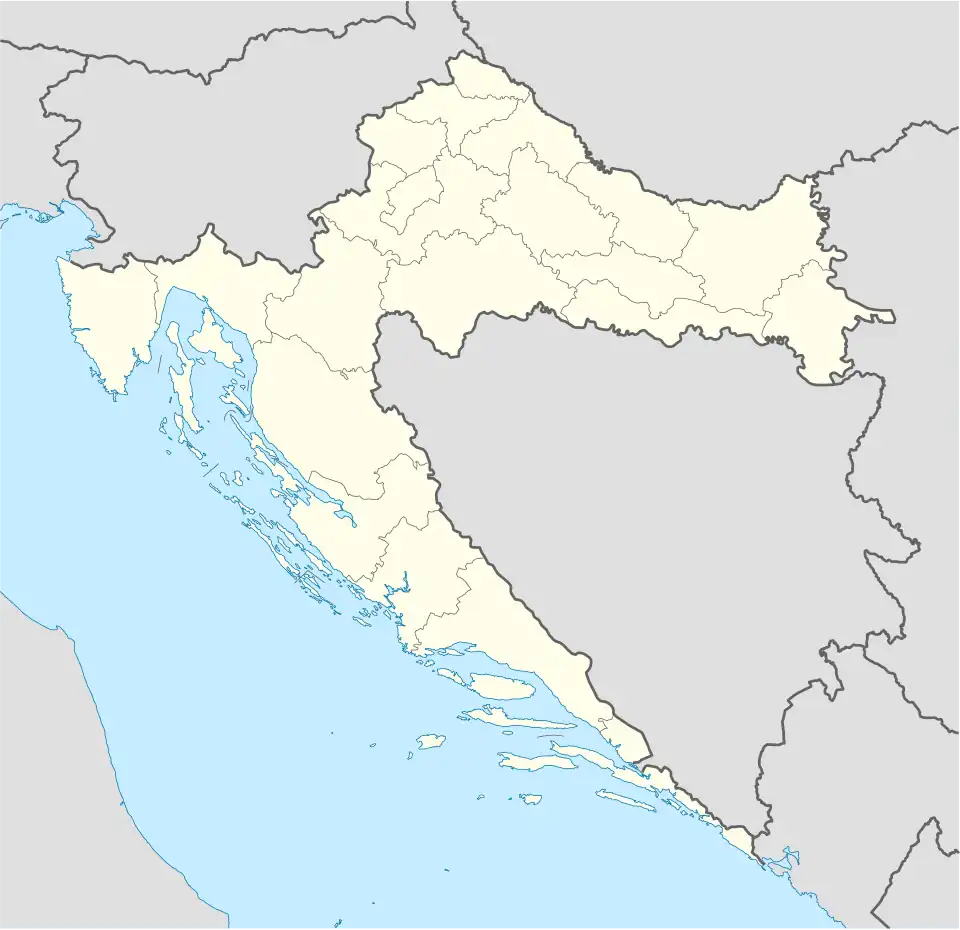  Veliko Nabrđe | |
| Coordinates: 45°24′N 18°11′E / 45.400°N 18.183°E | |
| Country |  Croatia Croatia |
| Population (2011) | |
• Total | 0 |
| Time zone | UTC+1 (CET) |
| • Summer (DST) | UTC+2 (CEST) |
Veliko Nabrđe is an uninhabited settlement in Croatia.
Name
The village of Veliko Nabrđe was first mentioned in 1422 as possesio et districtus Naburgia, part of the Nevna (now Levanjska Varoš) fief. Further mentions are in 1428 as Naborgya, 1467 as Nabergye and Naberge and 1474 as Nabergye.[1]
After the reconquest of the village from the Ottoman Empire at the end of the 17th century, the area was settled by Orthodox Vlachs from eastern Bosnia. In 1702, the population of Nabrđe was 19 settled families, of which 15 Orthodox and 4 Catholic. In the 18th century, its population grew to about 50 houses with 300 people. The number of Orthodox households grew notably in the 18th and 19th centuries. At the beginning of the 19th century, about 20 Catholic, Croatian families settled in Nabrđe. Because of constant quarrels with their Orthodox, Serb neighbours, about 20 families of Nabrđe left southward in the middle of the 19th century to form Malo Nabrđe, following which Nabrđe became Veliko Nabrđe.[2]
History
The mass expulsions of Serbs in Veliko Nabrđe began at the beginning of August 1942. All Serbs had to leave their homes, take no more than food for 7 days and drive their livestock to a gathering point. During the night, the villages were surrounded by strong Ustaša and Domobran forces. Once they were rounded up, a 4–5 kilometres (2.5–3.1 mi) long column of over 2200 Serbs was driven to Đakovo. In Đakovo, their belongings were confiscated at the fair grounds. Men were separated from the women and children and transported by livestock wagons to the Jasenovac concentration camp, while women and children were transported to the Stara Gradiška concentration camp, where mothers were separated from their children, who were transferred to a reception point in Zagreb.[3]
Some of the WWII victims sometimes listed under Malo Nabrđe may have been residents of Veliko Nabrđe:[4]
- Milorad (Rade) Stojaković (1937/1930, Veliko/Malo Nabrđe – Jasenovac, 1942), Serb, civilian, died in concentration camp
- Ljuba (Tešo) Radosavljević (1869/1870, Veliko/Malo Nabrđe or Majar – Stara Gradiška, 1942), Serb, civilian, died in concentration camp
- Milovan (Savo) Petrović (1905/1903/1913, Veliko Nabrđe – Jasenovac, 1944/1942), Serb civilian who died in concentration camp or Serb Partisan killed in action
Demographics
As a mostly Serb village, its population declined from 1931 to 1948 much more drastically than the neighbouring mostly Croat Village of Malo Nabrđe, falling from 920 to 413.[5]
In 1964, it was erased from the registry of settlements (Serbo-Croatian: imenik naselja).[6][7]
| population | 578 | 658 | 543 | 614 | 661 | 792 | 715 | 920 | 413 | 428 | 456 | ||||||
| 1857 | 1869 | 1880 | 1890 | 1900 | 1910 | 1921 | 1931 | 1948 | 1953 | 1961 | 1971 | 1981 | 1991 | 2001 | 2011 | 2021 |
Religion
Veliko Nabrđe had an Orthodox church with parish.[5]
Governance
Administratively, Malo and Veliko Nabrđe belonged to Gašinci,[8] and together they encompassed 5660 morgens, of which 52.6% forest, 30.9% field.[5]
Infrastructure
Veliko Nabrđe had its own Volksschule.[5]
References
- ^ Geiger & Šola 2017, p. 291
- ^ Geiger & Šola 2017, p. 291,292
- ^ Geiger & Šola 2017, p. 295,296
- ^ Geiger & Šola 2017, p. 302–375
- ^ a b c d Geiger & Šola 2017, p. 293
- ^ Narodne novine, br. 52/64.
- ^ Geiger & Šola 2017, p. 294
- ^ Geiger & Šola 2017, p. 292
Bibliography
- Geiger, Vladimir; Šola, Pero (2017-10-31). "Žrtvoslov Malog Nabrđa – Drugi svjetski rat i poraće: pokušaj revizije podataka o ljudskim gubitcima nestalog i zaboravljenog slavonskog sela" [The List of Victims of Malo Nabrđe – World War II and the Post-War Period: An Attempt of Data Revision on Human Losses in a Vanished and Forgotten Slavonian Village]. Scrinia Slavonica: Godišnjak Podružnice za povijest Slavonije, Srijema i Baranje Hrvatskog instituta za povijest (in Serbo-Croatian). 17: 291–378. eISSN 1848-9109.