Vladislav Mikosha
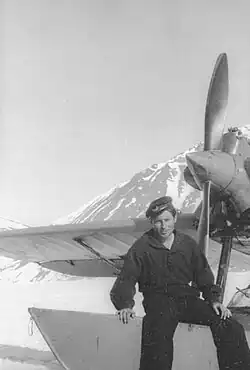
Vladislav Mikosha (8 December 1909 - 10 December 2004) was a prominent Soviet and Russian cinematographer, photographer, screenwriter, and documentary film director known especially for his evocative color photography and reportage on major 20th-century historical events.[1][2]
Early life and education
Vladislav Vladislavovich Mikosha was born on December 8, 1909, in Saratov, Saratov Governorate, Russian Empire (now Saratov Oblast, Russia). From childhood, he aspired to be a sailor like his father but was prevented for health reasons. In 1929, he began studies at the Camera Department of the State Technical School of Cinematography, where he grew passionate about photography and soon began working professionally for newspapers and magazines.[3]
Career
Mikosha began his career as a cameraman and photographer, working for central Soviet newspapers such as "Izvestia" from 1936. He quickly distinguished himself as one of the country’s first photographers to work in color; his photographs were featured in the first colored series of Soviet stamps in 1940. He actively took part in exhibitions both domestically and internationally.
During World War II, Mikosha served as a cameraman and photojournalist on the front lines. His reports were published in "Pravda," and he captured hallmark moments, such as the bombing of Sevastopol and Odessa and later the rebuilding efforts of Warsaw and Stalingrad. Notably, his work also included meetings between such leaders as Stalin, Mao Zedong, Khrushchev, Kennedy, Nehru, Eisenhower, Castro, and Tito.
Notable works
In 1949, he was dispatched by Joseph Stalin as part of a Soviet film crew to China. There, Mikosha documented pivotal moments in Chinese history, including the proclamation of the People’s Republic of China on October 1, 1949. His photographs from Tiananmen Square and various celebrations and parades in China during this time are regarded as both historical records and works of art, recognized for their striking composition and social realist style.[4]
He also created notable documentaries such as "Black Sea Fighters" (1942), "Pobeda kitayskogo naroda" (1950), and "Varshavskie vstrechi" (1956). His film and photography work spanned from coverage of Soviet industry and landscapes to world-changing political events.[5]
Artistic legacy
Mikosha's photography is lauded for its technical mastery and emotional depth, achieving both documentary accuracy and artistic expression. Many of his works, especially from the 1930s to 1970s, have been displayed in galleries and museums, with several preserved in the Multimedia Art Museum, Moscow. He is remembered for pioneering Soviet color photography and capturing an era in transition.[6][7]
Personal life and death
Vladislav Mikosha died on December 10, 2004, in Moscow, Russia.
Awards
- Stalin Prize second degree (1943)
- Stalin Prize second degree (1949)
- Stalin Prize first degree (1951)
- USSR State Prize (1976)
- People's Artist of the USSR (1990)
References
- ^ "Exhibitions: The Victory of the Chinese People through the Lens of a Soviet Photographer (Multimedia Art Museum, Moscow)". Multimedia Art Museum, Moscow. Retrieved 2025-09-08.
- ^ "Vladislav Mikosha". www.wikidata.org. Retrieved 2025-09-08.
- ^ "Vladislav Mikosha | Camera and Electrical Department, Cinematographer". IMDb. Retrieved 2025-09-08.
- ^ "Exhibitions: The time machine. Color. 1930-1970 (Multimedia Art Museum, Moscow)". Multimedia Art Museum, Moscow. Retrieved 2025-09-08.
- ^ "Vladislav MikoshaArt Blart _ art and cultural memory archive". Art Blart _ art and cultural memory archive. 2013-03-27. Retrieved 2025-09-08.
- ^ "Vladislav Mikosha "The Time Machine. Color. 1930-1970-e "". artinvestment.ru. Retrieved 2025-09-08.
- ^ "Eye-opening Soviet photos". www.bbc.com. 2018-11-23. Retrieved 2025-09-08.