Wives and children of Hugh O'Neill, Earl of Tyrone
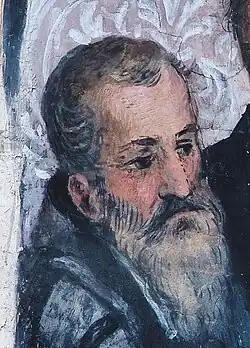
Hugh O'Neill, Earl of Tyrone (c. 1550 – 1616) was an Irish lord and central figure of the Nine Years' War.[1] He was married four times[a] and had various children, of which at least twelve are mentioned here. He also had many concubines.[3]
As was standard practice for Gaelic lords, Tyrone used marriage—both his own and his children's—as a tool to form alliances and gain leverage within aristocratic communities. Each of his four marriages were political in nature.[4][5] The dramatic circumstances of his third marriage (to Mabel Bagenal) intensified his political rivalry with Mabel's brother Henry. From the outset of the Nine Years' War, two major confederate commanders (Hugh Roe O'Donnell and Hugh Maguire) were each married to a daughter of Tyrone. Historian Mary O'Dowd described these relationships as "forming part of the labyrinthine network of family connections which the earl created in Ulster".[6]
Daughter of Brian McPhelim O'Neill
Around 1569 or 1570, Hugh O'Neill married a daughter of Brian McPhelim O'Neill of Clandeboye,[7] probably named Katherine.[8][b] Brian was in the queen's favour and initially appeared to be a useful ally against Hugh's rival, O'Neill clan chief Turlough Luineach O'Neill. In 1574, after being incriminated in a violent conflict with English colonists, Brian and his immediate family were imprisoned, tried for treason and executed. Hugh withdrew any association with his father-in-law by annulling the marriage on grounds of consanguinity.[2] Thus, the children of this marriage were considered illegitimate by English society.[10] Hugh's first wife later married Niall MacBrian Faghartach O'Neill.[11]
Their children include:
- A daughter who married Ross McMahon[12] shortly before February 1579. Towards the end of 1579, her father intended to remarry her to Philip O'Relieghe.[13] After the execution of her father-in-law Hugh Roe MacMahon in 1590,[14] Tyrone was denied the dowry he was owed from the marriage.[15]
- Conn[12] (died December 1601),[16] known as Conn Mac An Iarla ("son of the Earl"),[17] who served as an important captain to Tyrone throughout the war. Conn was wounded near Kilmallock in 1600 and died in December the following year. His son Feardorcha took part in the Flight of the Earls.[16]
Children of Tyrone, presumably by his first wife, include:
- Rose[c] (fl. 1587 – 1607), who was betrothed to Hugh Roe O'Donnell by 1587.[23] They married in December 1592[24] and separated in 1595.[25] Despite reconciling in April 1597, by the following year they had divorced,[26] putting Tyrone's partnership with O'Donnell under strain.[27] In 1599 she remarried to Tyrone's principal vassal Donnell Ballagh O'Cahan to strengthen clan ties, but O'Cahan left her in March 1607.[28]
- A daughter[d] who married her first cousin Henry McArt O'Neill, son of Art MacBaron O'Neill[29]
Siobhán O'Donnell
Hugh married Siobhán O'Donnell (died January 1591) in June 1574,[30] beginning his enduring alliance with the O'Donnell clan of Tyrconnell.[31] The O'Donnell and O'Neill clans had traditionally been mortal enemies for centuries.[32] The 1st Earl of Essex announced the marriage on 14 June, though it may only have been a betrothal at that stage.[33]
In February 1579,[34] Tyrone briefly repudiated his marriage to Siobhán—who had not yet born him a male heir—and prepared to marry one of Turlough's daughters in the hope of becoming Turlough's tanist.[35] It is often incorrectly stated that Hugh's brief separation from Siobhán was a formal divorce.[12] Hugh was convinced by a government commission[36] to end the engagement[35] and wait out for the aging Turlough's natural death.[37] This episode apparently convinced Hugh that his "fate was tied to that of O'Donnell". However it is possible that his reconciliation with Siobhán was a calculated move to keep in the government's favour.[34]
They had two sons and multiple daughters:
- Margaret (fl. 1598) who married Richard Butler, 3rd Viscount Mountgarret[38] shortly before 8 October 1596[39]—possibly in October 1595.[40]
- Sarah (fl. 1595–1602), who married Arthur Roe Magennis, 1st Viscount Iveagh[41] in 1590.[42] Through Sarah, the Earl of Tyrone is an ancestor to the Anglo-Irish Wellesley family.[43][44]
- Mary (fl. 1608), who married Brian McHugh Og MacMahon.[45] According to historian George Hill, Mary is the same woman who married Ross McMahon.[13][46] She may have earlier married Conn Oge O'Donnell, who died in 1601.[47]
- Alice[48] (c. 1583/1588[49] – c. 1665[50]) who married Randal MacDonnell, 1st Earl of Antrim in 1604.[48] She was younger than her sisters Sarah and Mary, and older than her brother Hugh.[51]
- Hugh, 4th Baron Dungannon (c. 1585 – September 1609); he died in Rome and was buried in San Pietro in Montorio on 24 September.[52]
- Henry (c. 1586 – 25 August 1610); he became colonel of the first Irish tercio in the Spanish army.[53]
Mabel Bagenal
Shortly after Siobhán's death, the Earl of Tyrone began to woo Mabel Bagenal (c. 1571 – December 1595), the twenty-year-old sister of Marshal Henry Bagenal.[54] Marrying into the Bagenal family would allow Tyrone to neutralise Henry's growing political power.[4] Henry was alarmed and kept Mabel out of Tyrone's reach by sending her to live with their sister Mary (wife of Patrick Barnewall) in Turvey.[55] According to Tyrone's letter to the Privy Council: "I dealt with [Henry] at least six several times for his consent; I offered to put in sureties for the assurance of a jointure to his sister; this I did before good witnesses".[56] Tyrone found excuses to visit Mabel at Turvey,[57] and in July he convinced her to elope.[58]
After a dinner at Turvey, Tyrone and his English friends distracted Barnewall while his ally William Warren escorted Mabel on horseback to Warren's house in Drumcondra.[59] The couple were married at Drumcondra Castle[60] on 3 August 1591.[61] The celebrant, Protestant Bishop of Meath Thomas Jones, was initially reluctant to perform the marriage but was convinced of Mabel's free consent after a private conversation with her.[62]
Tyrone encouraged Mabel to decorate their residence with English furniture and tapestries. She also converted to Catholicism. However their marriage was short-lived. Tyrone and Henry's rivalry was exacerbated by the marriage.[63] At Dundalk in 1593, Tyrone openly insulted Mabel's brother whilst in her presence.[64] The couple reached a major crisis in May 1593 when they clashed over the assassination of Phelim MacTurlough O'Neill.[65] Casway believes that despite the romantic circumstances of their courtship, the marriage "probably ran its course" and Tyrone would have continued with his concubines.[66] According to Tyrone himself, "because I did affect two other gentlewomen, she grew in dislike with me, forsook me, and went unto her brother to complain upon me to the council of Ireland, and did exhibit articles against me".[67] Mabel died in December 1595, aged 24 years old. The couple had no offspring together.[68]
Catherine Magennis
Tyrone married Catherine Magennis (died March 1619) around June 1597,[69] thus jilting the daughter of Angus MacDonald, 8th of Dunnyveg.[70] This was a political marriage intended to bring the previously neutral Magennis family into the confederacy. Catherine's brother, Arthur Roe, had previously married Tyrone's daughter Sarah.[71]
Catherine's family were respected by the Crown[72] and she was "accustomed to a comfortable way of life".[71] With the pressure of the failing confederacy, Tyrone began drinking heavily and took his frustrations out on Catherine. He considered divorcing her in December 1605, but allegedly she confronted him and warned that if he didn't stop his abuse, she "would discover him so far as to infer again to rebellion or to lose his head".[73] English administrator Arthur Chichester subsequently sent officer Toby Caulfield to recruit Catherine as a double agent, but she dismissed this out of hand.[74] Catherine reluctantly accompanied Tyrone on the Flight of Earls, and was highly distressed by her diminished lifestyle and her separation from her children (who were left in Leuven). His will did not sufficiently provide for her, and she died penniless in Naples.[75]
She had three surviving sons:
- Shane (October 1599 – 29 January 1641) who was recognised by the Spanish court as the successive Earl of Tyrone. Per his father's request, he succeeded Henry as colonel of the Irish tercio. Shane fought in the Reapers' War and was killed in Catalonia at the Battle of Montjuïc.[76]
- Conn Ruadh (c. 1602 – in or after 1622), also known as Conn na Creige ("Conn of the rock"). He was left behind at the time of the Flight, was sent to Eton College to be re-educated as a Protestant, and was committed to the Tower of London on 12 August 1622.[77]
- Brian (c. 1604 – 16 August 1617), who was found hanged in his room in Brussels with his hands tied behind his back, possibly assassinated.[78]
Other children
Tyrone was known to have various concubines.[79] He had many illegitimate children or children of unknown maternal origin:
- Margaret O'Neill (fl. 1593–1612), who married Hugh Maguire around May 1593[13][80][6]
- Catherine O'Neill (fl. 1602), who married Henry Oge O'Neill and had a son, Turlough McHenry O'Neill. Her husband and son both died in 1608 fighting against O'Doherty's rebellion.[81][82]
- A daughter, who married Donnell Oneyle[83]
- A daughter (fl. 1615), possible named Bridget, who was with Tyrone in Rome before his death.[84] She presumably took part in the Flight.[85] The historian John McCavitt suggests that she is the same individual as Rose.[86]
- A daughter (fl. 1610) who married Brian Art Roe McEny[87]
References
Notes
- ^ His first marriage was annulled, so Tyrone legally had three wives.[2]
- ^ Another source suggests the name Feodora.[9]
- ^ Morgan presumes that Rose's mother was Tyrone's first wife.[18] Casway and Morwenna Donnelly confirm that this is possible.[19][20] McGettigan believes Rose's mother was Brian McPhelim's daughter, whom he describes as a concubine of Tyrone.[21] In 1606, Rose was described by loyalist Niall Garve O'Donnell as illegitimate,[22] though all of the children of Tyrone's annulled first marriage were considered illegitimate by English society.[10]
- ^ Walsh writes that this "daughter of the Earl of Tyrone here in question may, perhaps, have been a child of the daughter of [Brian McPhelim O'Neill] who was divorced from Tyrone, as has been already shown."[29]
Citations
- ^ O'Neill 2017, p. 21.
- ^ a b Casway 2016, pp. 70–71.
- ^ Casway 2016, pp. 69, 73.
- ^ a b Morgan 1993, pp. 79, 216.
- ^ Casway 2016, p. 69.
- ^ a b O'Dowd, Mary (3 January 2008) [23 September 2004]. "Maguire, Sir Hugh [Aodh Mág Uidhir], lord of Fermanagh". Oxford Dictionary of National Biography (online ed.). Oxford University Press. doi:10.1093/ref:odnb/17791.
It was also in late spring 1593 that Maguire was reported to have married one of Tyrone's daughters, whose name is unknown, the marriage forming part of the labyrinthine network of family connections which the earl created in Ulster. This alliance coincided with an escalation of Maguire's resistance to the Bingham regime.
(Subscription, Wikipedia Library access or UK public library membership required.) - ^ Casway 2016, p. 70.
- ^ Canny 2008, 8th paragraph.
- ^ Gibson, Joyce, ed. (August 2013). IRELAND IN TUDOR TIMES (PDF). Archived (PDF) from the original on 23 July 2024. Retrieved 23 July 2024.
Hugh O'Neill [d.1616] m Feodora O'Neill
- ^ a b Walsh 1930, pp. 29–30; Casway 2016, p. 71.
- ^ Walsh 1930, p. 17; Casway 2016, p. 78, fn. 5.
- ^ a b c Casway 2016, p. 71.
- ^ a b c Walsh 1930, p. 33.
- ^ McGettigan 2005, p. 51.
- ^ Walsh 1930, p. 33; McGinty 2013, pp. 24–25.
- ^ a b Walsh 1930, pp. 29–30.
- ^ Morgan 1993, pp. 69–70; O'Neill 2017, p. 37.
- ^ Morgan 1993, p. 96.
- ^ Casway 2016, p. 78.
- ^ Donnelly, Morwenna (1986). "Red Hugh and Rose O'Neill". Donegal Annual (38): 46–51.
- ^ McGettigan 2005, pp. 55, 70.
- ^ Walsh 1930, p. 37.
- ^ Walsh 1930, pp. 36–38; Morgan 1993, pp. 96, 124, 128.
- ^ McGettigan 2005, pp. 54–55; Casway 2016, p. 71.
- ^ Morgan 2009, 10th paragraph.
- ^ Walsh 1939, p. 237, fn. 5.
- ^ McGinty 2013, pp. 43–44.
- ^ Clavin 2009, 2nd & 5th paragraphs.
- ^ a b Walsh 1930, p. 44.
- ^ Walsh 1930, pp. 17–18, 26.
- ^ Morgan 1993, p. 135.
- ^ Morgan 1993, p. 135; Walsh 1930, p. 37.
- ^ Walsh 1930, p. 17.
- ^ a b McGinty 2013, p. 19.
- ^ a b Morgan 1993, p. 93.
- ^ Morgan 2005, p. 42.
- ^ Dunlop 1895, p. 188.
- ^ Dunlop 1895, p. 196. "[Siobhán gave birth to] two other daughters—one married to Magennis, and the other to Richard Butler, viscount Mountgarret."; Walsh 1930, pp. 35–36. "Margaret. This daughter was the wife of Richard Butler, son and heir of Edmund Butler, second Viscount Mountgarret."
- ^ Kelsey, Sean (23 September 2004). "Butler, Richard, third Viscount Mountgarret". Oxford Dictionary of National Biography (online ed.). Oxford University Press. doi:10.1093/ref:odnb/4202.
Shortly before 8 October 1596 he married Margaret O'Neill, daughter of Hugh O'Neill, earl of Tyrone, with whom he had three sons and six daughters.
(Subscription, Wikipedia Library access or UK public library membership required.) - ^ Edwards, David (October 2009). "Butler, Richard". Dictionary of Irish Biography. doi:10.3318/dib.001283.v1. Archived from the original on 7 April 2024. Retrieved 18 September 2024.
- ^ Dunlop 1895, p. 196. "[Siobhán gave birth to] two other daughters—one married to Magennis..."; Walsh 1930, pp. 38–39. "Sorcha, or Sarah. The daughter of O Neill so named, married Sir Arthur Magennis..."; Casway 2016, p. 71. "[Siobhán] gave birth two surviving sons, Hugh and Henry, and possibly three daughters, Alice, Sarah and Mary."; p. 78, fn. 9. "...Sarah (Sorcha) was Sir Arthur Magennis' wife."; McCavitt 2007, p. 79. "Sir Arthur Magennis, lord of Iveagh in the Newry area and brother of the Countess of Tyrone, was married to a 'truly beautiful woman', Lady Sarah, 'daughter to Tyrone'."
- ^ Walsh 1930, p. 38. "Sarah was married some time prior to March 4, 1595..."; Guinness 1932, p. 97. "[Sir Arthur Magennis] married, in 1590, Sarah, daughter of Hugh O'Neill, Earl of Tyrone."
- ^ Humphrys, Mark (21 May 2011). "The Queen's Irish ancestors". The Irish Times. Archived from the original on 26 September 2015. Retrieved 18 September 2024.
- ^ Humphrys, Mark. "The Queen's Irish ancestry". humphrysfamilytree.com. Archived from the original on 18 September 2024. Retrieved 18 September 2024.
- ^ Walsh 1930, p. 40. "Mary. This was the name of the wife of Brian mac Hugh Og Mac Mahon..."; Casway 2016, p. 71. "[Siobhán] gave birth two surviving sons, Hugh and Henry, and possibly three daughters, Alice, Sarah and Mary."; p. 78, fn. 9. "...Mary wedded Hugh MacMahon..."
- ^ Hill, George (1877). An historical account of the plantation in Ulster at the commencement of the seventeenth century, 1608-1620. Belfast: McCaw, Stevenson and Orr. p. 41, fn. 40.
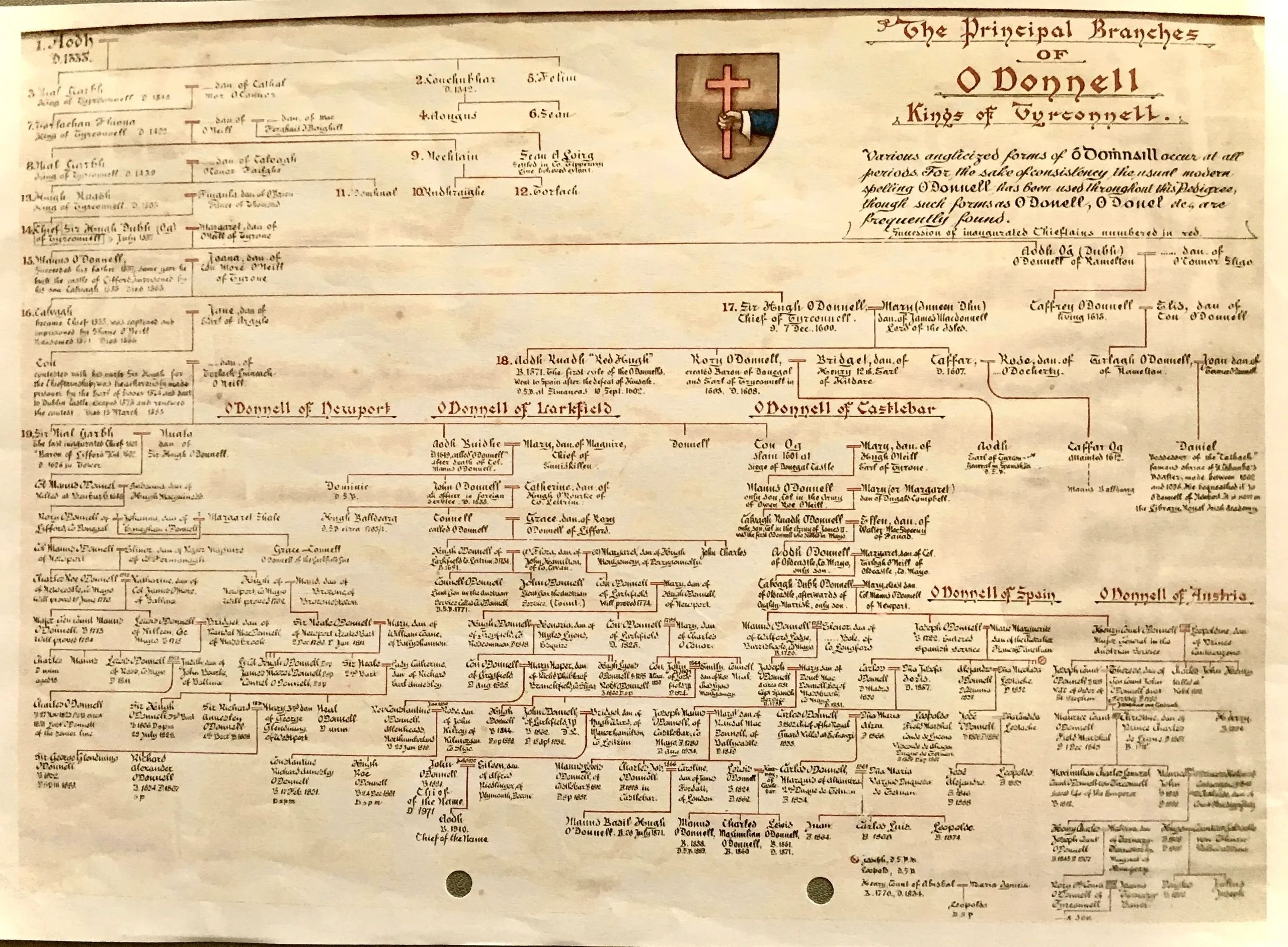
{{cite book}}: CS1 maint: postscript (link) - ^ "The Principal Branches of O'Donnell: Kings of Tyrconnell". O'Donnell of Tyrconnell. Archived from the original on 16 December 2025. Retrieved 2025-07-24.
- ^ a b Cokayne, George Edward (1910). Gibbs, Vicary (ed.). The complete peerage of England, Scotland, Ireland, Great Britain and the United Kingdom, extant, extinct, or dormant. Vol. I (2nd ed.). London: St Catherine Press. p. 174. OCLC 228661424.
- ^ Walsh 1930, pp. 41–42.
- ^ Ohlmeyer, Jane H (2001) [1993]. Civil War and Restoration in the Three Stuart Kingdoms: The Career of Randal MacDonnell, Marquis of Antrim. Dublin: Four Courts Press. p. 359. ISBN 978-0521419789.
- ^ Hill, George (1873). An historical account of the Macdonnells of Antrim: including notices of some other septs Irish and Scotch. Belfast: Archer & Sons. p. 222.
- ^ Casway 2016, pp. 71–72: Dungannon died in Rome in September 1609; Walsh 1996, p. 95: Dungannon was buried on 24 September 1609; Walsh 1930, p. 30. Dungannon was 24 years old at his death.
- ^ Walsh 1957, pp. 7–9: birth and death dates; Morgan 2013, pp. 9–10: colonel of the first Irish regiment.
- ^ Clarke, Barry & O'Byrne 2009, 1st–2nd paragraphs.
- ^ Clarke, Barry & O'Byrne 2009, 2nd paragraph; Casway 2016, p. 72.
- ^ Bagenal 1925, pp. 52–53.
- ^ Casway 2016, p. 72.
- ^ Bagenal 1925, p. 53; Clarke, Barry & O'Byrne 2009, 2nd paragraph.
- ^ Bagenal 1925, p. 53.
- ^ Walsh 1930, p. 19. fn. 1.
- ^ Clarke, Barry & O'Byrne 2009, 2nd paragraph.
- ^ Bagenal 1925, p. 54; McCavitt 2007, p. 21.
- ^ Clarke, Barry & O'Byrne 2009, 3rd–4th paragraphs.
- ^ Bagenal 1925, p. 55.
- ^ Clarke, Barry & O'Byrne 2009, 4th paragraph.
- ^ Casway 2016, pp. 72–73.
- ^ Salter, Richard (1988). Elizabeth I and her reign. Digitized by the Internet Archive in 2022 with funding from Kahle/Austin Foundation. Basingstoke: Macmillan Education. p. 108. ISBN 978-0-333-42381-3.
- ^ Clarke, Barry & O'Byrne 2009, 1st–4th paragraphs.
- ^ Canny 2008, 20th paragraph: married before 6 June 1597; Casway 2016, p. 77: died March 1619
- ^ O'Byrne, Emmett (October 2009). "MacDonnell (Nic Dhomhnaill), Fiona (Fionnghuala) ('Iníon Dubh')". Dictionary of Irish Biography. doi:10.3318/dib.006337.v1. Archived from the original on 18 April 2024.
- ^ a b Casway 2016, p. 73.
- ^ Guinness 1932, p. 97.
- ^ Casway 2016, pp. 73–74.
- ^ Casway 2016, pp. 73–74; O'Neill 2017, p. 194.
- ^ Casway 2016, pp. 76–77.
- ^ Walsh 1957, pp. 10–21.
- ^ Moody et al. 1940, pp. 189–190: left behind at the time of the Flight and re-educated at Eton as a Protestant; Walsh 1930, pp. 31–32: known as Conn Ruadh or Conn na Creige, born circa 1602, committed to the Tower on 12 August 1622.; Walsh 1996, pp. 60–61: left behind at the time of the Flight
- ^ Walsh 1930, pp. 9, 31: Assassinated aged thirteen on 16 August 1617; McGurk 2007, p. 16: found hanged in his room in Brussels.
- ^ Casway 2016, pp. 69, 73; Ricketts 2020, p. 7.
- ^ Moody 1938, pp. 269–270: Maguire's widow was Margaret O'Neill.
- ^ Walsh 1930, pp. 35, 65–66.
- ^ Casway, Jerrold (1984). Owen Roe O'Neill and the Struggle for Catholic Ireland. Digitized by the Internet Archive in 2022 with funding from Kahle/Austin Foundation. Philadelphia: University of Pennsylvania Press. ISBN 0-8122-7895-X.
- ^ Walsh 1930, p. 46.
- ^ Walsh 1930, pp. 44–45.
- ^ Walsh 1996, p. 74.
- ^ McCavitt 2007, pp. 79–80.
- ^ Walsh 1930, p. 45.
Sources
- Bagenal, Philip H. (1925). Vicissitudes of an Anglo-Irish Family 1530-1800: A Story of Irish Romance and Tragedy. London: Clement Ingleby, At the Sign of the Boar's Head.
- Canny, Nicholas (3 January 2008) [23 September 2004]. "O'Neill, Hugh [Aodh O'Neill], second earl of Tyrone". Oxford Dictionary of National Biography (online ed.). Oxford University Press. doi:10.1093/ref:odnb/20775. (Subscription, Wikipedia Library access or UK public library membership required.)
- Casway, Jerrold (2016). "Catherine Magennis and the Wives of Hugh O'Neill". Seanchas Ardmhacha: Journal of the Armagh Diocesan Historical Society. 26 (1): 69–79. JSTOR 48568219.
- Clarke, Aidan; Barry, Judy; O'Byrne, Emmett (October 2009). "Bagenal (O'Neill), Mabel". Dictionary of Irish Biography. Cambridge: Cambridge University Press. doi:10.3318/dib.006953.v1. Archived from the original on 21 February 2024.
- Clavin, Terry (October 2009). "O'Cahan, Sir Donnell Ballach". Dictionary of Irish Biography. doi:10.3318/dib.006536.v1. Archived from the original on 24 April 2024. Retrieved 10 September 2024.
- Dunlop, Robert (1895). . In Lee, Sidney (ed.). Dictionary of National Biography. Vol. 42. London: Smith, Elder & Co. pp. 188–196.
- Guinness, Henry S. (1932). "Magennis of Iveagh". The Journal of the Royal Society of Antiquaries of Ireland. 2 (1): 96–102. ISSN 0035-9106. JSTOR 25513625.
- McCavitt, John (2007). The Flight of the Earls: an illustrated history. Internet Archive. April Sky Design. ISBN 978-0-9555091-3-1.
- McGettigan, Darren (2005). Red Hugh O'Donnell and the Nine Years War. Dublin: Four Courts Press. ISBN 978-1-84682-485-2.
- McGinty, Matthew (2013), The Development and Dynamics of the Relationship between Hugh O'Neill and Red Hugh O'Donnell, pp. 1–69
- McGurk, John (August 2007). "The Flight of the Earls: Escape or Strategic Regrouping?". History Ireland. 15 (4): 16–21. ISSN 0791-8224. JSTOR 27725653.
- Moody, T. W. (1938). "Ulster Plantation Papers". Analecta Hibernica (8). The Irish Manuscripts Commission Ltd.: 179–297. ISSN 0791-6167. JSTOR 25510951.
- Moody, T. W.; Willis, Richard; Bust, Matthew; Grevyll, Fulke; Sotherton, Jo.; Bromley, Edw.; Denham, Jo. (September 1940). "The School-Bills of Conn O'Neill at Eton, 1615-22". Irish Historical Studies. 2 (6): 189–205. doi:10.1017/S0021121400112325. ISSN 0021-1214. JSTOR 30006103.
- Morgan, Hiram (1993). Tyrone's Rebellion: The outbreak of the Nine Years' War in Tudor Ireland. London: The Boydell Press. ISBN 0-85115-683-5.
- Morgan, Hiram (October 2009). "O'Donnell, 'Red' Hugh (Ó Domhnaill, Aodh Ruadh)". Dictionary of Irish Biography. doi:10.3318/dib.006343.v1.
- Morgan, Hiram (October 2005). "Gaelic lordship and Tudor conquest: Tír Eoghain, 1541–1603". History Ireland. 13 (5): 38–43. JSTOR 27725334. Archived from the original on 10 June 2024.
- Morgan, Hiram (2013). Peduelo Martin, Eduardo; Rodriguez de Diego, Julia (eds.). "The establishment of the Irish-Spanish relationship" (PDF). Los Irlandeses y la Monarquia Hispanica (1529-1800): Vinculos in Espacio y Tiempo. Madrid: 1–10. Archived (PDF) from the original on 25 May 2024.
- O'Neill, James (2017). The Nine Years War, 1593-1603: O'Neill, Mountjoy and the Military Revolution. Dublin: Four Courts Press. ISBN 978-1-84682-754-9.
- Ricketts, Elizabeth (February 2020). "Disrupting Mythological Foundations of Identity: Hugh O'Neill, Making History, and the Troubles". Critical Inquiries into Irish Studies. 2 (1). doi:10.70531/2576-6414.1004.
- Walsh, Paul, ed. (1930). The Will and Family of Hugh O'Neill, Earl of Tyrone [with an Appendix of Genealogies]. Dublin: Sign of the Three Candles.
- Walsh, Paul (1939). "Historical Criticism of the Life of Hugh Roe O'Donnell". Irish Historical Studies. 1 (3): 229–250. doi:10.1017/S0021121400030819. ISSN 0021-1214. JSTOR 30005953.
- Walsh, Micheline (April 1957). The O'Neills in Spain.
- Walsh, Micheline Kerney (1996). An exile of Ireland, Hugh O'Neill, Prince of Ulster. Dublin: Four Courts Press. ISBN 978-1-85182-234-8.
Further reading
- Morgan, Hiram (September 2014). "O'Neill, Hugh". Dictionary of Irish Biography. doi:10.3318/dib.006962.v1. Archived from the original on 26 September 2023. Retrieved 3 May 2024.
- O'Neill, James (January 2021). "Spouses, spies and subterfuge: the role and experience of women during the Nine Years War (1593-1603)". Proceedings of the Royal Irish Academy. 121C: 249–272. doi:10.3318/PRIAC.2021.121.02. hdl:10468/11583. JSTOR 10.3318/priac.2021.121.02.