Aires protégées du Pakistan
Il y a actuellement 157 aires protégées[Quand ?] au Pakistan qui sont reconnues par l'UICN.
Statistiques
| Catégorie | Total | Superficie totale | Source |
|---|---|---|---|
| Parcs nationaux | 14 | 1 191 323 ha | wdpa.org |
| Wildlife sanctuaries (Sanctuaires de vies sauvages) | 72 | 4 912 531 ha | wdpa.org |
| Domaines de chasses | 66 | 3 026 842 ha | wdpa.org |
| Zones humides protégées par la convention de Ramsar | 19 | 1 343 627 ha | ramsar.org |
| Aires protégées marines et littorales | 9 | 1 186 437 ha | southasiamcpaportal.org |
| Réserves de biosphère | 2 | 177 643 ha | unesco.org |
Catégories UICN
| Catégorie UICN | Total |
|---|---|
| Catégorie UICN Ia: Réserves naturelles | 0 |
| Catégorie UICN Ib: Zones de nature sauvage | 0 |
| Catégorie UICN II: Parcs nationaux | 5 |
| Catégorie UICN III: Monuments naturels | 0 |
| Catégorie UICN IV: Wildlife sanctuaries | 62 |
| Catégorie UICN V: Protected landscapes/seascapes | 5 |
| Catégorie UICN VI: Managed resource protected area | 2 |
| Zones non classées | 83 |
| Toutes catégories UICN confondues | 157 |
Listes par type
Parcs nationaux
| Parc national | Photo | Création | Superficie | District(s) | Province | Coordonnées |
|---|---|---|---|---|---|---|
| Ayubia | 
|
— | 931 ha | Rawalpindi | Pendjab | 33° 34′ 00″ N, 73° 30′ 00″ E |
| Shandure-Phander | 
|
2012 | 3 312 ha | Ghizer | Gilgit-Baltistan | 33° 51′ 55″ N, 73° 08′ 20″ E |
| Vallée de Broghil | 
|
2010 | 134 744 ha | Chitral | Khyber Pakhtunkhwa | 36° 50′ 28″ N, 73° 20′ 09″ E |
| Karakoram central | 
|
1993 | 1 390 100 ha | Gilgit et Skardu | Gilgit-Baltistan | 36° 53′ 52″ N, 75° 05′ 37″ E |
| Chinji | 1987 | 6 095 ha | Chakwal | Pendjab | 33° 00′ 37″ N, 72° 29′ 31″ E | |
| Chitral Gol | 1984 | 7 750 ha | Chitral | Khyber Pakhtunkhwa | 35° 55′ 59″ N, 71° 40′ 14″ E | |
| Deosai | 
|
1993 | 358 400 ha | Skardu | Gilgit-Baltistan | 34° 58′ 21″ N, 75° 23′ 47″ E |
| Deva Vatala | 2009 | 2 993 ha | Bhimber | Azad Kashmir | 32° 53′ 33″ N, 74° 18′ 11″ E | |
| Ghamot | 2004 | 27 271 ha | Neelum | Azad Kashmir | 35° 00′ 25″ N, 74° 12′ 01″ E | |
| Gurez | 2009 | 52 815 ha | Neelum | Azad Kashmir | 34° 43′ 53″ N, 74° 47′ 12″ E | |
| Hazarganji-Chiltan | 1980 | 15 555 ha | Quetta | Baloutchistan | 30° 17′ 09″ N, 67° 12′ 08″ E | |
| Hingol | 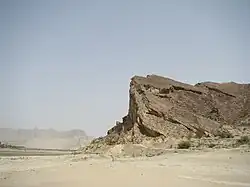
|
1988 | 165 004 ha | Awaran, Gwadar et Lasbela |
Baloutchistan | 25° 31′ 34″ N, 65° 05′ 10″ E |
| K2 | — | 233 468 ha | Gilgit | Gilgit-Baltistan | 35° 47′ 17″ N, 76° 10′ 58″ E | |
| Kala Chitta | 2009 | 36 965 ha | Attock | Pendjab | 33° 38′ 34″ N, 72° 24′ 03″ E | |
| Khunjerab | 1975 | 226 913 ha | Gilgit | Gilgit-Baltistan | 36° 30′ 03″ N, 75° 38′ 37″ E | |
| Kirthar | 
|
1974 | 308 733 ha | Dadu | Sindh | 25° 39′ 29″ N, 67° 32′ 56″ E |
| Lal Suhanra | 1972 | 87 426 ha | Bahawalpur | Pendjab | 29° 23′ 51″ N, 72° 01′ 33″ E | |
| Lulusar-Dudipatsar | 
|
2003 | 30 375 ha | Mansehra | Khyber Pakhtunkhwa | 35° 05′ 27″ N, 73° 55′ 47″ E |
| Machiara | 1996 | 13 532 ha | Muzaffarabad | Azad Kashmir | 34° 30′ 24″ N, 73° 33′ 55″ E | |
| Collines Margalla | 1980 | 17 386 ha | Rawalpindi | Pendjab | 33° 45′ 16″ N, 72° 57′ 23″ E | |
| Murree-Kotli Sattian-Kahuta | 2009 | 57 581 ha | Rawalpindi | Pendjab | ? | |
| Pir Lasura | 2005 | 5 625 ha | Kotli | Azad Kashmir | 33° 38′ 21″ N, 73° 50′ 48″ E | |
| Poonch River Mahaseer | 2010 | 4 500 ha | Kotli, Mirpur et Poonch |
Azad Kashmir | 33° 33′ 19″ N, 73° 54′ 58″ E | |
| Qurumber | 2011 | 74 000 ha | Ghizer | Gilgit-Baltistan | 36° 51′ 47″ N, 73° 46′ 52″ E | |
| Saiful Muluk | 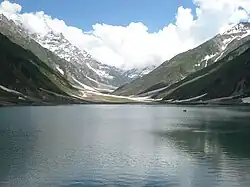
|
2003 | 4 867 ha | Mansehra | Khyber Pakhtunkhwa | 34° 52′ 51″ N, 73° 41′ 54″ E |
| Sheikh Buddin | 1993 | 15 540 ha | Dera Ismail Khan | Khyber Pakhtunkhwa | 32° 22′ 56″ N, 70° 56′ 59″ E | |
| Toli Pir | 
|
2005 | 5 045 ha | Poonch | Azad Kashmir | 34° 07′ 15″ N, 73° 37′ 59″ E |
| Panjal Mastan | 
|
2005 | 5 045 ha | Bagh | Azad Kashmir | 34° 03′ 27″ N, 73° 44′ 17″ E |
Wildlife Sanctuaries
Domaines de chasse
Zones humides protégées
Réserves de forêts protégées
Aires marines protégées
Conventions internationales
Réserves de biosphère
Le Pakistan possède 4 réserves de biosphère reconnues par l'Unesco[1] :
- Lal Suhanra, 1977 ;
- Forêt de Ziarat Juniper, 2013 ;
- Gallies, 2023 ;
- Chitral Bashkar Garmchashma, 2023.
Sites Ramsar
La convention de Ramsar est entrée en vigueur au Pakistan le .
En , le pays compte 19 sites Ramsar, couvrant une superficie de 13 438,07 km2.
Notes et références
- ↑ (en) « Pakistan | United Nations Educational, Scientific and Cultural Organization », sur www.unesco.org (consulté le )
- (en) Cet article est partiellement ou en totalité issu de l’article de Wikipédia en anglais intitulé « Protected areas of Pakistan » (voir la liste des auteurs).
- (en) Cet article est partiellement ou en totalité issu de l’article de Wikipédia en anglais intitulé « List of national parks of Pakistan » (voir la liste des auteurs).
 Portail de la conservation de la nature
  Portail du Pakistan