Heptachord

2 aufeinaderfolgende Tetrachorde, Heptachord basierend auf D, 1½11½1
Heptachord Lyra

Der Heptachord (gr., lat.: heptachordus – siebensaitig) ist ein musikwissenschaftlicher Begriff der Griechen, der auch im Mittelalter noch genutzt wurde.[1] Ein Heptachord bezeichnet dabei entweder die große Septime oder eine diatonische Folge von sieben Tönen, beschrieben als Kombination zweier Tetrachorde. Oft wird die Folge e f g a b c d angegeben als Heptachord.

 \relative c' { r e f g a bes c d }

.

Das Heptachord war gleichzeitig auch eine Form der Lyra (Zupfinstrument), mit eben sieben Saiten in einer diatonischen Stimmung vom Grundton bis zur Septime hatte.[2] Wie das Instrument oder die siebenstufige Leiter praktisch geklungen haben, ist unbekannt.

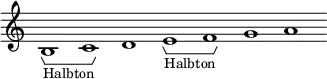
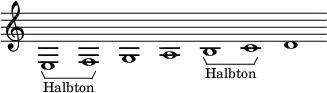
7 diatonische Folgen von 7 Tönen

Die 7 diatonische Folgen können folgenden babylonischen Skalen zugeordnet werden:[3]

  • kitmum 1,½,1,1,½,1
  • pītum ½,1,1,½,1,1
  • qablītum 1,1,½,1,1,½
  • išartum 1,½,1,1,1,½
  • embūbum ½,1,1,1,½,1
  • nīd qablim 1,1,1,½,1,1
  • nīš tuḫrim 1,1,½,1,1,1
 \new Staff \with { \consists Horizontal_bracket_engraver \remove "Time_signature_engraver" \remove "Bar_engraver" } \relative c' { 
  a1 b -\tweak HorizontalBracketText.text "Halbton"  \startGroup c\stopGroup d e-\tweak HorizontalBracketText.text "Halbton"\startGroup f\stopGroup g }
 \new Staff \with { \consists Horizontal_bracket_engraver \remove "Time_signature_engraver" \remove "Bar_engraver" } \relative c' { 
  g1 a b -\tweak HorizontalBracketText.text "Halbton"  \startGroup c\stopGroup d e-\tweak HorizontalBracketText.text "Halbton"\startGroup f\stopGroup }
 \new Staff \with { \consists Horizontal_bracket_engraver \remove "Time_signature_engraver" \remove "Bar_engraver" } 
\relative c' { 
  b1 -\tweak HorizontalBracketText.text "Halbton"  \startGroup c\stopGroup d e-\tweak HorizontalBracketText.text "Halbton"\startGroup f\stopGroup g a}
 \new Staff \with { \consists Horizontal_bracket_engraver \remove "Time_signature_engraver" \remove "Bar_engraver" } 
\relative c { 
  e1 -\tweak HorizontalBracketText.text "Halbton"  \startGroup f\stopGroup g a b-\tweak HorizontalBracketText.text "Halbton"\startGroup c\stopGroup d}
 \new Staff \with { \consists Horizontal_bracket_engraver \remove "Time_signature_engraver" \remove "Bar_engraver" } 
\relative c' { 
  d1 e -\tweak HorizontalBracketText.text "Halbton"  \startGroup f\stopGroup g a b-\tweak HorizontalBracketText.text "Halbton"\startGroup c\stopGroup}
 \new Staff \with { \consists Horizontal_bracket_engraver \remove "Time_signature_engraver" \remove "Bar_engraver" } 
\relative c' { 
  f,1 g a b -\tweak HorizontalBracketText.text "Halbton"  \startGroup c\stopGroup d e}
 \new Staff \with { \consists Horizontal_bracket_engraver \remove "Time_signature_engraver" \remove "Bar_engraver" } 
\relative c' { 
  c1 d e -\tweak HorizontalBracketText.text "Halbton"  \startGroup f\stopGroup g a b}

Zwei zusammengesetzte Heptachorde ergeben:

 \new Staff \with { \consists Horizontal_bracket_engraver \remove "Time_signature_engraver" \remove "Bar_engraver" } \relative c' { 
  a1 b -\tweak HorizontalBracketText.text "Halbton"  \startGroup c\stopGroup d e-\tweak HorizontalBracketText.text "Halbton"\startGroup f\stopGroup g a-\tweak HorizontalBracketText.text "Halbton"  \startGroup bes\stopGroup c d-\tweak HorizontalBracketText.text "Halbton"  \startGroup es\stopGroup f}

Einzelnachweise

  1. August Rossbach, Rudolf Westphal: Metrik der griechischen Dramatiker und Lyriker nebst den begleitenden musischen Künsten. Theil 2, Abtheilung 1: Rudolf Westphal: Harmonik und Melopöie der Griechen. Teubner, Leipzig 1863, S. 87.
  2. William Smith (Hrsg.): Dictionary of Greek and Roman Antiquities. 2nd Edition, improved and enlarged. Walton and Maberly u. a., London 1853, S. 721.
  3. Leon Crickmore: A New Light on the Babylonian Tonal System. Proceedings of the International Conference of Near Eastern Archaeomusicology (ICONEA 2008), The British Museum, London, December 4–6, 2008, editors: Richard Dumbrill and Irving Finkel. Iconea Publications, London 2008, S. 11–22 (englisch, musicircle.net [PDF]).