Aparallactus lunulatus
| Aparallactus lunulatus[1] | |||
| (Peters, 1854) | |||
 | |||
| Systematyka | |||
| Domena | |||
|---|---|---|---|
| Królestwo | |||
| Typ | |||
| Podtyp | |||
| Gromada | |||
| Rząd | |||
| Podrząd | |||
| Rodzina | |||
| Podrodzina | |||
| Rodzaj | |||
| Gatunek |
Aparallactus lunulatus | ||
| Synonimy | |||
|
| |||
| Kategoria zagrożenia (CKGZ)[3] | |||
 | |||
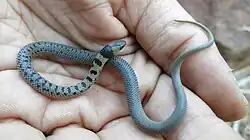
Aparallactus lunulatus – gatunek jadowitego węża z podrodziny aparalakt (Aparallactinae) w rodzinie gleboryjcowatych (Atractaspididae)[2].
Wąż ten występuje w Afryce w pasie subsaharyjskich sawann – od Burkiny Faso i Wybrzeża Kości Słoniowej na wschód po Erytreę, Etiopię i Somalię oraz na południe po Zimbabwe, północno-wschodnią RPA i Eswatini[2][3][4], być może też Botswanę[2].
Obecnie wyróżnia się dwa podgatunki[2]:
- Aparallactus lunulatus lunulatus (Peters, 1854)
- Aparallactus lunulatus nigrocollaris Chabanaud, 1916
Najdłuższa zanotowana samica mierzyła 43 centymetry[5], samiec 36 centymetrów[5]. Ciało w kolorze od szarym do oliwkowego lub ciemnobrązowe, brzuch jest zielonkawobiały. Samica w lecie składa 3 do 4 wydłużonych jaj[5]. Węże te najczęściej przebywają pod kłodami, kamieniami.
Przypisy
- ↑ Aparallactus lunulatus, [w:] Integrated Taxonomic Information System (ang.).
- 1 2 3 4 5 6 7 8 9 P. Uetz & J. Hallermann, Aparallactus lunulatus, [w:] The Reptile Database [online] [dostęp 2025-06-09] (ang.).
- 1 2 Aparallactus lunulatus, [w:] The IUCN Red List of Threatened Species (ang.).
- ↑ R. Midtgaard, Genus Aparallactus, [w:] RepFocus – A Survey of the Reptiles of the World [online] [dostęp 2025-06-09] (ang.).
- 1 2 3 Bill Branch, William R. Branch: Field guide to snakes and other reptiles of southern Africa. s. 63–64.
Bibliografia
- Bill Branch, William R. Branch: Field guide to snakes and other reptiles of southern Africa. Struik Publishers, 1998. ISBN 1-86872-040-3.