2002 United States House of Representatives elections in Minnesota

2002 United States House of Representatives elections in Minnesota

November 5, 2002 (2002-11-05)

All 8 Minnesota seats to the United States House of Representatives
  Majority party Minority party
 
Party Democratic (DFL) Republican
Last election 5 seats, 52.21% 3 seats, 42.02%
Seats before 5 3
Seats won 4 4
Seat change Decrease1 Increase1
Popular vote 1,097,911 1,029,612
Percentage 49.87% 46.76%
Swing Decrease2.34% Increase4.74%

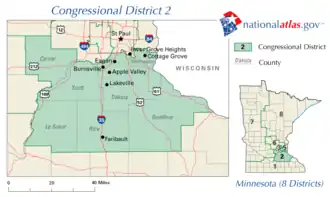
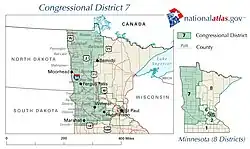
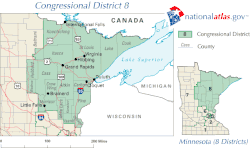
Map of Minnesota showing all eight districts, as apportioned for Representatives elected in the elections of 2002, 2004, 2006, 2008, and 2010
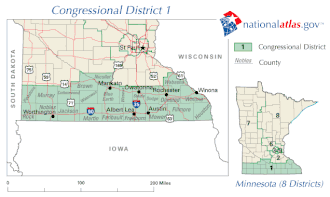
Map of Minnesota showing all eight districts, as apportioned for Representatives elected in the elections of 1994, 1996, 1998, and 2000

The 2002 congressional elections in Minnesota, were held on November 5, 2002 to determine who would represent the state, in the United States House of Representative.

Minnesota had eight seats in the House, and the 2002 congressional election was the first held pursuant to the apportionment made according to the 2000 United States census. Representatives are elected for two-year terms; those elected served in the 108th Congress from January 3, 2003 until January 3, 2005. The election coincided with a U.S. Senate election and a gubernatorial election. DFLer Bill Luther, formerly of the 6th congressional district, who was redistricted into the 2nd congressional district, was the only incumbent in Minnesota's House delegation who failed to win reelection.

Overview

Statewide

Party Candidates Votes[1] Seats
No. % No. +/– %
Democratic-Farmer-Labor 8 1,097,911 49.87 4 Decrease 1 50.00
Republican 8 1,029,612 46.76 4 Increase 1 50.00
Green 3 37,708 1.71 0 Steady 0.0
Independence 1 21,484 0.98 0 Steady 0.0
Other 1 12,430 0.56 0 Steady 0.0
Write-in 8 2,493 0.11 0 Steady 0.0
Total 29 2,201,638 100.0 8 Steady 100.0
Popular vote
Democratic
49.87%
Republican
46.76%
Green
1.71%
Other
1.65%
House seats
Democratic
50.00%
Republican
50.00%

By district

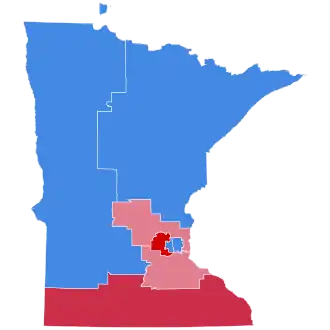
Results of the 2002 United States House of Representatives elections in Minnesota by district:

District Democratic Republican Others Total Result
Votes % Votes % Votes % Votes %
District 1 92,165 34.65% 163,570 61.50% 10,247 3.85% 265,982 100.0% Republican hold
District 2 121,121 42.22% 152,970 53.33% 12,769 4.45% 286,860 100.0% Republican hold
District 3 82,575 27.88% 213,334 72.02% 309 0.10% 296,218 100.0% Republican hold
District 4 164,597 62.22% 89,705 33.91% 10,238 3.87% 264,540 100.0% Democratic hold
District 5 171,572 67.03% 66,271 25.89% 18,139 7.09% 255,982 100.0% Democratic hold
District 6 100,738 35.06% 164,747 57.34% 21,827 7.60% 287,312 100.0% Republican gain
District 7 170,234 65.27% 90,342 34.64% 237 0.09% 260,813 100.0% Democratic hold
District 8 194,909 68.65% 88,673 31.23% 349 0.12% 283,931 100.0% Democratic hold
Total 1,097,911 49.87% 1,029,612 46.76% 74,115 3.37% 2,201,638 100.0%

District 1

2002 Minnesota's 1st congressional district election

 
Nominee Gil Gutknecht Steve Andreasen
Party Republican Democratic (DFL)
Popular vote 163,570 92,165
Percentage 61.5% 34.7%

Precinct results
Gutknecht:      40–50%      50–60%      60–70%      70–80%      80–90%      >90%
Andreasen:      40–50%      50–60%      60–70%      >90%
Tie:      40–50%

U.S. Representative before election

Gil Gutknecht
Republican

Elected U.S. Representative

Gil Gutknecht
Republican

After redistricting the new 1st district was made of approximately 75% from the old 1st with 25% from the old 2nd. Incumbent Republican Gil Gutknecht, who had represented the district since 1995, ran for re-election. He was re-elected with 56.4% of the vote in 2000.

Republican primary

Candidates

Nominee

Results

Republican Primary Election[2]
Party Candidate Votes %
Republican Gil Gutknecht (Incumbent) 25,978 100.0
Total votes 25,978 100.0

DFL primary

Candidates

Nominee
Withdrawn
  • Todd Rasmussen, banker and Winona school board member[3]

Results

Democratic–Farmer–Labor Primary Election[2]
Party Candidate Votes %
Democratic (DFL) Steve Andreasen 19,394 100.0
Total votes 19,394 100.0

Green primary

Candidates

Nominee
  • Gregory Mikkelson, small business owner and farmer[4]

Results

Green Primary Election[2]
Party Candidate Votes %
Green Gregory Mikkelson 467 100.0
Total votes 467 100.0

General election

Campaign

The major issues of the campaign included the Iraq War, agriculture, and medical care.[5][6]

Predictions

Source Ranking As of
Sabato's Crystal Ball[7] Safe R November 4, 2002
New York Times[8] Safe R October 14, 2002

Results

Gutknecht easily won a fifth term, defeating second-place Pomeroy by a landslide 26.85 percent margin, as Mikkelson finished at a very distant third.

Minnesota's 1st Congressional district election, 2002[1]
Party Candidate Votes %
Republican Gil Gutknecht (Incumbent) 163,570 61.5
Democratic (DFL) Steve Andreasen 92,165 34.7
Green Gregory Mikkelson 9,964 3.8
Write-in 283 0.1
Total votes 265,982 100.0
Republican hold

Finances

Candidate (party) Raised Spent Cash on hand
Gil Gutknecht (R) $894,474 $770,207 $187,252
Steve Andreasen (DFL) $123,540 $123,064 $477
Gregory Mikkelson (G) $17,285 $16,761 $521

District 2

2002 Minnesota's 2nd congressional district election

 
Nominee John Kline Bill Luther
Party Republican Democratic (DFL)
Popular vote 152,970 121,121
Percentage 53.3% 42.2%

Precinct results
Kline:      40–50%      50–60%      60–70%      70–80%
Luther:      40–50%      50–60%      60–70%      70–80%
Tie:      50%

U.S. Representative before election

Mark Kennedy
Republican

Elected U.S. Representative

John Kline
Republican

During the reapportionment that occurred in consequence of the 2000 United States census, the old 2nd district was broken up with the largest portion being transferred to the redrawn 7th. The new 2nd was based in the southern metro area and comprised approximately 41% from the old 6th, 22% from the old 2nd, 22% from the old 1st, 14% from the old 3rd and 1% from the old 4th.

Incumbent Republican Mark Kennedy, who's residence in Watertown remained in the 2nd decided to transfer to the new 6th.[9]

Bill Luther, the incumbent Democrat from the old 6th district opted to transfer to the new 2nd, despite his home in Stillwater remaining in the 6th, in order to avoid a match up with Kennedy.

Republican primary

Candidates

Nominee
Declined

Results

Republican Primary Election[2]
Party Candidate Votes %
Republican John Kline 22,596 100.0
Total votes 22,596 100.0

DFL primary

Candidates

Nominee
Declined

Results

Democratic–Farmer–Labor Primary Election[2]
Party Candidate Votes %
Democratic (DFL) Bill Luther (Incumbent) 14,437 100.0
Total votes 14,437 100.0

Other Candidates

  • Samuel Garst (No New Taxes), marketing consultant, DFL nominee for State House, District 33B in 1998 and for State Senate, District 33 in 2000

General election

Campaign

Luther, who was first elected to Congress in 1994, was unchallenged in the DFL primary. However, in the general election against Republican challenger John Kline, the more conservative composition of the new district worked against him. Luther's campaign was further harmed by political fallout that was created when Samuel Garst, a Luther campaign staffer, entered the race on the "No New Taxes" line in an attempt to use a false flag to split the conservative vote.[12][13][14][15]

Predictions

Source Ranking As of
Sabato's Crystal Ball[7] Lean R November 4, 2002
New York Times[8] Tossup October 14, 2002

Results

In the end, Garst was only able to secure 4.3 percent of the vote, and the political damage to Luther contributed to Kline winning the election by a margin of more than 11 percent.

Minnesota's 2nd Congressional district election, 2002[1]
Party Candidate Votes %
Republican John Kline 152,970 53.3
Democratic (DFL) Bill Luther (Incumbent) 121,121 42.2
No New Taxes Samuel Garst 12,430 4.3
Write-in 339 0.1
Total votes 286,860 100.0
Republican hold

Finances

Candidate (party) Raised Spent Cash on hand
John Kline (R) $1,553,133 $1,535,405 $50,091
Bill Luther (DFL) $2,485,486 $3,538,110 $41,588
Samuel Garst (NNT) Unreported

District 3

2002 Minnesota's 3rd congressional district election

 
Nominee Jim Ramstad Darryl Stanton
Party Republican Democratic (DFL)
Popular vote 213,334 82,575
Percentage 72.0% 27.9%

Precinct results
Ramstad:      50–60%      60–70%      70–80%      80–90%
Stanton:      50–60%

U.S. Representative before election

Jim Ramstad
Republican

Elected U.S. Representative

Jim Ramstad
Republican

After redistricting the new 3rd district was made of approximately 87% from the old 3rd with 10% from the old 6th and 3% from the 5th. Incumbent Republican Jim Ramstad, who had represented the district since 1991, ran for re-election. He was re-elected with 67.6% of the vote in 2000

Republican primary

Candidates

Nominee

Results

Republican Primary Election[2]
Party Candidate Votes %
Republican Jim Ramstad (Incumbent) 26,275 100.0
Total votes 26,275 100.0

DFL primary

Candidates

Nominee
  • Darryl Stanton, entrepreneur, inventor and candidate for this seat in 2000

Results

Democratic–Farmer–Labor Primary Election[2]
Party Candidate Votes %
Democratic (DFL) Darryl Stanton 14,837 100.0
Total votes 14,837 100.0

General election

Predictions

Source Ranking As of
Sabato's Crystal Ball[7] Safe R November 4, 2002
New York Times[8] Safe R October 14, 2002

Results

Ramstad won election to his seventh term in Congress, by a landslide 44.14 percent margin.

Minnesota's 3rd Congressional district election, 2002[1]
Party Candidate Votes %
Republican Jim Ramstad (Incumbent) 213,334 72.0
Democratic (DFL) Darryl Stanton 82,575 27.9
Write-in 309 0.1
Total votes 296,218 100.0
Republican hold

Finances

Candidate (party) Raised Spent Cash on hand
Jim Ramstad (R) $1,040,631 $794,180 $891,541
Darryl Stanton (D) Unreported

District 4

2002 Minnesota's 4th congressional district election

 
Nominee Betty McCollum Clyde Billington
Party Democratic (DFL) Republican
Popular vote 164,597 89,705
Percentage 62.2% 33.9%

Precinct results
McCollum:      40–50%      50–60%      60–70%      70–80%      80–90%
Billington:      40–50%      50–60%      60–70%

U.S. Representative before election

Betty McCollum
Democratic (DFL)

Elected U.S. Representative

Betty McCollum
Democratic (DFL)

The district was largely unaffected by the redistricting with the new 4th district was made of approximately 92% from the old 4th with 8% from the old 6th. Incumbent Democrat Betty McCollum, who had represented the district since 2001, ran for re-election. She was elected with 48.0% of the vote in 2000.

DFL primary

Candidates

Nominee

Results

Democratic–Farmer–Labor Primary Election[2]
Party Candidate Votes %
Democratic (DFL) Betty McCollum (Incumbent) 30,878 100.0
Total votes 30,878 100.0

Republican primary

Candidates

Nominee

Results

Republican Primary Election[2]
Party Candidate Votes %
Republican Clyde Billington 14,052 100.0
Total votes 14,052 100.0

Independence primary

Candidates

Withdrawn

Green primary

Candidates

Nominee
  • Scott Raskiewicz, substitute public school teacher

Results

Green Primary Election[2]
Party Candidate Votes %
Green Scott Raskiewicz 877 100.0
Total votes 877 100.0

General election

Predictions

Source Ranking As of
Sabato's Crystal Ball[7] Safe D November 4, 2002
New York Times[8] Safe D October 14, 2002

Results

Defeating Billington by a comfortable 28 percent margin, McCollum easily won her second term in Congress, as Raskiewicz finished a very distant third.

Minnesota's 4th Congressional district election, 2002[1]
Party Candidate Votes %
Democratic (DFL) Betty McCollum (Incumbent) 164,597 62.2
Republican Clyde Billington 89,705 33.9
Green Scott Raskiewicz 9,919 3.8
Write-in 319 0.1
Total votes 264,540 100.0
Democratic (DFL) hold

Finances

Candidate (party) Raised Spent Cash on hand
Betty McCollum (DFL) $736,337 $699,558 $143,546
Clyde Billington (R) $87,613 $87,612 $0
Scott Raskiewicz (G) Unreported

District 5

2002 Minnesota's 5th congressional district election

 
Nominee Martin Olav Sabo Daniel Nielsen Mathias Tim Davis
Party Democratic (DFL) Republican Green
Popular vote 171,572 66,271 17,825
Percentage 67.0% 25.9% 7.0%

Precinct results
Sabo:      40–50%      50–60%      60–70%      70–80%      80–90%
Mathias:      50–60%

U.S. Representative before election

Martin Olav Sabo
Democratic (DFL)

Elected U.S. Representative

Martin Olav Sabo
Democratic (DFL)

Incumbent Democrat Martin Olav Sabo, who had represented the district since 1979, ran for re-election. He was re-elected with 69.2% of the vote in 2000.

DFL primary

Candidates

Nominee

Results

Democratic–Farmer–Labor Primary Election[2]
Party Candidate Votes %
Democratic (DFL) Martin Olav Sabo (Incumbent) 33,310 100.0
Total votes 33,310 100.0

Republican primary

Candidates

Nominee
  • Daniel Mathias, courier driver and part time college professor

Results

Republican Primary Election[2]
Party Candidate Votes %
Republican Daniel Nielsen Mathias 9,947 100.0
Total votes 9,947 100.0

Green primary

Candidates

Nominee

Results

Green Primary Election[2]
Party Candidate Votes %
Green Tim Davis 1,635 100.0
Total votes 1,635 100.0

General election

Predictions

Source Ranking As of
Sabato's Crystal Ball[7] Safe D November 4, 2002
New York Times[8] Safe D October 14, 2002

Results

Sabo had no difficulty winning his 13th term in Congress, defeating Republican challenger Daniel Nielsen Mathias by a margin of just over 41 percent, while Green candidate Tim Davis finished a distant third.

Minnesota's 5th Congressional district election, 2002[1]
Party Candidate Votes %
Democratic (DFL) Martin Olav Sabo (Incumbent) 171,572 67.0
Republican Daniel Mathias 66,271 25.9
Green Tim Davis 17,825 7.0
Write-in 314 0.1
Total votes 255,982 100.0
Democratic (DFL) hold

Finances

Candidate (party) Raised Spent Cash on hand
Martin Olav Sabo (DFL) $463,831 $507,209 $162,110
Dan Mathias (R) $9,699 $13,409 $21
Tim Davis (G) Unreported

District 6

2002 Minnesota's 6th congressional district election

 
Nominee Mark Kennedy Janet Robert Dan Becker
Party Republican Democratic (DFL) Independence
Popular vote 164,747 100,738 21,484
Percentage 57.3% 35.1% 7.5%

Precinct results
Kennedy:      40–50%      50–60%      60–70%      70–80%
Robert:      40–50%      50–60%      60–70%

U.S. Representative before election

Bill Luther
Democratic (DFL)

Elected U.S. Representative

Mark Kennedy
Republican

In the reapportionment that occurred in consequence of the 2000 United States census, the old 6th was effectively split into two main parts, with approximately 50% forming the core of the redrawn seat and the next largest portion (around 41%) becoming part of the new 2nd. The new 6th also contained 24% from the old 7th, 14% from the 2nd, 10% from the 8th and 3% from the 3rd.

Incumbent Democrat Bill Luther, who had represented the district since 1995, opted to move to the new 2nd and run for re-election there, after Mark Kennedy, the incumbent Republican from the old 2nd, decided to contest the redrawn 6th.[10]

DFL primary

Candidates

Nominee
Declined
  • Bill Luther, incumbent U.S. Representative (running in the 2nd district)[11]

Results

Democratic–Farmer–Labor Primary Election[2]
Party Candidate Votes %
Democratic (DFL) Janet Robert 16,204 100.0
Total votes 16,204 100.0

Republican primary

Candidates

Nominee
Withdrawn
  • David Reichow, consultant[10]
Declined

Results

Republican Primary Election[2]
Party Candidate Votes %
Republican Mark Kennedy (Incumbent) 22,239 100.0
Total votes 22,239 100.0

Independence primary

Candidates

Nominee
  • Dan Becker, state-licensed drug and alcohol counselor

Results

Independence Primary Election[2]
Party Candidate Votes %
Independence Dan Becker 2,199 100.0
Total votes 2,199 100.0

General election

Campaign

Corporate ethics became a major theme of the campaign with both Kennedy and Robert running attack ads linking the other to lawsuits involving companies they had worked for.[18][19][20]

Predictions

Source Ranking As of
Sabato's Crystal Ball[7] Lean R (flip) November 4, 2002
New York Times[8] Safe R (flip) October 14, 2002

Results

Kennedy, who was first elected in 2000, encountered little difficulty in winning his second term in Congress, defeating DFL challenger Janet Robert by a landslide margin of 22.28 percent, while Independence Party candidate Dan Becker finished a distant third.

Minnesota's 6th Congressional district election, 2002[1]
Party Candidate Votes %
Republican Mark Kennedy (Incumbent) 164,747 57.3
Democratic (DFL) Janet Robert 100,738 35.1
Independence Dan Becker 21,484 7.5
Write-in 343 0.1
Total votes 287,312 100.0
Republican gain from Democratic (DFL)

Finances

Candidate (party) Raised Spent Cash on hand
Janet Robert (D) $2,180,560 $2,178,467 $2,092
Mark Kennedy (R) $1,901,227 $1,844,908 $24,932
Daniel Becker (I) $8,493 $8,489 $0

District 7

2002 Minnesota's 7th congressional district election

 
Nominee Collin Peterson Dan Stevens
Party Democratic (DFL) Republican
Popular vote 170,234 90,342
Percentage 65.3% 34.6%

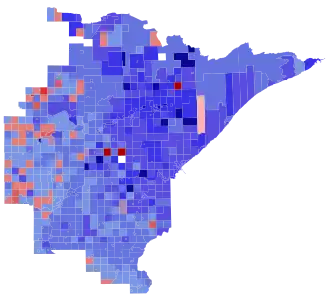
Precinct results
Peterson:      50–60%      60–70%      70–80%      80–90%      >90%
Stevens:      50–60%      60–70%      70–80%
Tie:      40–50%      50%

U.S. Representative before election

Collin Peterson
Democratic (DFL)

Elected U.S. Representative

Collin Peterson
Democratic (DFL)

Following redistricting approximately 62% from the old 7th remained with 38% from the old 2nd transferring in. Incumbent Democrat Collin Peterson, who had represented the district since 1991, ran for re-election. He was re-elected with 68.7% of the vote in 2000.

DFL primary

Candidates

Nominee

Results

Democratic–Farmer–Labor Primary Election[2]
Party Candidate Votes %
Democratic (DFL) Collin Peterson (Incumbent) 35,130 100.0
Total votes 35,130 100.0

Republican primary

Candidates

Nominee
Withdrawn
  • Brad Monson[21]
  • Leroy Schlangen, dairy farmer[22]

Results

Republican Primary Election[2]
Party Candidate Votes %
Republican Dan Stevens 29,855 100.0
Total votes 29,855 100.0

General election

Predictions

Source Ranking As of
Sabato's Crystal Ball[7] Safe D November 4, 2002
New York Times[8] Safe D October 14, 2002

Results

Peterson faced no difficulty winning his 8th term in Congress, defeating Republican challenger Dan Stevens by a landslide 30.63 percent margin.

Minnesota's 7th Congressional district election, 2002[1]
Party Candidate Votes %
Democratic (DFL) Collin Peterson (Incumbent) 170,234 65.3
Republican Dan Stevens 90,342 34.6
Write-in 237 0.1
Total votes 260,813 100.0
Democratic (DFL) hold

Finances

Candidate (party) Raised Spent Cash on hand
Collin Peterson (DFL) $417,253 $535,219 $123,864
Dan Stevens (R) $209,629 $201,199 $8,431

District 8

2002 Minnesota's 8th congressional district election

 
Nominee Jim Oberstar Bob Lemen
Party Democratic (DFL) Republican
Popular vote 194,909 88,673
Percentage 68.6% 31.2%

Precinct results
Oberstar:      50–60%      60–70%      70–80%      80–90%      >90%
Lemen:      40–50%      50–60%      60–70%      70–80%      >90%
Tie:      50%

U.S. Representative before election

Jim Oberstar
Democratic (DFL)

Elected U.S. Representative

Jim Oberstar
Democratic (DFL)

The 8th district remained mostly untouched by the redistricting with approximately 91% of the new seat remaining, with 9% added from the old 7th. Incumbent Democrat Jim Oberstar, who had represented the district since 1975, ran for re-election. He was re-elected with 67.8% of the vote in 2000.

DFL primary

Candidates

Nominee

Results

Democratic–Farmer–Labor Primary Election[2]
Party Candidate Votes %
Democratic (DFL) James L. Oberstar (Incumbent) 50,582 100.0
Total votes 50,582 100.0

Republican primary

Candidates

Nominee
Eliminated in primary
  • Warren Nelson, engineering consultant and candidate for this seat in 2000

Results

Republican Primary Election[2]
Party Candidate Votes %
Republican Robert Lemen 13,422 50.6
Republican Warren Nelson 13,132 49.4
Total votes 26,554 100.0

General election

Predictions

Source Ranking As of
Sabato's Crystal Ball[7] Safe D November 4, 2002
New York Times[8] Safe D October 14, 2002

Results

Oberstar had no difficulty winning his 15th term in Congress, defeating Republican challenger Bob Lemen by a margin of more than 37 percent.

Minnesota's 8th Congressional district election, 2002[1]
Party Candidate Votes %
Democratic (DFL) Jim Oberstar (Incumbent) 194,909 68.7
Republican Robert Lemen 88,673 31.2
Write-in 349 0.1
Total votes 283,931 100.0
Democratic (DFL) hold

Finances

Candidate (party) Raised Spent Cash on hand
Jim Oberstar (DFL) $1,057,294 $1,030,632 $75,308
Robert Lemen (R) $16,349 $16,887 $623

References

  1. ^ a b c d e f g h i "Home - Election Results".
  2. ^ a b c d e f g h i j k l m n o p q r s t "Home - Election Results".
  3. ^ Associated Press (March 28, 2002). "DFLer says he'll run against Gutknecht". brainerddispatch.com. Winona, MN: Brainerd Dispatch. Retrieved November 17, 2025.
  4. ^ Matthew Stolle (September 8, 2006). "PROFILES Gutknecht, Mikkelson seek GOP banner". postbulletin.com. Post-Bulletin. Retrieved November 16, 2025.
  5. ^ Mark Steil (August 7, 2002). "Congressional candidates vie for Farmfest voters". minnesota.publicradio.org. Minnesota Public Radio. Retrieved November 17, 2025.
  6. ^ Mark Steil (October 11, 2002). "In 1st District, farming is king. But voters focus on Iraq". minnesota.publicradio.org. Minnesota Public Radio. Retrieved November 17, 2025.
  7. ^ a b c d e f g h "50 most competitive House races of 2002". Sabato's Crystal Ball. November 6, 2002. Archived from the original on November 6, 2002. Retrieved November 24, 2023.
  8. ^ a b c d e f g h "2002 Senate, House and Governor Ratings". The New York Times. October 14, 2002. Retrieved December 21, 2023.
  9. ^ Tom Scheck (September 12, 2002). "Redistricting has confused voters". minnesota.publicradio.org. Minnesota Public Radio. Retrieved November 17, 2025.
  10. ^ a b c d e f g h i j Laura McCallum (March 25, 2002). "Kennedy opts for 6th District, and possible bout with Luther". minnesota.publicradio.org. Minnesota Public Radio. Retrieved November 17, 2025.
  11. ^ a b Tom Scheck (May 13, 2002). "Luther opts for 2nd District". minnesota.publicradio.org. Minnesota Public Radio. Retrieved November 17, 2025.
  12. ^ "Luther, Kline get heated in TV debate". minnesota.publicradio.org. Minnesota Public Radio. August 22, 2002. Retrieved November 17, 2025.
  13. ^ Tom Scheck (August 27, 2002). "Second District candidates differ on war with Iraq". minnesota.publicradio.org. Minnesota Public Radio. Retrieved November 17, 2025.
  14. ^ Tom Scheck (October 21, 2002). "Candidates in Minnesota's 2nd District battle over the economy". minnesota.publicradio.org. Minnesota Public Radio. Retrieved November 17, 2025.
  15. ^ Tom Scheck (October 24, 2002). "Luther, Kline face off in 2nd District debate". .minnesota.publicradio.org. Minnesota Public Radio. Retrieved November 17, 2025.
  16. ^ Brian Bakst (July 17, 2002). "Peter Vento, son of late congressman, files for dad's seat". postbulletin.com. St. Paul, MN: Associated Press. Retrieved November 17, 2025.
  17. ^ "Vento's son withdraws from race for Congress". brainerddispatch.com/. St. Paul, MN: Brainerd Dispatch. July 18, 2002. Retrieved November 17, 2025.
  18. ^ "Focus on the 6th District". minnesota.publicradio.org. Minnesota Public Radio. August 23, 2002. Retrieved November 17, 2025.
  19. ^ Tom Scheck (September 25, 2002). "Attack ads in 6th District focus on corporate ethics". minnesota.publicradio.org. Minnesota Public Radio. Retrieved November 17, 2025.
  20. ^ Jeff Horwich (October 9, 2002). "Sixth district race heats up". minnesota.publicradio.org. Minnesota Public Radio. Retrieved November 17, 2025.
  21. ^ Dan Gunderson (May 17, 2002). "In redrawn 7th District, GOP looks to make a move". minnesota.publicradio.org. Minnesota Public Radio. Retrieved November 17, 2025.
  22. ^ Michael Jacobson (February 20, 2002). "Farmer to trade cows for ballots". paynesvillearea.com. Paynesville Press. Retrieved November 17, 2025.