1982 United States House of Representatives elections in Tennessee
 | ||||||||||||||||||||||||||||
November 2, 1982
| ||||||||||||||||||||||||||||
All 9 Tennessee seats to the United States House of Representatives | ||||||||||||||||||||||||||||
|---|---|---|---|---|---|---|---|---|---|---|---|---|---|---|---|---|---|---|---|---|---|---|---|---|---|---|---|---|
| ||||||||||||||||||||||||||||
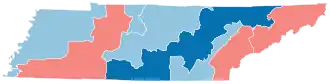  Democratic hold Democratic gain Republican hold
| ||||||||||||||||||||||||||||


| Elections in Tennessee |
|---|
 |
 Government Government |
The 1982 congressional elections in Tennessee was held on November 2, 1982, to determine who will represent the state of Tennessee in the United States House of Representatives.
Following the 1982 elections, Tennessee’s congressional delegation changed in size due to reapportionment after the 1980 United States census. The state regained the 9th congressional district that it had lost after the 1970 census, increasing its delegation from eight to nine members.[1] The newly 4th congressional district, an open seat won by Democrat Jim Cooper, combined territory from several previous districts. Although the "4th district" designation had existed previously, the configuration used in 1982 was substantially different and had no incumbent. Cooper’s victory was considered a Democratic gain, resulting in a net increase of one seat for the Democratic Party and leaving the Tennessee delegation with a 6–3 Democratic majority.[2][3]
Overview
| United States House of Representatives elections in Tennessee, 1982[4] | |||||
|---|---|---|---|---|---|
| Party | Votes | Percentage | Seats | +/– | |
| Democratic | 697,823 | 59.35% | 6 |  1 1
| |
| Republican | 469,527 | 39.94% | 3 | — | |
| Independent | 8,292 | 0.71% | 0 | — | |
| Write-in | 41 | 0.00% | 0 | — | |
| Totals | 1,175,683 | 100.00% | 9 | — | |
By district
| District | Incumbent | This race | |||
|---|---|---|---|---|---|
| Member | Party | First elected | Results | Candidates | |
| Tennessee 1 | Jimmy Quillen | Republican | 1962 | Incumbent re-elected. |
|
| Tennessee 2 | John Duncan Sr. | Republican | 1964 | Incumbent re-elected. |
|
| Tennessee 3 | Marilyn Lloyd | Democratic | 1974 | Incumbent re-elected. |
|
| Tennessee 4 | None (district created) | New seat. Democratic gain. |
| ||
| Tennessee 5 | Bill Boner | Democratic | 1978 | Incumbent re-elected. |
|
| Tennessee 6 | Al Gore Redistricted from the 4th district |
Democratic | 1976 | Incumbent re-elected. |
|
| Tennessee 7 | Robin Beard Redistricted from the 6th district |
Republican | 1972 | Incumbent retired to run for U.S. Senator. Republican hold. |
|
| Tennessee 8 | Ed Jones Redistricted from the 7th district |
Democratic | 1969 (special) | Incumbent re-elected. |
|
| Tennessee 9 | Harold Ford Sr. Redistricted from the 8th district |
Democratic | 1974 | Incumbent re-elected. |
|

District 4
The new 4th district ran diagonally across the state, from heavily Republican areas near the Tri-Cities, Knoxville and Chattanooga to the fringes of the Nashville suburbs. The district stretched across five media markets – the Tri-Cities (Kingsport, Johnson City, and Bristol), Knoxville, Chattanooga, Nashville and Huntsville, Alabama. The district touched four states – Virginia, Kentucky, Alabama, and Mississippi – and nearly touched North Carolina and Georgia.
Democratic nominee Jim Cooper defeated Cissy Baker, an editor in Washington for CNN and the daughter of U.S. Senate Majority Leader Howard Baker,[5] with 66% of the vote, becoming the youngest member of Congress at the time at the age of 28.
Prior to this election, much of the eastern portion of the 4th had not been represented by a Democrat since the Civil War.
District 7
Republican nominee Don Sundquist sought the seat of Congressman Robin Beard, who was retiring to run against Jim Sasser for the U.S. Senate. Beard's district, the 6th, had been renumbered as the 7th following redistricting.[6] In the general election, Sundquist edged Bob Clement, son of former Governor Frank G. Clement, by just over 1,000 votes out of over 145,000 votes cast.[7]
This district would not have a competitive general election again until the 2025 7th congressional district special election.[8]
See also
- 1982 United States Senate election in Tennessee
- 1982 Tennessee gubernatorial election
- 1982 United States elections
References
- ^ "Tennesseans in National Government" (PDF). Tennessee Blue Book. Retrieved February 9, 2026.
- ^ "1982 House elections" (PDF).
- ^ "Tennesseans in National Government" (PDF). Tennessee Blue Book. Retrieved February 9, 2026.
- ^ "1982 House elections" (PDF).
- ^ Our Campaigns – TN District 7, 1982. Retrieved: January 9, 2013.
- ^ Governor Don Sundquist Papers (finding aid) Archived October 11, 2012, at the Wayback Machine, Tennessee State Library and Archives, 2007. Retrieved: January 9, 2013.
- ^ Our Campaigns – TN District 7, 1982. Retrieved: January 9, 2013.
- ^ Ostermeier, Dr Eric (October 8, 2025). "A Brief History of Democrats Flipping Tennessee US House Districts". Smart Politics. Retrieved February 10, 2026.